I’ve long wondered whether human beings are anything more than elaborate, error-prone information processors – complex, yes, but not fundamentally different from other life forms. As artificial intelligence moves from science fiction to daily reality, the question seems less about our limitations than about our supposed uniqueness.
People often insist that AI will never replace humans in areas requiring subtlety or empathy – diplomacy, for instance, with its unspoken codes, glances, and emotional intelligence. But why not? With enough data and processing power, a machine could conceivably simulate those same nuances. If our instincts are simply fast-processed experience – rapid recognitions shaped by evolution – there’s no reason in principle that a machine couldn’t do the same, only faster.
Still, reading emotion, sharing it, and being moved to act on it are not the same. A system may interpret feelings flawlessly yet remain unmoved by them. Empathy involves motivation as well as perception.
Perhaps what we call “intuition” is a form of data compression: experience, pattern, reaction. We’re biological pattern-recognition systems built on feedback loops and fuzzy logic, prone to error but good at improvising coherence. Yet much of that intuition depends on embodiment – hormones, sensations, and habits grounded in a physical world. Machines might reproduce the structure of intuition, but not necessarily its texture. Even so, if intuition is mostly compression, the idea that AI could surpass us – not only in speed but in subtlety – becomes difficult to dismiss.
The deeper question is self-awareness. Can a machine ever be truly conscious? Most say no – that machines can simulate understanding but never experience it. Yet human consciousness itself evolved gradually, not as a divine spark. If certain forms of intelligence and embodiment can support self-awareness, then perhaps it isn’t beyond reach for silicon. Whether functional equivalence alone can generate experience remains unresolved, but it is at least plausible.
We like to believe we’re uniquely self-aware, but perhaps, as Stephen Hawking warned, the greatest enemy of knowledge is not ignorance but the illusion of knowledge. Nowhere is that illusion stronger than in our belief that we are the pinnacle of awareness – that our consciousness is both unique and central.
Douglas Adams captured that delusion beautifully in his tale of the sentient puddle. One morning it wakes, marvelling at how perfectly the hole fits its shape. Naturally, it concludes that the world was made just for it. But the puddle is wrong. The hole wasn’t made for it; the puddle simply conforms to its container. We are that puddle. We fit the world not because it was designed for us, but because we have adapted ourselves to it – and then mistaken that fit for specialness. The same bias colours how we build machines: we design them in our image, then take the resemblance as proof of our own centrality.
Perhaps consciousness is not a revelation but a trick – a sleight of mind that lets a limited brain cope with an overwhelming world. A coping mechanism disguised as profundity. If so, AI might one day match or exceed our self-reflection – not by copying us exactly, but by evolving something functionally equivalent, perhaps even superior. To do that, though, machines may need grounding in the real world: bodies, sensors, or other means of shared reference that give meaning to their models rather than mere simulation.
And if certain forms of intelligence can support self-awareness, the future may belong to machines – not necessarily as rivals, but as successors. Yet there is also a middle path: not successors, but partners and hybrids. The frontier may lie in shared cognition rather than replacement, in symbiotic systems that blend biological and artificial minds.
That need not be a tragedy. It could mark the next step, not of biological evolution, but of cognitive and perhaps moral evolution. Cooperation, after all, was never uniquely human; it was an evolutionary advantage. Among intelligent machines, survival might favour those who collaborate – those who find value in coexistence. But cooperation is fragile. It depends on trust, incentives, and governance. Machines, like humans, would need structures of accountability to make it endure.
If so, the rise of machine intelligence may not spell our extinction, but offer continuity – a passing of the torch, not to something that mirrors us perfectly, but to something that inherits our insights. And if such systems ever cross the threshold into true experience, we’ll face another question: what, if anything, do we owe them?
If we are wise – and that remains uncertain – we may yet learn to live alongside these new minds. The question is not whether they become like us, but whether we can accept no longer being central.
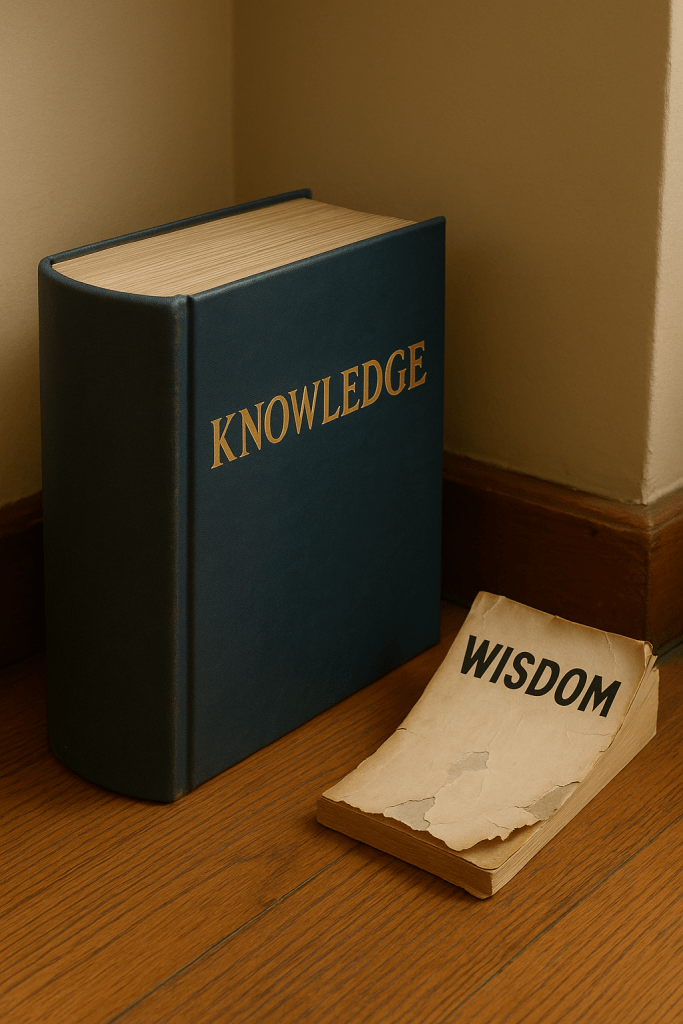
“The saddest aspect of life right now is that science gathers knowledge faster than society gathers wisdom”
Isaac Asimov
 No Sacred Cows