In May 2025 Jia Tolentino wrote in the New Yorker about what she calls her “broken brain.” She means the fog that settles when words slip out of focus, when news feeds pile horror upon horror, and when reality itself feels unreliable.
“I feel a troubling kind of opacity in my brain lately – as if reality were becoming illegible, as if language were a vessel with holes in the bottom and meaning was leaking all over the floor”.
She blames the speed of politics, the flood of images from Gaza, and the creeping invasion of synthetic fakery – AI faces, deepfakes, doctored clips – until the act of paying attention itself becomes exhausting.
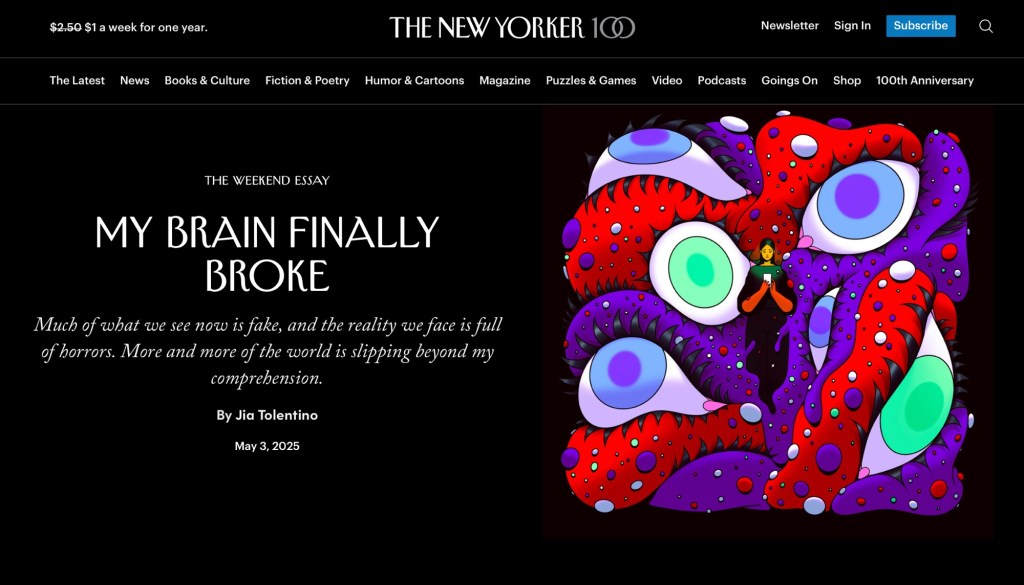
https://www.newyorker.com/culture/the-weekend-essay/my-brain-finally-broke
It struck a chord with me, having been circling the same ideas for years. Newsfeed numbness – the more you see of violence, cruelty, and collapse, the less able you are to feel. The moral compass does not shatter – it just spins helplessly, like a needle over too many magnets.
Tolentino writes as an American essayist cataloguing the psychic toll of her own culture. But her “broken brain” is our common inheritance. The overload is global, the denial universal. I saw it in Thailand during the unrest of 2008, when rolling street protests became background noise; I see it in France today, where ecological breakdown and bureaucratic inertia pile on top of daily political crises. The pattern is the same: we are running systems – political, technological, ecological – at a pace no mind can process, let alone resist. Outrage itself feels redundant. And that, perhaps, is the point: flood people with so many grotesque headlines, so much noise and spectacle, that resistance fragments before it can gather force, or else curdles into manipulated anger – from America’s culture wars to Europe’s street protests and beyond. The instinctive are swept into fury; the deliberative sink into fog. Both serve the same end.
“The phone eats time; it makes us live the way people do inside a casino, dropping a blackout curtain over the windows to block out the world, except the blackout curtain is a screen, showing too much of the world, too quickly”.
This progression is brutally simple. Overload collapses empathy; numbness follows; then the very act of looking becomes unreliable. Images of suffering blur into AI hallucinations, real protest footage sits beside doctored clips, and even a child’s search results are contaminated with fakes. The result is not only fatigue, but a collapse of trust in perception itself – and numbness is not neutral. It is precisely what power structures rely on: a dazed public is easier to rule.
“Fake images of real people, real images of fake people; fake stories about real things, real stories about fake things. … The words blur and the images blur … a permission structure is erected for us to detach from reality – first for a moment, then a day, a week, an election season, maybe a lifetime”.
And detachment has a cost. It runs alongside policy changes that cut into daily life – deportations under Trump’s new orders, benefits pared back in the US, NHS waiting lists stretching beyond endurance in Britain, droughts and floods forcing migration in Asia. Authoritarian gestures are dressed up as routine governance, and by the time we notice, the damage is already done. This is not just about our minds. It is how cruelty advances while we are too dazed to resist.
I find Tolentino’s essay oddly reassuring. Not because it offers a cure, but because it confirms that even sharp observers and writers are buckling under the same weight as the rest of us. The failure is not mine alone, or yours. It is structural. Our minds were never designed for this volume of horror, this speed of contradiction, this corrosion of truth.
Perhaps the task is not to repair the mind at all, but to notice – clearly, stubbornly – that the fracture is everywhere. Naming it is resistance. What we do with that knowledge will mark the fate of our civilisation.
 No Sacred Cows