Today’s attack at Bondi Beach was, according to early reports, aimed at a Hanukkah celebration.
If that is confirmed, it will be yet another example of something humanity has failed to confront honestly. Religion has repeatedly given stupid people an excuse to commit unspeakable atrocities against their fellow humans.
Not because faith uniquely creates violence, but because it can sanctify it. It allows cruelty to be reframed as virtue, and murder as duty.
Swap God or Allah for a leader, a flag, or a slogan, and cult-of-the-personality politics does exactly the same thing. It licenses hatred and intolerance by outsourcing moral judgement. The mechanism is identical. So is the stupidity.
As Richard Dawkins wrote: “Religion is capable of driving people to such dangerous folly that faith seems to me to qualify as a kind of mental illness”.
And, depressingly current despite being written centuries ago, Voltaire observed: “Those who can make you believe absurdities can make you commit atrocities”.
Bondi is not a symbol. It is a beach. Families, swimmers, cafés, celebrations. When ordinary places and innocent civilians become targets, the problem is not misunderstanding or grievance. It is belief taken seriously enough to suspend reason.
Humanity keeps doing this. And then acts surprised.
Escape from Eight Hours of Techno Torture, to Sanctuary at the Macaca Beach Bar
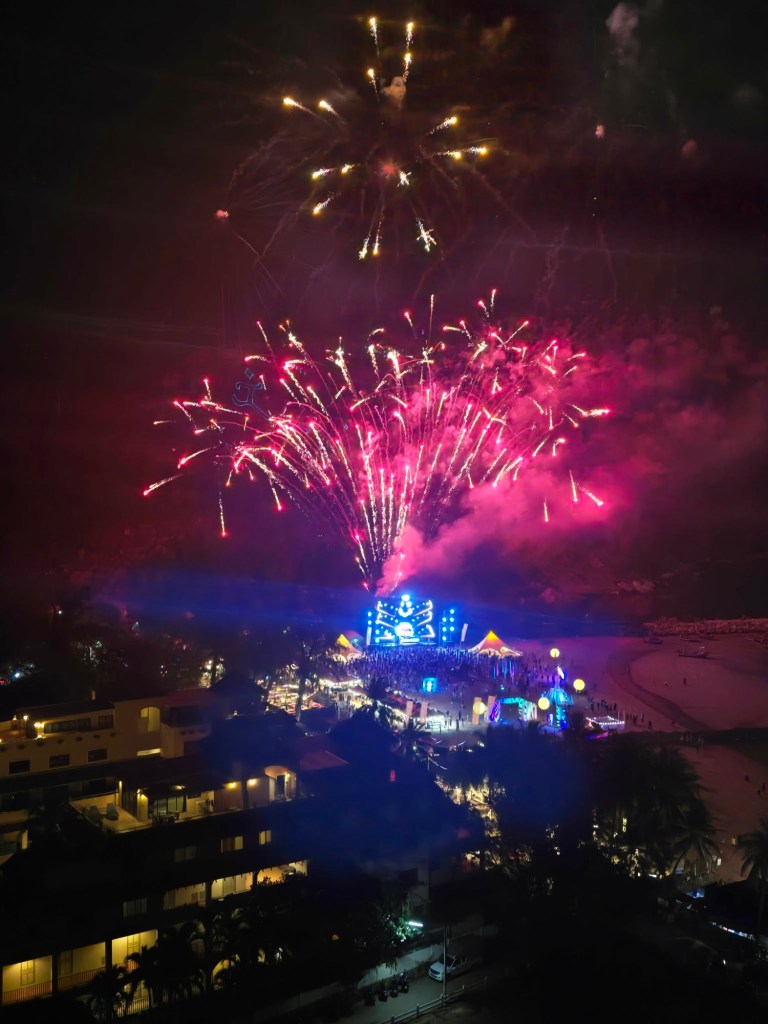
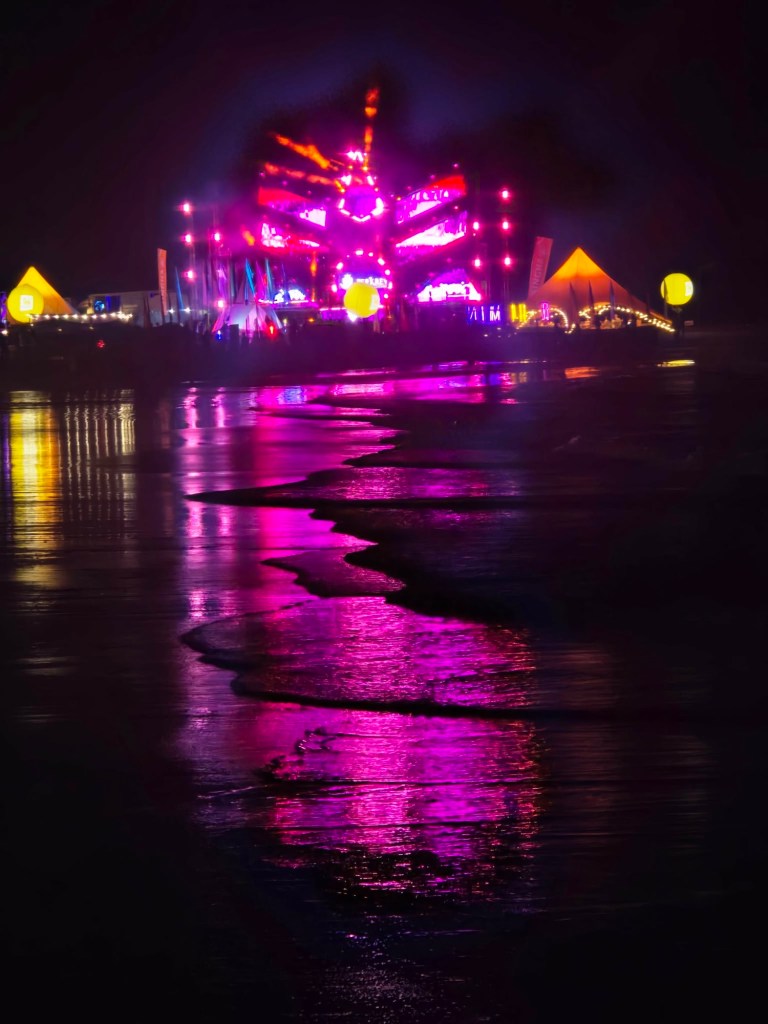
We came to Khao Takiab for a peaceful night by the sea. Softly lapping waves reflecting the full moon, a light breeze, a swim in warm water. Instead, we found ourselves with a front-row seat at a deafening eight-hour Full Moon techno slash EDM party we had not planned on watching from our balcony.
From our fourteenth-floor room the bass reached parts of me usually only accessible via MRI or possibly, Heineken. The sliding glass doors and half the room’s contents vibrated ominously. The hotel had thoughtfully listed the prices of breakable items, should the evening’s physics experiment go wrong: 5000 baht for the balcony doors, 5000 for the shower partition, 3000 for the mirrors. A sort of DIY earthquake insurance.
The entire building shook to the pounding bass like a washing machine on its final spin cycle. Sleep was not a concept with any practical meaning.
It turns out the Full Moon electronic music scene in Hua Hin is alive, well, and apparently trying to contact the International Space Station. I had never heard of EDM before last night either. Had I not googled it, I would have guessed it stood for Eardrum Destruction Mode. Or possibly Everyone’s Deaf by Morning.
I posted a 30-second clip to YouTube, only for it to be instantly blocked for copyright. Imagine claiming ownership of that racket. Bold.
Eventually we made a strategic retreat, wandering around the Khao Takiab headland, guided by nothing more scientific than the absence of tremors in the ground and the assumption that even EDM could not penetrate several million tons of rock. And there, on the quiet side, we stepped straight into a parallel universe.
⸻
Macaca Beach Bar: The Anti-Techno Sanctuary
Gone were the seismic shockwaves. Gone were the DJs attempting to collapse the ionosphere.
Instead: calm.
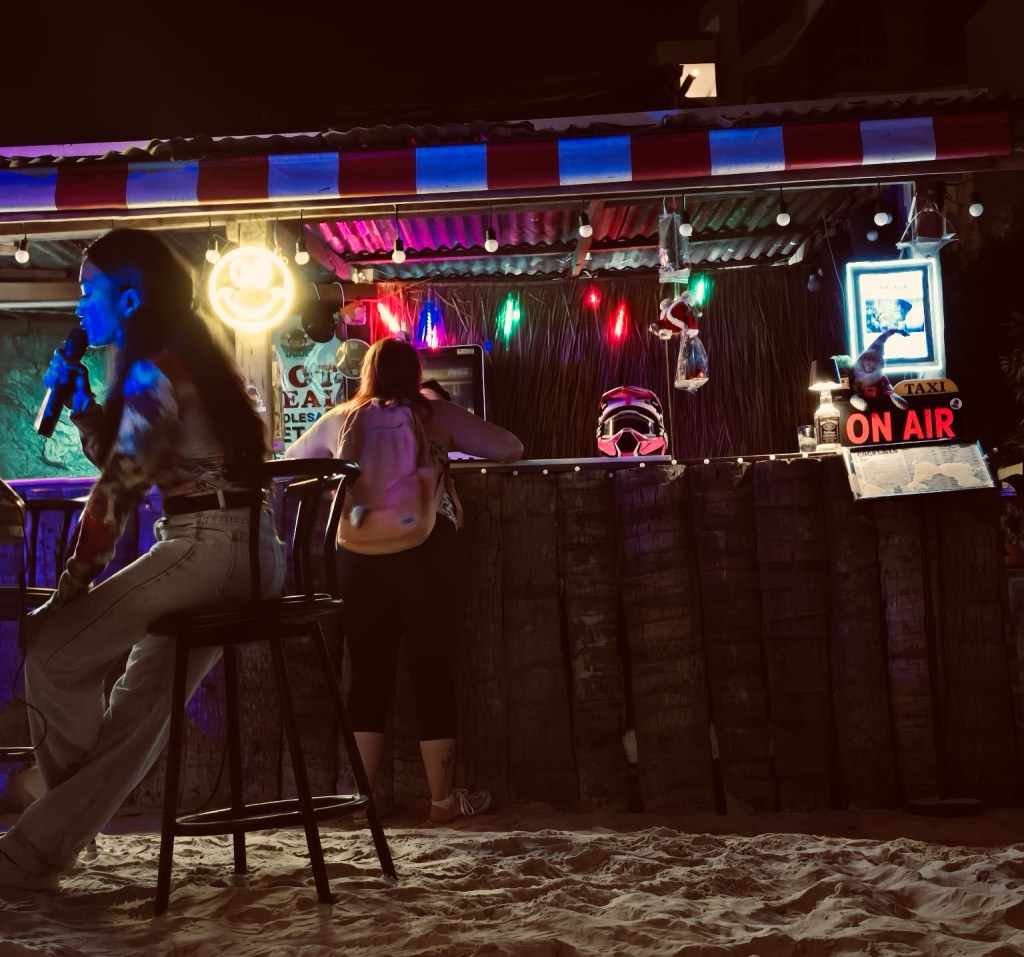
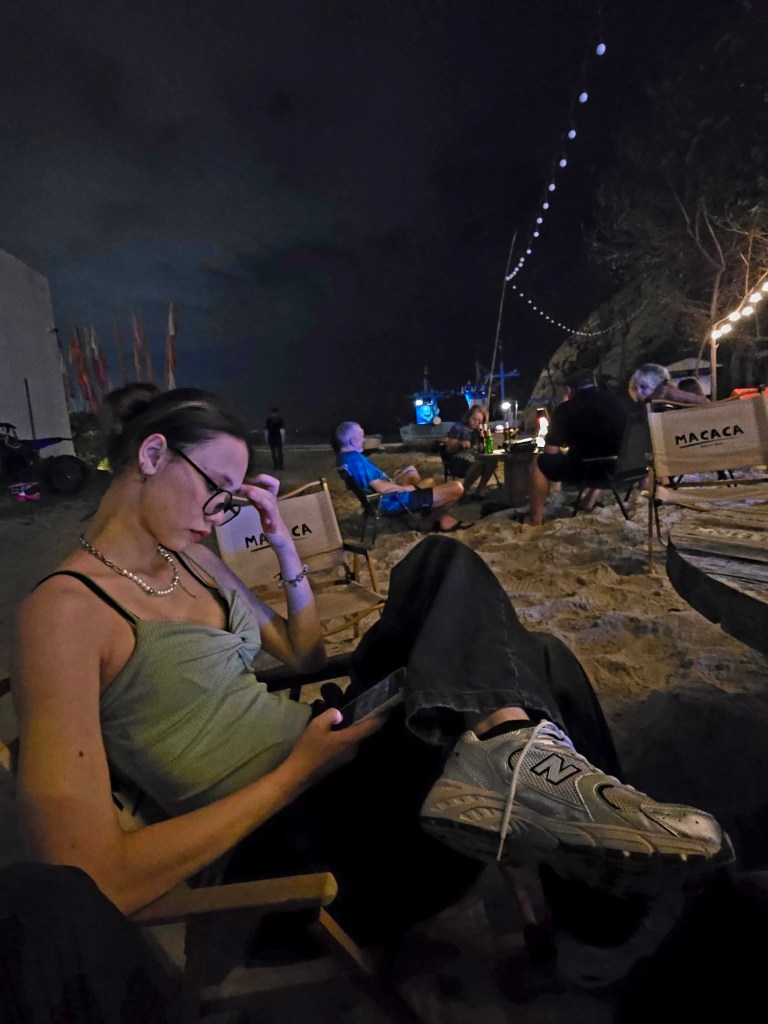
Macaca Beach Bar was everything the party was not. Cheerful, gentle, human.
A singer with warm, bluesy, jazz-soul vocals in an Amy-meets-Withers style – soft, smoky, effortlessly relaxed.
Cocktails mixed with pride.
Free salad and BBQ chicken because… why not.
People who value tranquillity over decibel warfare.
It was the sort of place that restores your sanity within minutes. Proof that much of humanity still remains unconnected, conversational, and perfectly capable of not shouting.
On the other side of the headland, EDM was still competing with Voyager 1 to become the first audio signal detected by extraterrestrial life. Yes, I am aware sound does not travel in space. However, EDM appears to be a new scientific phenomenon that operates on quantum principles. It can be detected simultaneously in every corner of the known universe and possibly in one or two unknown ones.
Amazing what a short walk can do for your faith in humanity… and your will to live.
The early morning songtaew was peaceful. A lay ascetic sat opposite me, quiet, composed, radiating the sort of calm that makes everyone else behave for once. No drama. No noise. No need to pretend the world is listening (as in the earlier blog).
Fast-forward to the return journey, where tranquillity died a swift death.
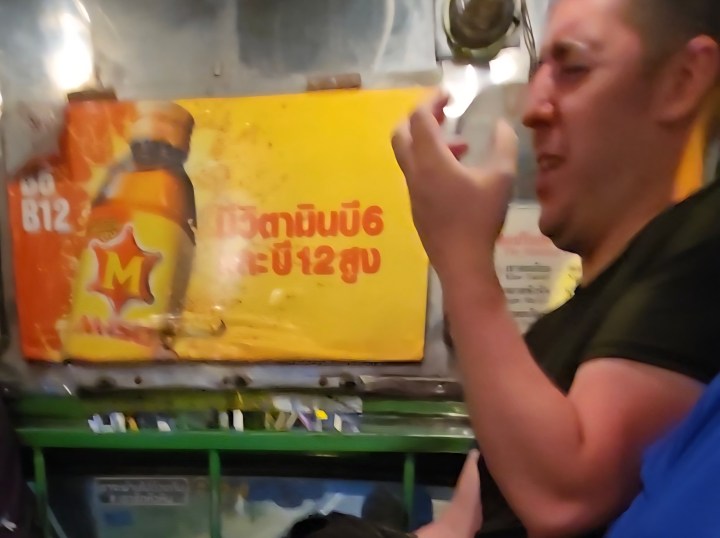
In his place: a drunk American with the volume setting of a foghorn and the self-awareness of a parking bollard. He asked if we wanted him to sing, but didn’t pause long enough to hear the universal internal “no”.
His opening act was Rolling in the Deep. His excuse? Five weeks ago an AI app had allegedly told him he had “a great voice for Adele”.
The AI should be prosecuted.
The bus was packed with Thais, Scandinavians, Germans, a French couple and one Brit, yet he assumed all would understand his rapid-fire drunk American monologue — delivered at full volume because, as we know, when people don’t understand you, the correct solution is to shout.
He powered on regardless, offering unsolicited compliments to a young Thai girl and proudly informing a German that he had “actually been to Germany”, as if announcing a major expedition to a developing nation.
Then he threatened an encore — I See Red, unintentionally appropriate.
At that point I pressed the red buzzer and abandoned ship. Walking home was easier than staying for verse two.
Sunrise with a gentle ascetic… Sunset with unsolicited American karaoke.
A neat illustration of Thailand’s ability to present the entire human spectrum in under twelve hours.
“Alcohol is necessary for a man so that he can have a good opinion of himself, undisturbed by the facts“.
Finley Peter Dunne (1867-1936) American humourist and journalist. Chicago Tribune on 26 April 1914, under the title “Mr. Dooley on Alcohol”.
A man climbed onto the baht bus today who could have walked straight out of the early chapters of Hermann Hesse’s Siddhartha – the years when Siddhartha leaves his comfortable life with his father, the Brahmin, to join the Samanas[1], the wandering ascetics who strip existence down to hunger, silence, and sheer will. This was long before the temptations, glitter and intoxications of town life[2], long before his encounter with the Buddha[3], long before he discovers that the hardest part of a spiritual journey often comes after the ideals have fallen away.
He wasn’t a monk. His pale-purple robes were immaculate – crisp, freshly laundered, and carefully kept. Beneath them, a bright white undershirt lay perfectly clean, almost formal in its simplicity. It was only the small purple bag resting across his lap that showed the marks of time: faded, stained, and frayed, its printed lettering from an old temple ceremony half-worn away. A topknot pinned in place, script tattoos climbing his neck and hands, and a long staff capped at both ends with crystal bulbs completed the picture – not of neglect, but of someone who presents the life he has chosen with deliberate discipline.
Most tourists would have seen only an eccentric figure sharing their ride. But for me, something in him struck a deeper chord.
I first read Siddhartha when I was young, when the idea of abandoning everything – possessions, ambitions, expectations – carried a certain romantic allure. But the book has only grown heavier with age. Hesse understood the full arc: Siddhartha’s shift from punishing asceticism to its opposite extreme – the seductions of town life, comfort, status, and the slow drift into sensuality… and then the moment of self-recognition, sharp enough to cut through every illusion he had gathered. The sudden departure. The collapse. And afterwards, the quieter journey: the ferryman[4], the slow apprenticeship to the river[5], the failed attempts at fatherhood, the inconsolable despair when his son ran away[6], and eventually reconciliation with himself once all the noise had fallen away. Enlightenment.
And perhaps what stayed with me most, as I watched the man on the bus, was the reminder that we never truly stop growing or searching, even when the world assumes we have already arrived. Some paths bend back unexpectedly, some separate, some rejoin later in ways we could never have predicted – and sometimes the agonising distance between people is simply another part of the journey rather than the end of it[7].
The man sat perfectly still, the staff resting across his knees, utterly self-contained. There was no performance in him, no desire to be noticed – just an interior steadiness, as if whatever road he had walked before this one and the road beneath us now shared the same quiet momentum.
The driver didn’t ask him for his fare. Here, that is considered making merit: a small gesture toward someone regarded as living a spiritual life.
But for me, it was also a moment of recognition: a small reminder, arriving without announcement on a calm Hua Hin morning, of the long looping path between confusion and clarity that most of us travel more than once in a lifetime – whether in forests, in cities, or on a rattling baht bus heading down the coast toward the next stop.
Footnotes
[1] Samanas The wandering Indian ascetics Siddhartha joins at the beginning of the novel. They practise extreme renunciation, fasting, and meditation.
[2] Town life” period Siddhartha becomes wealthy and successful, indulging in worldly pleasures. He eventually realises he has lost himself.
[3] Encounter with the Buddha Siddhartha meets the Buddha but chooses not to join his monastic order, believing he must find truth alone.
[4] The ferryman A humble man who becomes Siddhartha’s quiet teacher, showing him how to listen and observe without judgement.
[5] The river The central symbol of the novel – representing balance, unity, impermanence, and the flow of life.
[6] His son Siddhartha’s attempt to raise his newly-discovered, angry and resentful son ends painfully, deepening his understanding of attachment and loss.
[7] Paths diverging and returning A gentle echo of the novel’s theme that relationships and lives are not linear – separation does not always mean ending.
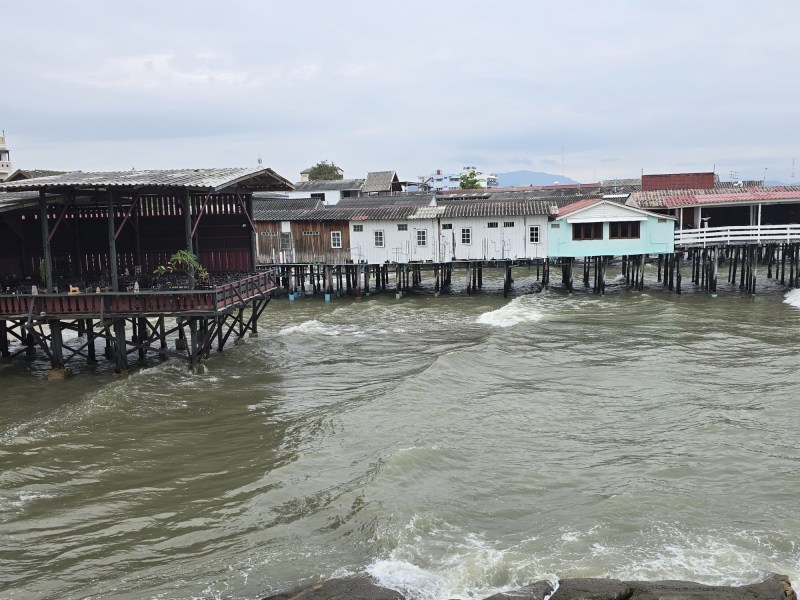
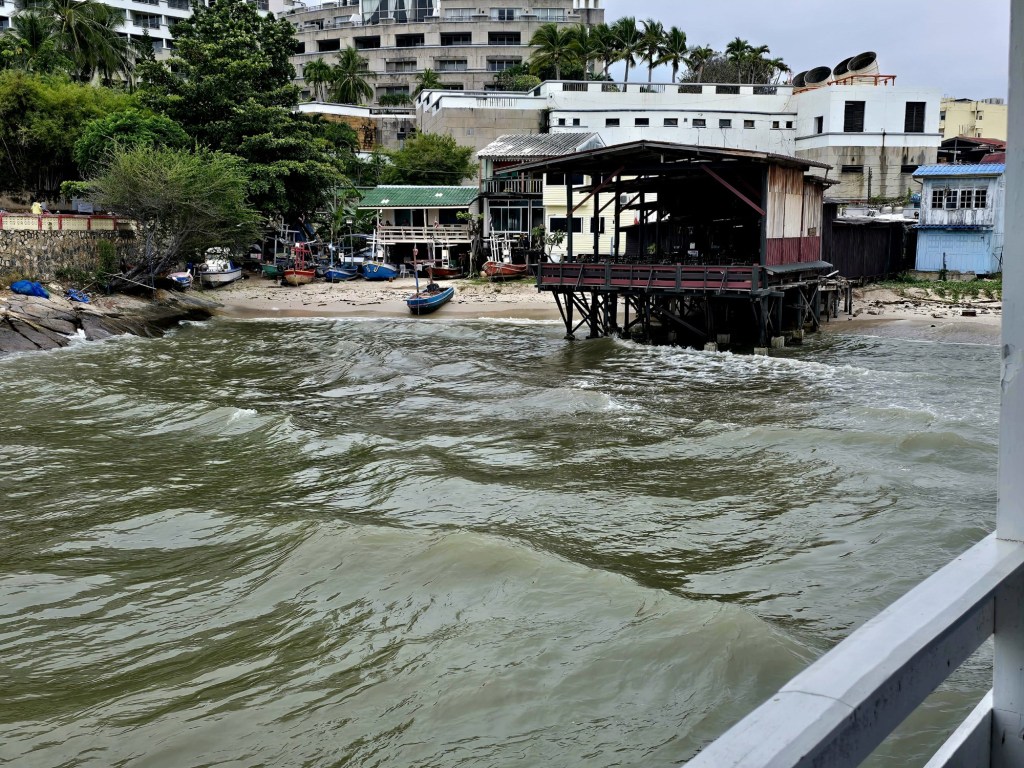
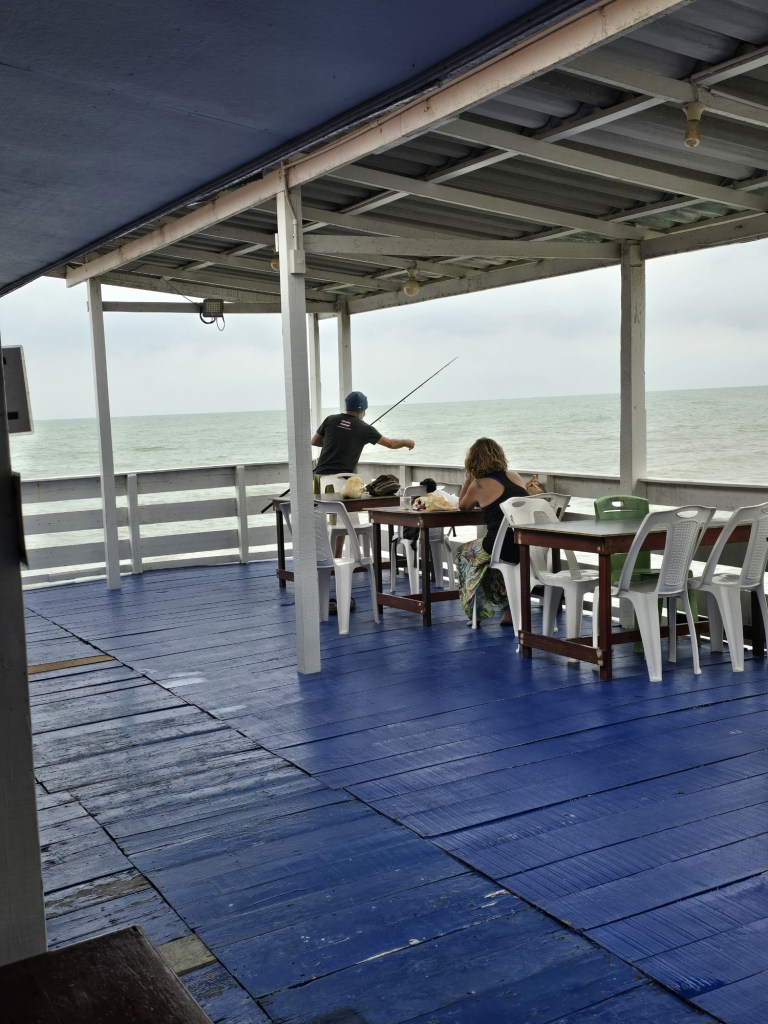
I seem to have checked myself into what can only be described as a vintage survival capsule. One of Hua Hin’s old stilted piers, the sort the municipality has been dismantling for “encroaching on public land” since roughly the Late Bronze Age. Some have already gone. This one is still here through sheer bloody-mindedness and salt deposits.
I found it during an insomniac dawn wander, following the roar of the surf like a moth with questionable judgement. Suddenly I was in the old fishing-pier quarter, staring at a wooden structure clinging to the coastline as if no one had told it the century had changed. Naturally, I booked a room.
The deal: 550 baht for a fan (the November sea breeze does most of the work anyway), or 850 baht for aircon if you enjoy chilling the Gulf of Thailand at your own expense.
The room itself is painted a cheery sky-blue, presumably so you do not notice when the actual sky comes in through the rattling windows. The waves thunder directly beneath the floorboards with all the subtlety of a bowling alley. But honestly, this is precisely the charm. Old Hua Hin, before glossy resorts and rooftop cocktails. Fishing boats on the sand. Salt-bleached timber. And the constant sense that the sea would quite like its living room back.
Clip one: filmed inside the room while hoping not to be adopted by Poseidon.
Still, sleeping above the water in a place that may not exist much longer feels like a novelty worth embracing. Preferably while sober.
Postscript: the morning after.
The whole place sways with each crashing wave, like a Clacton beach hut in a north-easterly gale quietly questioning its life choices.
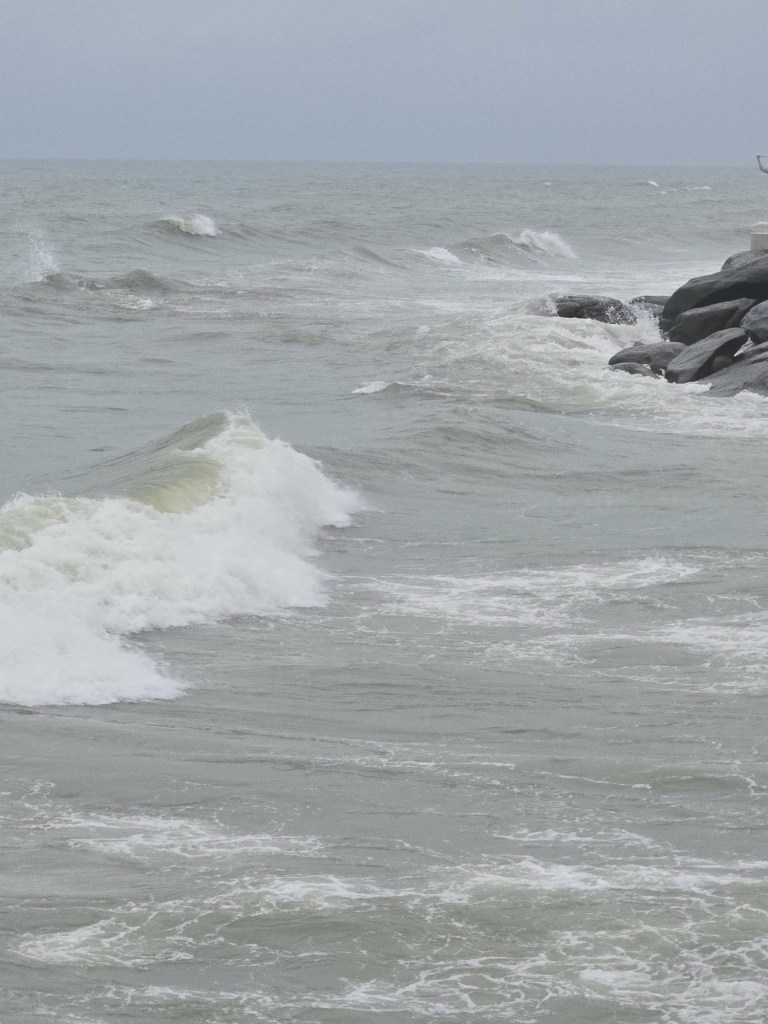
I cannot pretend I slept. I had, with flawless timing, chosen the night Hua Hin was being slapped about by the remnants of a tropical storm.
In fact, while I was lying there waiting for the floorboards’ final monologue, the city raised red flags and banned swimming altogether:
🚩 “Hua Hin bans swimming” … as the sea tries to climb onto the land Waves of two to three metres, a beefed-up northeast monsoon, and a wind surge marching across the South… basically everything you do not want when your bedroom is held up by wooden legs older than most democracies.
Officials installed red flags along the main beach from the Chao Mae Tubtim shrine to Khao Takiab and told everyone to stay out of the water until further notice. Sensible, though I would have appreciated a similar notice pinned to my stilted room.
When even solitude needs a tripod. One man’s dawn swim meets the selfie apocalypse.
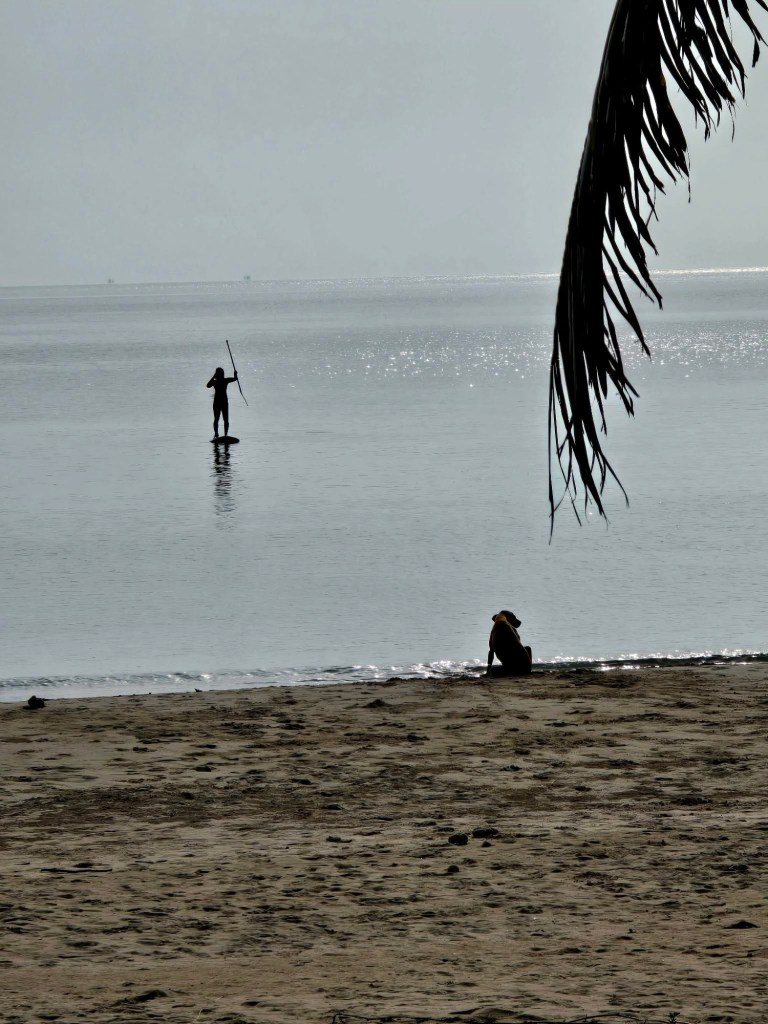
After an hour’s swim at dawn in glorious solitude, the sea smooth as glass, the horizon glowing like molten silver – I thought I had the beach to myself: two kilometres of unspoilt quiet. Then, inevitably, modern civilisation arrived.
A lone ‘content-creator-slash-YouTuber-slash-influencer’ appeared, tripod in hand. For forty-five relentless minutes she performed interpretive TikTok semaphore to music only she could hear – all legs, hair, and self-adoration – stopping and restarting each take with admirable determination. What was this, performance art? No, impossible. I’ve seen better choreography at a wake. So it could only be what’s now ironically called content – a word redefined to mean vacuous, pointless nonsense for fans with the attention span of a flea.
When at last she was satisfied, she packed up and drove away without a backward glance, leaving the sea, the sand, and what remains of civilisation exactly as she found them: untagged.
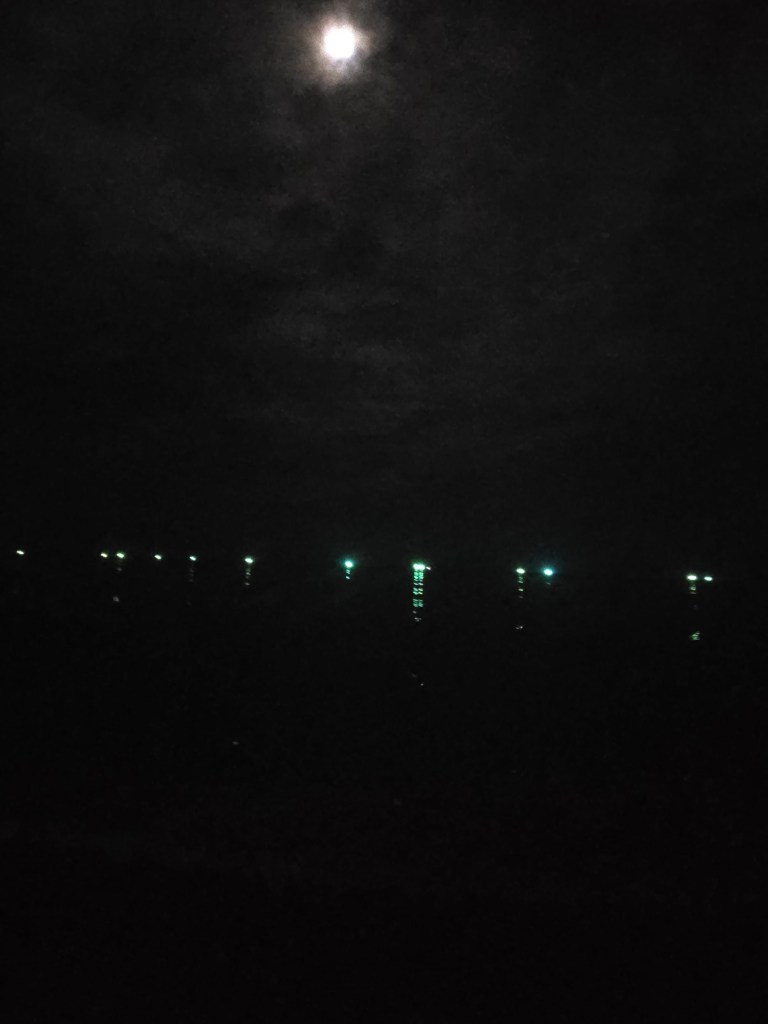
By night, this stretch of the Gulf of Thailand becomes a quiet constellation of green and blue lights. The bright beacons strung along the horizon are squid-fishing boats, their powerful lamps suspended high above the decks to draw the squid towards the surface. Each light may be visible from as far as fifteen or twenty kilometres away, their glow mirrored perfectly in the flat calm of the sea.
Yesterday evening the water was so still, it felt like gliding over glass. I had two kilometres of beach entirely to myself, the surf reduced to a faint whisper. Thung Wua Laen shelves so gently that you can wade out fifty metres before the water reaches your chest. Beyond that, the sea shimmered green and blue from the distant boats – the only movement a faint pulse of phosphorescence when my hands broke the surface.
A swim beneath those lights, with the night sky overhead and the horizon glowing like a string of emeralds and sapphires, felt like slipping briefly out of time.
The nation’s turkeys are queueing proudly for the block, feathers puffed up, convinced the farmer’s really one of them. He talks their talk, shares their outrage, even has a pint on telly – what’s not to trust? The dream, of course, is that the animals have taken back the farm – though, as Orwell warned, it’s the pigs who end up running the place.
No more Brussels on the menu, having given Farmer Fartage chronic indigestion of late, with his flagship Brexit dinner now thoroughly overcooked and getting dreadful reviews.
The new dish of the day is Dover Roast: slow-cooked fear, basted hourly by GB News, served with a side of “taking back control”. “He’s saying what we’re all thinking”, they cluck, while the carving knives are sharpened quietly out of sight.
The Seasoning never changes – nostalgia, envy, and a pinch of someone else to blame. Then comes the Stuffing: hospitals stripped to the bone, schools left to stew in neglect, and welfare quietly scraped into the bin. The flock nods approvingly. “At least he’s keeping the boats out!” they gobble, as their own livelihoods drift gently downstream – straight into the gravy boat, where Farmer Fartage and his friends are already topping up their glasses.
The Basting continues – resentment sizzling in its own fat. And now come the Turkey Trots: a nation running in circles, sick from swallowing the same reheated slogans, yet somehow proud of its patriotic diarrhoea.
When Carving Time arrives, Farmer Fartage stands beaming in his Union Jack apron, knife gleaming.
“Now that’s what I call taking back control,” he says, slicing through what’s left of the working class.
“Bootiful,” sigh the turkeys, as the plates are cleared. The pigs, naturally, will be dining at the Ritz.
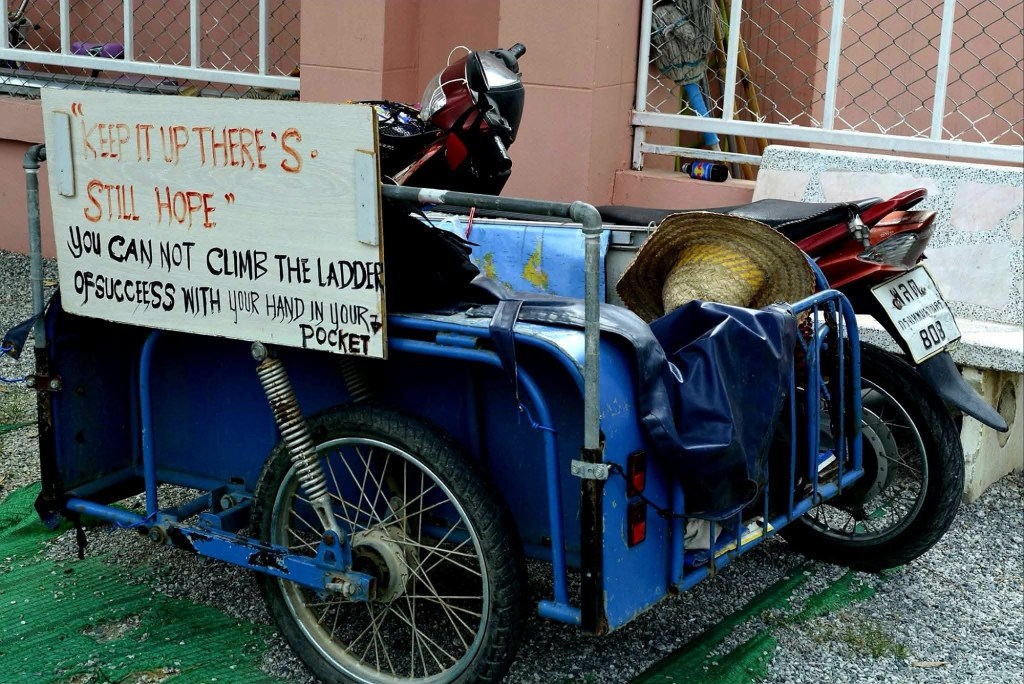
On the gardener’s sidecar at my daughter’s school in Thailand, 11 years ago.
“Keep it up there’s still hope. You cannot climb the ladder of success with your hand in your pocket”.
Whether success means career, purpose, a scrap of happiness, or simply hanging in there with sanity intact, the message still stands. You won’t get there by standing still.
In these times, when everything feels uncertain, maybe that battered sign has it right. There’s always hope – but only if we keep climbing.
As time runs its quiet course, we may look back on those we loved and respected and realise, too late, that there was always more we might have said before they were gone. Words left unspoken, gestures postponed, gratitude assumed rather than expressed. Affection we felt but rarely voiced. We might have thanked them, sincerely, and without pride. Told them, one last time, how much we loved them, how deeply we valued their presence in our lives, how fiercely their absence would be felt. We might have left no shadow of doubt.
They deserved that certainty. To know, as they faced the gathering dark, that their lives had meaning beyond themselves. That their lives had touched others in ways they perhaps never fully knew. Such knowledge might have brought a quiet comfort, a softening of the fear that comes when the light begins to fail. For it is a lonely thing to meet death believing that those once closest to you have ceased to care – or worse, that they never truly did. And as the final moments pass, there is no longer time to know the difference.
The dead will not see our tears, nor hear our whispered regrets carried too late on the wind. Whatever love we hold, it is to the living that we must give it voice. For the hour grows late, and the sands of time slip quietly away.