We Are The Tide

What the sea remembers, the land forgets.

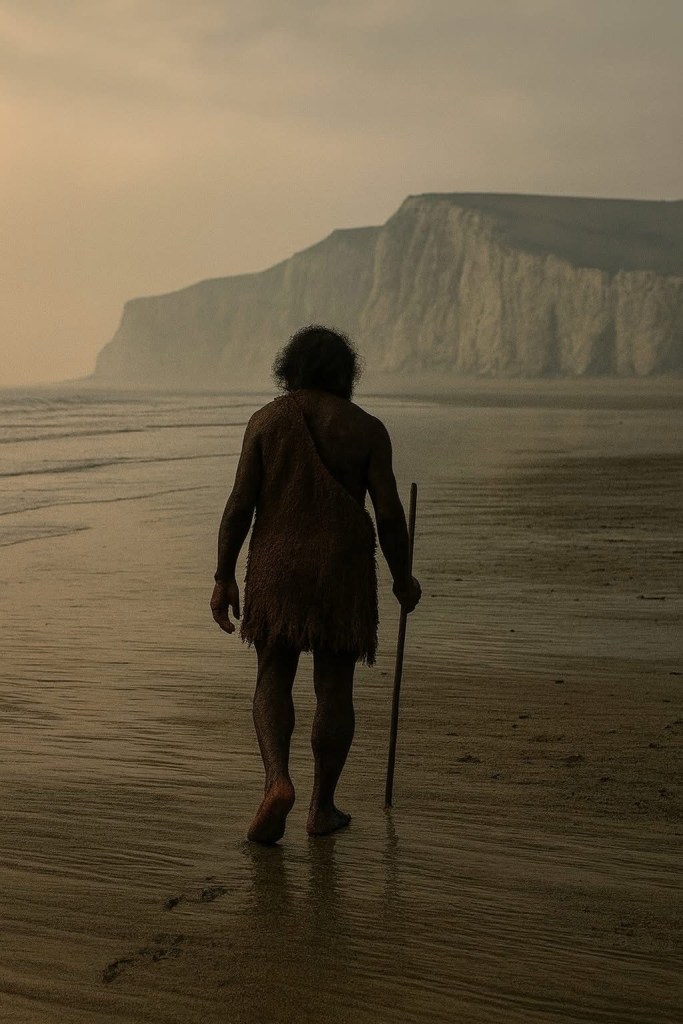
The first people to walk this green and pleasant land came from Africa.
Not recently – but in the long dawn of our species, when the only borders were rivers and mountain ranges, and the only language was survival.

They carried no papers or flags. They followed herds, water, warmth.
They crossed what was once land, and what would one day become sea, and left only stone tools, footprints, and genes in their wake.

They were not white – and whiteness had not yet been invented.
That came later, gradually and imperfectly, through ice and pigment, adaptation and isolation.

Evolution, not entitlement.

And still, they moved. Across rivers and seas, over ridges, through forests, to the islands.
Long before there was a Britain to be British about, there were people here – wandering, settling, moving again.

The earliest settlers brought fire and language. They carried no passports.

Then came others, in waves, over centuries.
They brought bronze, iron, farming, burial rites, new gods and ghosts, memories and myths.
They came from the west, the east, the near continent –
from what we now call Europe, Asia, the Middle East.

They came because people always have – in search of food, space, safety.
More clement skies. More peaceful and accepting neighbours.

The Celts – only a beginning because the fog of time obscures what came before – were just one ripple in the sediment time left behind.

The Romans followed, with roads and walls and underfloor heating.
Then the Angles, Saxons, Jutes, and Norsemen.
Vikings who came to plunder and stayed to trade.
The Normans came latest of the conquerors, but left their mark in law, language, and stone.

This island has never been still.
Never pure.
Only porous.

And yet somehow, in our painful and lingering post-imperial insularity, we convince ourselves we are the finished product.
Native. Defined. Entitled.

Some scowl at the boats now battling the waves across the Channel –
forgetting that boats carried all of us, if not in our lifetimes, then in the long-forgotten memories of our ancestors.

Some of my own forebears came in chains. Others wielded the whips.
One branch fled Jamaica. Another claimed a Scottish coat of arms.
That is not contradiction. That is Britain.

Every family tree, if traced without blinkers, eventually runs aground on a foreign shore.
Refugee. Coloniser. Indentured labourer. Chancer. Survivor.

We are not a race.
We are a journey.

It is not migration that is new – it is the outrage.
The myth of purity.
The delusion that history and culture start and end at Dover, and that identity can be ring-fenced by fear.

It is not the boats that shame us.
It is how we greet them.
Global Travel on the Cheap? Tales from the HelpX Underground

Take your pick – CouchSurfing, HelpX, WWOOFing. Different acronyms, same broad principle: a kind of barter network for the twenty-first century wanderer. Travellers exchange their labour, skills, or mere enthusiasm for food, lodging, and a taste of local life. No money changes hands – just goodwill, elbow grease, and a pinch of cultural curiosity.

CouchSurfing always sounded vaguely disreputable, conjuring images of scruffy backpackers slumped in smoky lounges. In reality, it’s more often a polite, Airbnb-lite experience. Mostly urban. Mostly brief. And nowadays, largely sanitised.

WWOOFers, meanwhile, tend to head for the hills – or at least for the nearest compost toilet. In return for shared meals and fresh air, they plough the permaculture furrow, dig ditches by moonlight, and discuss lunar planting cycles with soft-spoken eco-hosts and their dogs. Always dogs.

HelpX falls somewhere in between. It casts a wider net – no requirement to know your nitrogen from your phosphorous, or to ferment your own vegan kimchi. If you’re willing to paint a wall, prune a vine, or just not leave toothpaste streaks in the bathroom, you’ll probably do fine.

When I stumbled back home to France after one of my extended spells in Thailand, I started hosting. Sceptically, at first. But a year in, I had to admit – it worked. Mostly.

There were hiccups. One Brit arrived oozing menace, told us he kept a gun in his lorry cab, and allegedly pulled a knife on his previous host over dinner. His stay here ended with Kathryn, a wonderful Yorkshire lass who returned for multiple stays, being thrown against a wall. After he left, he rang late at night to threaten us all. The usual pleasantries.

Kathryn Barker, she fought to the end. RIP May 2022.

Then came John – a wide-eyed Englishman with a time perception problem. You could send him to weed a remote patch of garden and find him an hour later in the same spot, mid-stare, seemingly locked in existential awe at two coupling gendarme beetles. Then cannabis plant began popping up instead of courgettes. Nina, our 90 kilo English Mastiff – who would sample anything remotely edible amongst the veg – ambled erratically poolside early evening, and fell in. It was a full moon, and she apparently discovered her inner lupus and began howling at the moon. John wrote later, asking if he could return. We declined.

Another helper, a sweet but baffled French girl, was asked to turn over a flower bed. Half an hour later she returned, garden fork in hand, looking forlorn. “It doesn’t work,” she said. She hadn’t realised you needed to use your foot to push the fork into the earth. To her credit, she later became an expert at adorning the sunloungers.

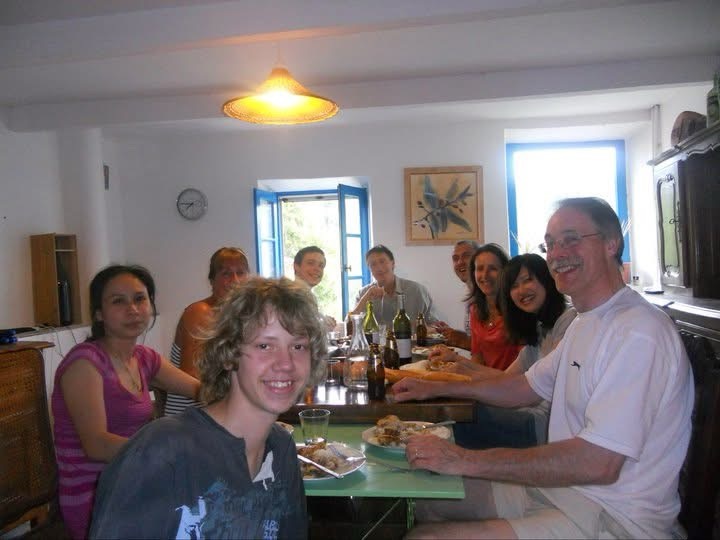
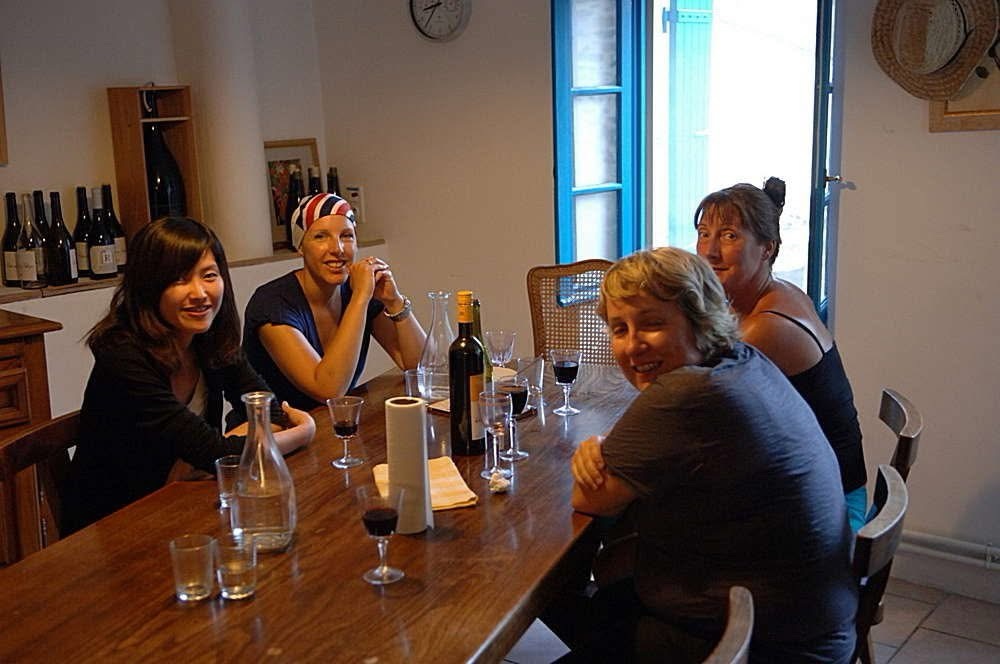
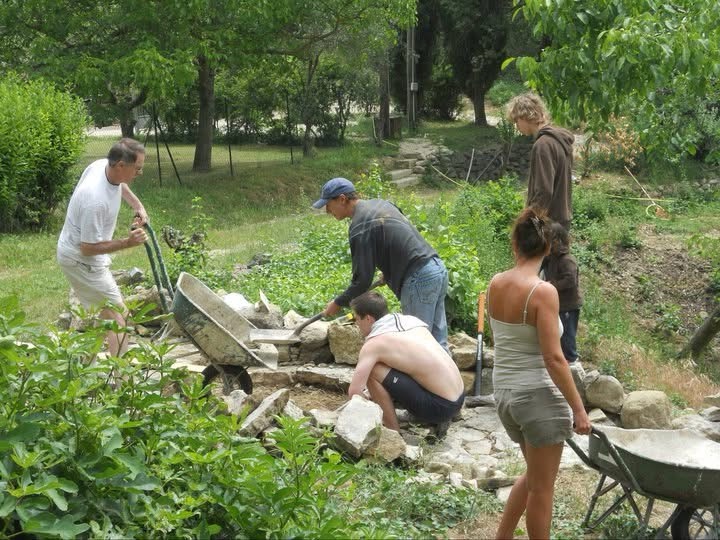
But there were gems. Retired Canadians who could tile a roof without complaint. Hungarians who cooked like angels and fixed broken water pumps. Germans who repointed walls with frightening efficiency. A couple of Irish lads who drank most of the pastis but rewired the entire barn. An entire New Zealand farming family who had taken a year off to tour Europe in a camper van, and stripped the brambles from steep slopes with hand-held scythes at speeds a Stihl brush cutter would struggle to match. And countless others, from early-twenties backpackers to seasoned nomads in their sixties, who left behind more laughter than mess.

At the dinner table, stories were swapped about hosts. There was the swinger couple in the Dordogne, who preferred jacuzzi-based bonding to house renovation. The Dutch château owner who believed aliens lived at the Earth’s core and fed his helpers little more than lukewarm lentil soup. One HelpXer escaped on foot to the nearest village, with the host following in his car, accusing the poor guy of “ingratitude” through the open window.

Of course, the system has its flaws. A minority of hosts exploit cheap labour; a minority of travellers exploit generous hosts. There are the overstayers, the under-washers, and the pathologically oblivious. But the same could be said of any extended family.

What struck me most, though, was the sheer global sprawl of it all. There were host listings in Moldova, Fiji, El Salvador, even Jordan (spelled with an extra “n” on the site last I checked). South-East Asia was catching on too – Laos, Cambodia, Vietnam, Thailand, even parts of China.

Would I recommend it? Without hesitation. If you’ve got a spare room, some half-finished projects, and an appetite for strangeness – yes. If you’re twenty and restless, and you don’t mind weeding courgettes in exchange for clean sheets and dinner – absolutely.

It’s not Shangri-La. But it’s real. Human. Messy. And occasionally magnificent.

Provence Through the Pastis Fumes

New Year’s Eve. The local hunters were out in force, already well into their celebrations and firing potshots at anything that moved faster than a snail. Fortunately for the region’s fauna (including us), most creatures with the good sense to keep their heads down survived intact. The kids and I managed the hundred-metre dash from house to garage without incident.

By dusk, and in good time for the first round of apéritifs, we bumped our way up the rutted track through olive groves to a neighbour’s house. No public roads here, and the risk of stray bullets not negligible. We were deep in the Provençal hills, far from anything resembling restraint.

Inside: bedlam. The merriment was already at full throttle, the Pastis bottle emptying rapidly. Resistance was futile. A quick perroquet – Pastis with mint syrup and ice – and I was in the spirit. Seven people conducting three conversations apiece, all at full volume.

Children hovered at the fringes, wisely keeping a respectful distance. In rural Provence, modern parenting has yet to breach the stone walls. Kids learn young that interruption is perilous.

Through the double glazing, I caught the dull crack of a gunshot. I was the only one not mid-diatribe, and no one else seemed to notice. I considered asking about the legality of nocturnal firearms, but a heated debate over the butcher’s far-right sympathies had already taken centre stage. As so often here, the volume was inversely proportional to the level of genuine disagreement.

Conversation veered towards Isabelle’s unfortunate Peugeot. Parked overnight in Malaucène, she’d assumed the midnight pops and bangs were early fireworks. Come morning, four cars including hers were charred husks. One, it was whispered, had been torched for insurance. When the brakes gave way, it rolled downhill into the rest. The explosions? Tyres.

Then the phone shrieked – volume cranked to eleven, or it would never have been heard over the din. It was Jean, a neighbour and, as it turned out, the source of the earlier gunfire. He wanted to know if anyone had seen intruders. The phantom truffle thieves were back.

Minutes later, Jean burst in, shotgun slung casually over one shoulder. “Quand mes chiens parlent…” he muttered cryptically – “When my dogs speak…” – leaving the threat to hang in the smoky air.

I hadn’t met Jean before. His complexion bore the distinctive hue of prolonged Pastis exposure. Forty-something? Sixty? Hard to tell. He launched into a breathless tale of truffle theft, rural espionage and canine clairvoyance, punctuating every twist with the wave of his shotgun. I instinctively ducked.

Partway through what resembled Rambo: The Agricultural Cut, Jean paused to check the weapon. Not loaded. I exhaled. Someone refilled his glass.

Two younger lads grabbed their own rifles from beside the door, ready to join the night patrol. God help any unfortunate soul out for a midnight stroll. I asked Laurent, our host, about the legalities. He reassured me they only tirent dans l’air – shoot into the air. I wasn’t convinced they knew which way was up.

Conversation turned, inevitably, to les Anglais. With barely a glance in my direction, the party erupted in laughter. I’d missed the joke. Probably for the best.

Apparently, the Baron family over the hill had sold a charming cottage to an English couple just before the financial crash. They’d retained a narrow strip of land right up to the house wall. The Brits, oblivious, signed the deeds. Two weeks later, the Barons arrived at dawn with a vine-pruning crew and a van full of radios. Every day. Loud. The Brits caved. The Barons sold them the sliver – at several times the going rate.

Eventually, we took our leave. Kids bundled into the car, NRJ radio blasting, we crept back down the track, headlights slicing through the olive trees. I prayed Jean and his militia wouldn’t mistake us for escaping truffle bandits.

We made it.

To friends, old and new – Bonne Année 2002

Post-scriptum – France Bleue News, 24/11/2025

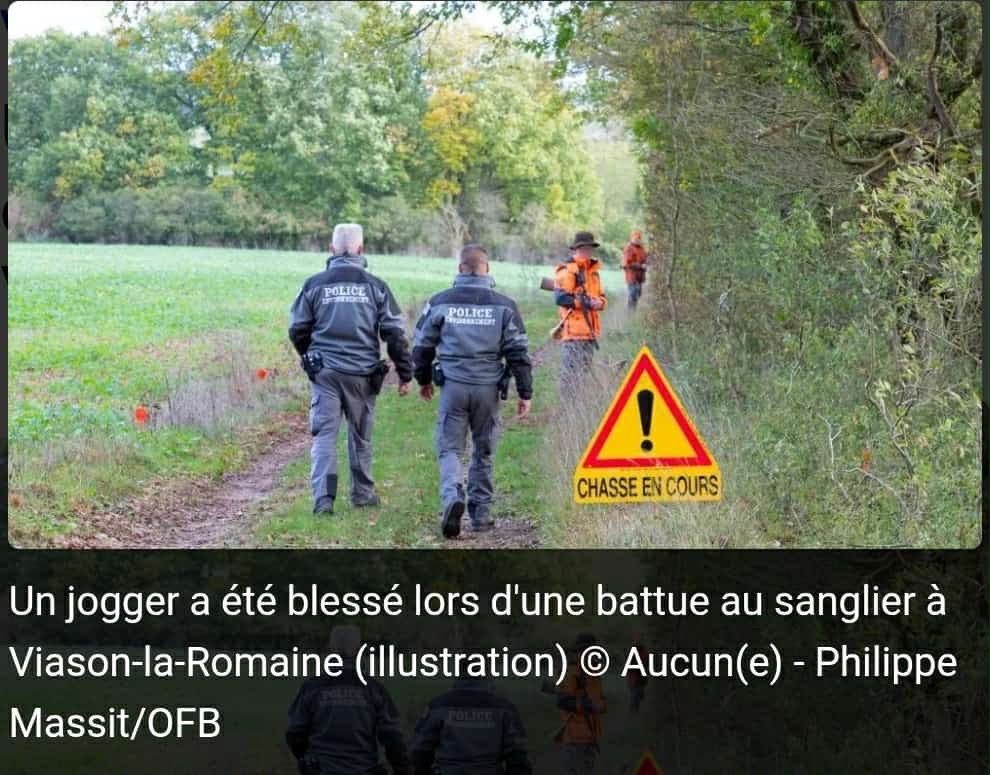
Jogger takes shot to the knee during a wild boar hunt