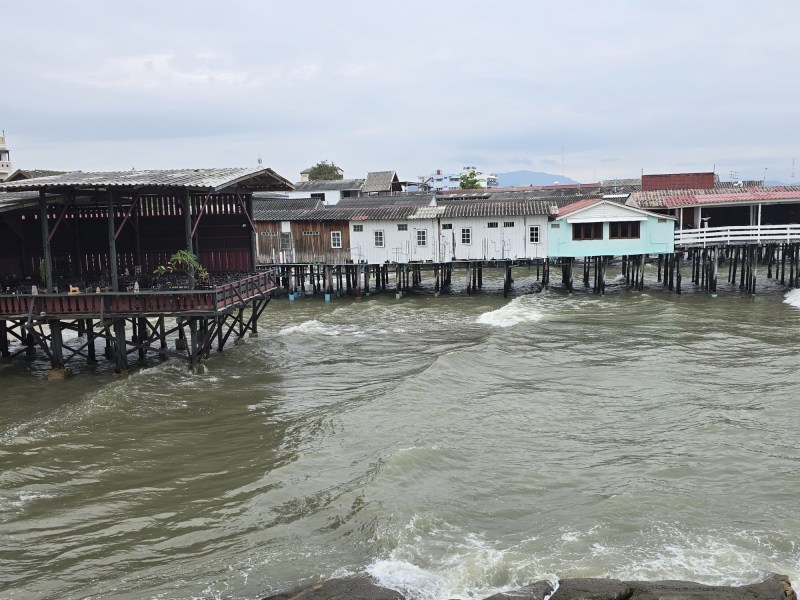
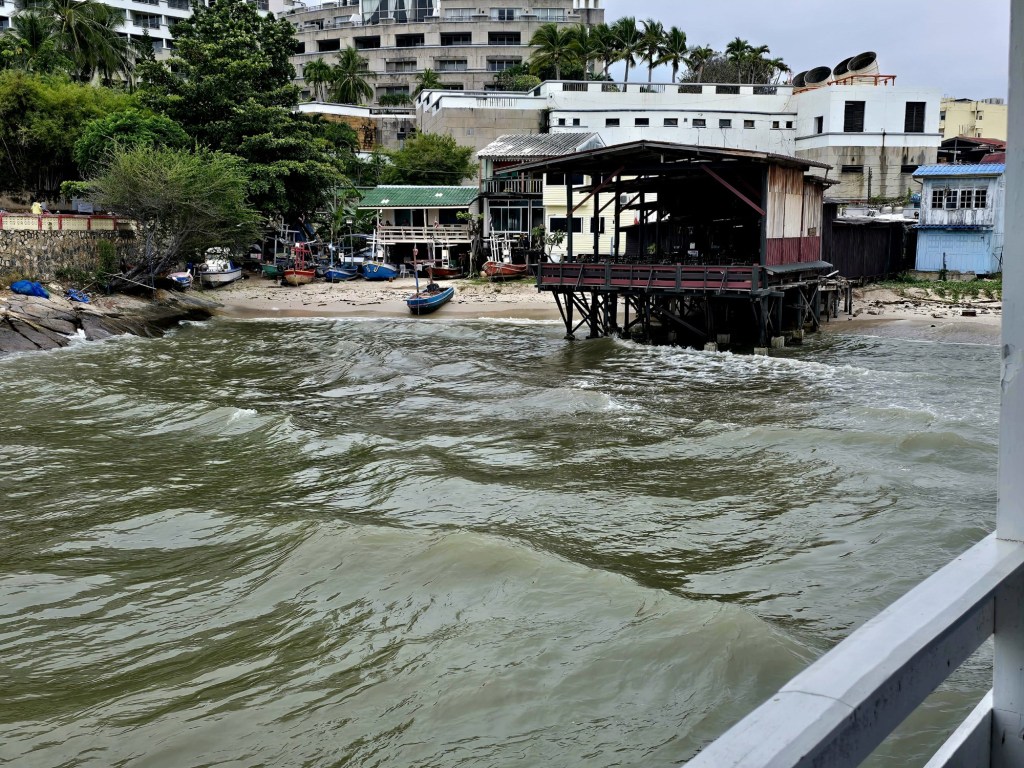
I seem to have checked myself into what can only be described as a vintage survival capsule. One of Hua Hin’s old stilted piers, the sort the municipality has been dismantling for “encroaching on public land” since roughly the Late Bronze Age. Some have already gone. This one is still here through sheer bloody-mindedness and salt deposits.
I found it during an insomniac dawn wander, following the roar of the surf like a moth with questionable judgement. Suddenly I was in the old fishing-pier quarter, staring at a wooden structure clinging to the coastline as if no one had told it the century had changed. Naturally, I booked a room.
The deal: 550 baht for a fan (the November sea breeze does most of the work anyway), or 850 baht for aircon if you enjoy chilling the Gulf of Thailand at your own expense.
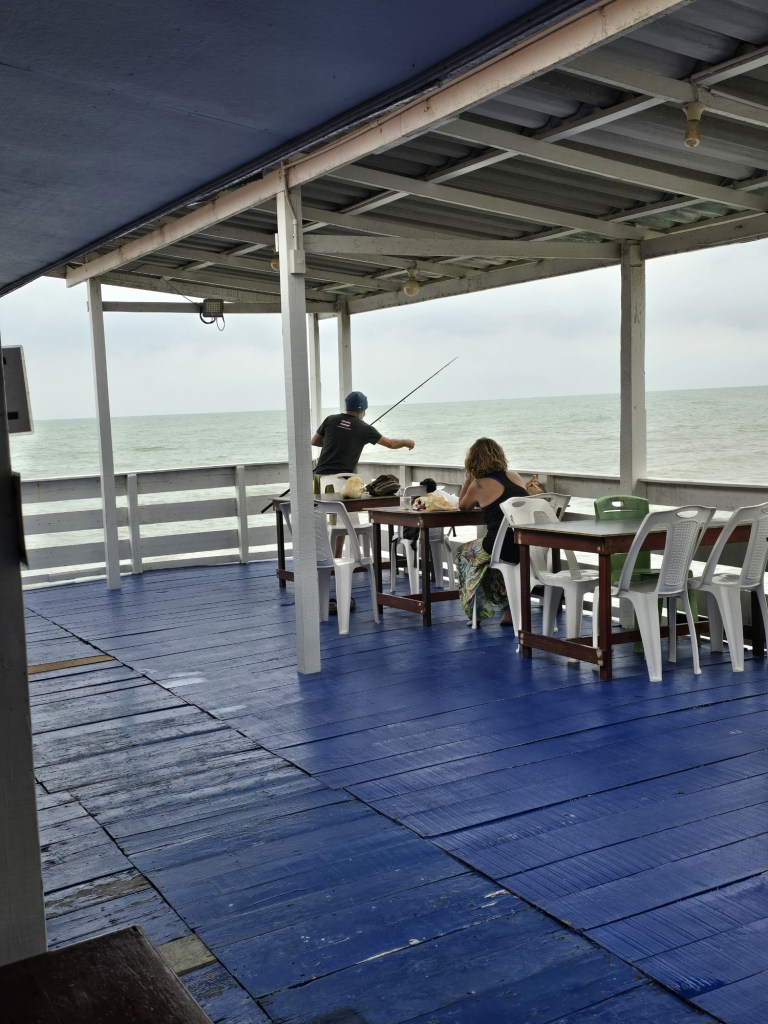
The room itself is painted a cheery sky-blue, presumably so you do not notice when the actual sky comes in through the rattling windows. The waves thunder directly beneath the floorboards with all the subtlety of a bowling alley. But honestly, this is precisely the charm. Old Hua Hin, before glossy resorts and rooftop cocktails. Fishing boats on the sand. Salt-bleached timber. And the constant sense that the sea would quite like its living room back.
Clip one: filmed inside the room while hoping not to be adopted by Poseidon.
Still, sleeping above the water in a place that may not exist much longer feels like a novelty worth embracing. Preferably while sober.
Postscript: the morning after.
The whole place sways with each crashing wave, like a Clacton beach hut in a north-easterly gale quietly questioning its life choices.
I cannot pretend I slept. I had, with flawless timing, chosen the night Hua Hin was being slapped about by the remnants of a tropical storm.
In fact, while I was lying there waiting for the floorboards’ final monologue, the city raised red flags and banned swimming altogether:
🚩 “Hua Hin bans swimming” … as the sea tries to climb onto the land Waves of two to three metres, a beefed-up northeast monsoon, and a wind surge marching across the South… basically everything you do not want when your bedroom is held up by wooden legs older than most democracies.
Officials installed red flags along the main beach from the Chao Mae Tubtim shrine to Khao Takiab and told everyone to stay out of the water until further notice. Sensible, though I would have appreciated a similar notice pinned to my stilted room.
Family trees are strange things. They offer the illusion of order, a tidy branchwork of names and dates. But beneath the surface, they’re tangled with myth, omission, and the mess of human behaviour. Mine is no different. It begins in Scotland, detours through Jamaica, dips its toes in the abolitionist movement, and ends up – for a moment, at least – in the House of Lords.
In 2000, curiosity got the better of me, and I began investigating my mother’s side of the family – the Wedderburns. The process started slowly, with dusty registers and hesitant searches, but eventually, a story began to emerge that was far richer – and darker – than I’d anticipated.
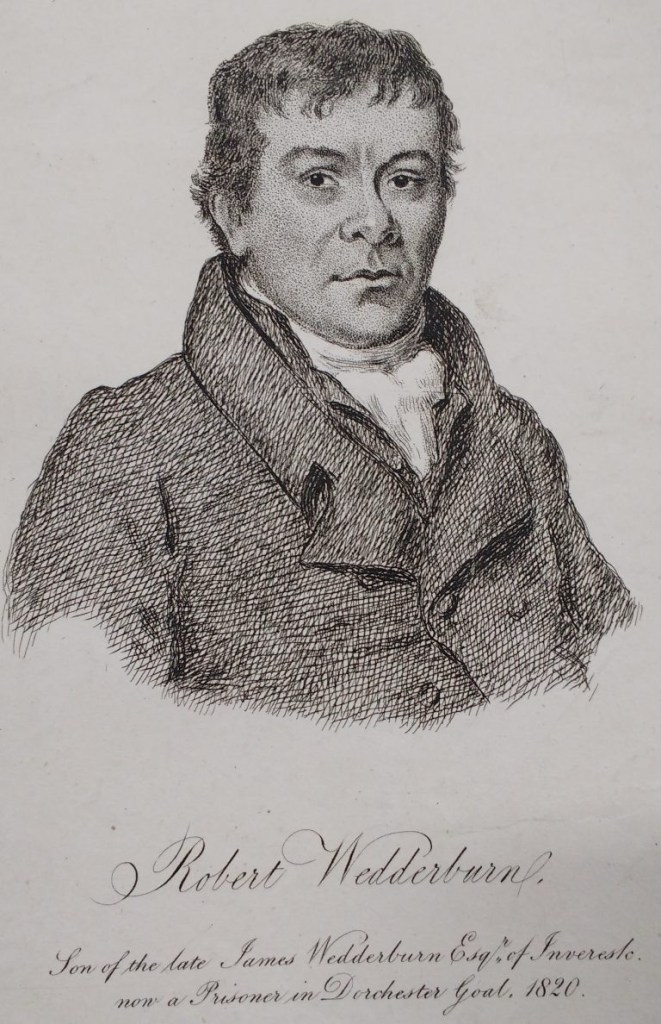
I confirmed that we were directly descended from Robert Wedderburn: a radical, a pamphleteer, an anti-slavery campaigner, a fierce critic of Empire. The illegitimate son of an enslaved woman and a Scottish plantation owner, he was born in Jamaica in the late 18th century and later became a thorn in the side of British respectability. His writings – vivid, angry, unrelenting – had been buried for years but not forgotten. And there he was, in my bloodline, my ancestral grandfather. A ghost with something to say.
I kept the discovery to myself for a while. Not because I was ashamed – quite the opposite – but because I sensed it might cause a stir. That opportunity arrived in 2001, at a centenary party for the mother of Lord Kenneth (Bill) Wedderburn, a Labour peer, legal heavyweight, and fellow descendant.
It was a polite gathering – hors d’oeuvres, linen tablecloths, clinking glasses. Various limbs of the family tree had assembled, including the more genteel of our ‘scalemaker’ line, convinced their name traced back to the aristocratic Wedderburns of Blackness in Dundee. And indeed it did – but not quite in the manner they had imagined. It was the perfect moment to drop a quiet genealogical bombshell.
I outlined, cheerfully, how our name didn’t just descend from Scottish aristocracy but also from slavery and resistance. Robert Wedderburn wasn’t some obscure offshoot. He was direct blood. Some eyebrows lifted. Some dropped. A few went missing altogether. There was a ripple of discomfort, a touch of denial. But also, to my surprise, a smattering of genuine intrigue. Bill’s daughter Professor Lucy Wedderburn, I distinctly remember, actually laughed in delight.
Bill Wedderburn wasn’t at the party – he and his mother had long since fallen out – but we met up the following day. He was sharp as ever, keen to see the evidence. I brought baptism records, slave registers, Robert’s pamphlets, even the will of Jamaican slave and plantation owner Sir John Wedderburn, who had named his mixed-race children as beneficiaries. It was all there, plain as day. And of course Robert was born ‘free’.
To Bill’s credit, he was delighted. This was no embarrassment – it was dynamite. He’d always seen the links between class struggle and racial injustice, and here they were, stitched into his own lineage. He arranged for me to visit the House of Lords – a surreal experience, not least because I was introduced as a newly discovered cousin to one Alexander Scrymgeour-Wedderburn, the 12th Earl of Dundee, hereditary peer and Royal Standard Bearer of Scotland.
The Earl was gracious, if faintly bemused. When Bill told him of our shared descent, he offered the standard reply: that the Black Wedderburns were simply former slaves who had adopted the name of their owners. Bill raised an eyebrow. I produced the documents.
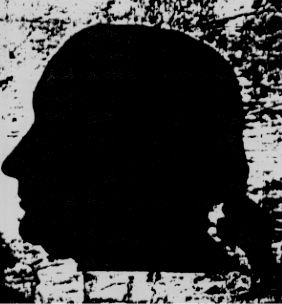
It wasn’t really a contest. The Earl, though courteous, was no match for Bill’s legal tenacity. He conceded, eventually, and even invited me to visit his estate in Scotland, where the family still kept records, letters, and a silhouette woodcut portrait of the executed Sir John Wedderburn – originally sketched by the gaoler’s daughter on the night before his hanging after Culloden.
That was the moment, I think, when history stopped being abstract. Two men, once on opposite sides of a slave-owning dynasty – one a Labour peer, the other a hereditary lord – now sat across from each other at Westminster, their bloodlines reluctantly re-entwined.
Bill and I kept in touch. We shared a quiet pleasure in the irony of it all. He once said, grinning, “Well, that puts the bloody cat among the pigeons, doesn’t it?” Indeed it did.
I wrote to the Earl later, to follow up on his invitation. He never replied.
Aquila non captat muscas, goes the old family motto – the eagle does not catch flies.
Maybe not. But some of us keep flitting about, nonetheless.
That was 2001. Now in 2025, the world has changed greatly. However, the French saying “plus ça change, plus c’est la même chose” comes to mind. The more things change, the more they stay the same. And this is delightfully encapsulated in the epilogue to the detailed and meticulously researched. And this is delightfully encapsulated in the epilogue to the detailed and meticulously researched biography of Robert Wedderburn by Ryan Hanley, published in March 2025. I’ve corresponded with Ryan several times over the past couple of years, and I’m sure he won’t mind my quoting this final passage.
“In our atomised and terminally online times, Robert’s insistence on the need for radical solidarity over liberal individualism sounds like a clarion call through the fog of an obscured past, a nearly forgotten, brief moment when another world seemed possible. It is fitting that he is more and more seen by scholars as an important figure for our understanding of the relationship between slavery and capitalism. His apparently intuitive understanding that racialised capitalism was the common denominator in the exploitation of workers around the world – from enslaved people in Jamaica to factory workers and dung-tailors in London – has inspired scholars to explore how early socialist ideas were articulated in relation to empire.
It seems difficult not to see ourselves reflected when we look at the world that made – and then so spectacularly unmade – Robert’s reputation. Within the ongoing omni-crisis of late-stage capitalism – food banks, unaffordable housing, resurgent state-condoned racism, and paid-for political gaslighting operating at an industrial scale – Robert’s outright rejection of any authority derived from the violent expropriation and hoarding of land and resources is now very much back in vogue.
The language that scholars have used when describing Robert’s radicalism – “organic,” “natural,” “earthy,” even “pungent” – speaks to an enduring sense that he embodies a pure form of radicalism: radicalism as it should be. His prophetic vision of a world without slavery or poverty was predicated on the idea that solidarity between colonised and exploited peoples was not only possible and desirable but inevitable.
While he learned, to his cost, toward the end of his life, that such solidarity could not be taken for granted, Robert remained optimistic about the capacity for poor and enslaved people to find common cause in the pursuit of freedom and equality. Until his death, he believed that they might one day even be successful. For this belief, he was once derided as naïve – even deluded. But he was more of a realist than people gave him credit for.
He understood from the example of Haiti the need to plan carefully to defend anything that might be gained from an insurrectionary movement for freedom. He learned from Barbados and Demerara, and from William Davidson and Arthur Thistlewood too, that insurrections most often ended up with bloody reprisals – with severed heads held up to the crowd or fixed on a spike over Temple Bar. He learned from his father and half-brother Andrew that the law is no guide to conscience, and that power has a habit of legitimising itself as it reproduces.
Most importantly, he learned from [his mother] Rosanna and [grandmother] Amy that sometimes it was worth the punishment to thumb one’s nose at authority – to unsettle for a moment the complacent, self-regarding assumptions about justice and honour held among a pack of slaveholders. Seemingly doomed acts of defiance in the face of overwhelming odds can yield major effects further down the line.
In Jamaica they have a saying: “If you are the big tree, then we are the small axe.” There is nothing naïve about that.”
Bill, had he still been here, would have loved this work by Dr Ryan Hanley. And I can’t help but see how our worldviews, two centuries later, uncannily mirror Robert’s, and have done so since well long before either of us even knew of his existence. A kinship in more than the genetic sense.
House of Lords revisited
If I have a regret, it’s that I only got to know Bill properly when he was nearing the end of his life. We met on several occasions afterward, usually at the House of Lords. I liked him immensely. He was direct, abrasive, unapologetic – not unlike Robert, I imagined.
We lunched together in the Peers’ Dining Room a few times – an august venue where the long table rule still holds: one sits beside whomever arrived before. One time I was sandwiched between Bill and the eccentric Lord Longford – known as “Lord Porn” for his anti-pornography crusades, and “Lord Wrongford” for his unpopular and undoubtedly misguided attempts to free Myra Hindley, one of the Moors murderers. Conversation was sporadic and punctuated by explosive sneezing, tissues tumbling from every pocket like ticker tape.
Another visit brought minor scandal. Wandering the corridors, I found myself face-to-face with the Speaker of the House and his entourage. You’re supposed to stand aside in silence. I didn’t. Bill hissed at me like a schoolmaster catching a pupil smoking behind the bike sheds.
Later, while Bill was needed for a vote, I wandered off and slipped into what appeared to be a quiet library. Within moments, a flustered staff member appeared – but couldn’t cross the threshold from the red-carpeted corridor to the green-and-red of the room itself. “Sir! Sir!” he stage-whispered. “Only peers may enter the Library!” I apologised and stepped out, but couldn’t resist asking whether the many decrepit Lords had to do their own dusting.
For all its grandeur, its ritual and its red velvet robes, that place still can’t quite silence the ghosts.




 No Sacred Cows