
Scientist, RAF officer, NHS leader and Lord-Lieutenant of West Sussex
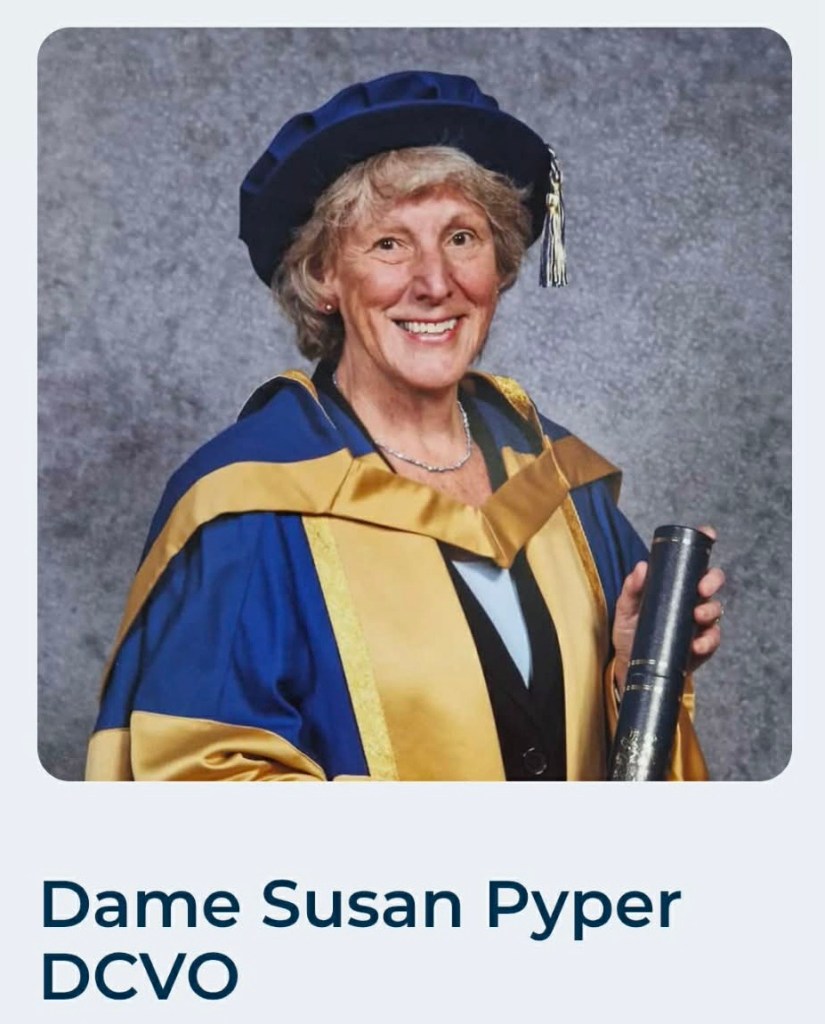
Dame Susan Elizabeth Pyper, née Harrison, was born in December 1951, the elder daughter of Ronald Harrison and Joan Harrison, née Wedderburn. Joan was my mother’s cousin, making Susan a member of my own Wedderburn generation of cousins. Her younger sister was Jenny.
Ronald Harrison died in 1957, when Susan was only about five. She can therefore have retained no more than early childhood memories of her father, while Jenny, being younger, would scarcely have remembered him at all. Joan was left to bring up the two girls alone while pursuing a responsible career at Scotland Yard.
Durham University
The publicly available record says remarkably little about Susan’s early childhood, birthplace or schooling. Much more becomes visible when she entered Durham University and later embarked upon a succession of demanding careers in science, the Royal Air Force, the National Health Service and public life.
Susan studied Zoology at St Aidan’s College, Durham University, graduating in 1973. Durham records her degree, college and year in its published account of alumni recognised in the 2022 Queen’s Birthday Honours.
While at Durham, she attended lectures given by David Bellamy, then teaching in the university’s Botany Department. Susan remembered herself as fortunate to have been taught by him. Bellamy later became one of Britain’s most recognisable television naturalists, but his exuberance, booming voice and unmistakable manner were evidently already well established in the lecture theatre.
That recollection has an incidental personal sequel of my own.
David Bellamy and the Canterbury Festival of Faith and the Environment
While living in Folkestone, where I remained from 1980 until June 1990, I attended the Canterbury Festival of Faith and the Environment, held from 15 to 17 September 1989. It was a substantial interfaith and ecological gathering centred upon Canterbury Cathedral but extending through much of the city.
Canterbury appeared almost to have been taken over. There were Buddhist gatherings, meetings involving numerous faith traditions, ecological and development organisations, processions and religious groups moving through the streets. I remember a large body of Hare Krishna devotees singing their way around the city. I also encountered the World Development Movement, of which I was then a member.
As an atheist with Buddhist leanings, I attended several of the gatherings and also went to the concluding formal service, apparently in Canterbury Cathedral. I found myself seated beside David Bellamy.
When the congregation rose to sing All Things Bright and Beautiful, I remained silent. Bellamy did not. His singing voice possessed the same foghorn volume as his speaking voice, although rather less regard for the tune. He did enough singing for both of us.
By 1989 Bellamy was already an instantly recognisable television personality. He was appointed OBE five years later, in 1994.
Forensic science and the Metropolitan Police
After graduating from Durham, Susan began her professional career as a forensic scientist with the Metropolitan Police. The University of Chichester’s official biography places this at the beginning of her working life, before her RAF service.
No publicly accessible source yet identifies her exact forensic specialism, grade, department or period of employment. It has not been possible to establish whether she worked principally with biological evidence, microscopy, fibres, trace material or another branch of forensic science. Nor have any securely attributable scientific papers or case references emerged.
That lack of detail is not necessarily surprising. Forensic scientists working within police laboratories frequently appeared in public records only when giving expert evidence in prominent cases, publishing research or occupying senior management positions. Much routine scientific casework remained institutionally rather than individually documented.
The Metropolitan Police connection also ran through Susan’s family.
Joan Harrison and Scotland Yard
Susan’s mother, my Auntie Joan, was not a police officer but worked at Scotland Yard as a personal assistant and administrator in the office of the Metropolitan Police Commissioner. The precise title and dates of her appointment have not yet been documented through public records, but her senior administrative position was well established within the family.
Joan was a formidable woman, both in personality and physical presence. One childhood encounter with her remains particularly vivid.
Not long before my family moved from Leigh-on-Sea to Harrogate in about 1969, my parents organised a solo trip to London for me, including an overnight stay with a relative. I was ten or eleven and had never travelled alone anywhere before except to Grindley’s bookshop in Leigh High Street. I proudly took the train from Westcliff to Fenchurch Street and then negotiated the Tube into central London.
With time to spare, I found myself wandering up Shaftesbury Avenue from Trafalgar Square. A small group of men had gathered around a box on the pavement, apparently playing cards. I would now recognise them immediately as a thoroughly shady collection of individuals. At that age, however, I merely saw an intriguing game and an easy opportunity to double my money.
It was the three-card trick. I watched carefully and identified the jack correctly each time. Naturally, this was because I was being allowed to. In a moment of catastrophic confidence, I placed my entire travelling fund on the box: the princely sum of £10, a considerable amount of money at the time.
I lost.
The cards, the box and the surrounding crowd disappeared almost simultaneously. I was left virtually penniless, with barely enough money to telephone home.
My mother told me to remain by the telephone box while she contacted Auntie Joan. Emergency funding was arranged. I was instructed to present myself at Scotland Yard at a fixed time, where Joan would meet me in reception.
I approached the building with considerable trepidation and made absolutely certain that I arrived early.
At the appointed hour, to the second, Auntie Joan materialised.
She handed over the money, delivered a brief, stern and entirely unsmiling lecture, then turned on her heel and strode back to work.
Although I have since learned how the tricksters perform their trick, I have never dared gamble on the three-card con again. Sixty years later, the memory of Auntie Joan’s withering stare and terrifying voice remains more than sufficient deterrent.
The full story belongs properly in a separate family anecdote, but it conveys something of the disciplined and highly capable environment in which Susan and Jenny were raised.
Royal Air Force service
Susan subsequently served for eleven years as an officer in the Royal Air Force. This is consistently stated by the University of Chichester, although the published biographies do not identify her service number, branch, rank, promotions, postings or precise dates.
Her graduation in 1973 and the beginning of her NHS career in 1992 provide the outer chronological limits. Her Metropolitan Police work came first, followed by eleven years in the RAF, so her service must have occupied a substantial part of the later 1970s and 1980s.
Whether her RAF duties drew upon her scientific and forensic background remains unknown. No securely identifiable commissioning or promotion notices have yet been found under either Harrison or Pyper.
The RAF nevertheless remained an important part of her identity. When her appointment as the University of Chichester’s first Pro-Chancellor was announced, Susan quoted the RAF motto, Per Ardua ad Astra, “Through adversity to the stars”, as the message she wished to convey to the university community.
Marriage and family
Family records identify Susan’s husband as John Pyper. Some later ceremonial material appears to refer to him as Jonathan, but the family record uses John and should take precedence unless a civil marriage entry establishes otherwise.
Susan and John had two children:
Anthony Pyper, born 27 March 1988;
Gemma Pyper, born 26 May 1989.
The timing suggests that Susan combined the later stages of her RAF career, or the transition into civilian public service, with raising two young children. No detailed public account of the family’s domestic life has been found, and it would be inappropriate to speculate beyond the surviving family information.
National Health Service career
In 1992 Susan began what became a substantial career in National Health Service governance. The University of Chichester records that she chaired a number of NHS trusts, including Western Sussex Primary Care Trust and Royal West Sussex NHS Trust.
Sussex Weald and Downs NHS Trust
By September 1999, Susan had become chair of Sussex Weald and Downs NHS Trust. The appointment was recorded by Health Service Journal, which corrected an earlier misprinting of the trust’s name.
This is the earliest precisely identified NHS chairmanship so far found, although her NHS work had begun seven years earlier. Her appointments between 1992 and 1999 remain unidentified.
Western Sussex Primary Care Trust
Susan subsequently chaired Western Sussex Primary Care Trust.
A Sussex-wide consultation document from 2004 identifies her as chairman and Claire Holloway as chief executive. Western Sussex PCT was coordinating work across Brighton and Hove, East Sussex and West Sussex concerning mental-health, learning-disability and substance-misuse services. The document shows that Susan’s work extended beyond the ceremonial chairing of meetings into the strategic coordination of services across several organisations and local-authority areas.
The precise beginning and end dates of this chairmanship remain to be established.
Royal West Sussex NHS Trust
Susan later became chairman of Royal West Sussex NHS Trust, responsible principally for St Richard’s Hospital in Chichester.
The surviving annual report describes her as having chaired the trust for four years before its merger with Worthing and Southlands Hospitals NHS Trust on 1 April 2009. During her chairmanship she also led its Finance and Remuneration Committees.
In her farewell statement she described the experience as an extraordinary privilege and paid tribute to the dedication of the hospital’s staff. The trust employed approximately 2,400 people and served a population of around 210,000, while also treating many patients from neighbouring areas.
Susan handed the chairmanship of the new merged organisation to Hywel Evans when Western Sussex Hospitals NHS Trust was created in April 2009.
Independent NHS investigation
Later in 2009, NHS Chief Executive Sir David Nicholson appointed Neil Goodwin, supported by Susan, to investigate allegations that United Lincolnshire Hospitals NHS Trust had been bullied and harassed by the East Midlands Strategic Health Authority.
The published report described Susan as Lord-Lieutenant of West Sussex and an experienced NHS chair recently retired from an acute hospital trust. Her role was associated with ensuring the independence, impartiality and propriety of the investigation.
The appointment demonstrates the level of confidence placed in her judgement after almost two decades in health-service governance.
Sussex Community Foundation
Susan served as a director of the Sussex Community Foundation from May 2006 until October 2008. Her resignation came shortly before her appointment as Lord-Lieutenant.
The foundation’s work supporting local voluntary and charitable organisations was closely aligned with the wider civic responsibilities she was about to assume.
Lord-Lieutenant of West Sussex
Susan was appointed Lord-Lieutenant of West Sussex in November 2008 and served until the end of July 2022, a tenure of almost fourteen years. The University of Chichester describes the office as that of the Queen’s personal representative in the county.
The Lord-Lieutenant represents the sovereign at civic and ceremonial occasions, accompanies members of the Royal Family during official visits, presents honours and awards, supports the armed forces and cadet organisations, appoints Deputy Lieutenants and maintains links among local government, charities, churches, businesses and voluntary organisations.
Susan’s period in office involved a wide range of royal, military, medical, charitable, environmental and civic engagements. Her background in the RAF and NHS gave her a particularly strong connection with the armed forces and health services, while her scientific education remained visible in her support for environmental causes.
She retired on 31 July 2022 after nearly fourteen years in office.
The Order of St John
In 2010 Susan was appointed Commander, Sister of the Most Venerable Order of the Hospital of St John of Jerusalem.
She was promoted to Dame of the Order in December 2013.
The Order of St John is closely associated with charitable and humanitarian work, principally through St John Ambulance. These honours reflected another strand of Susan’s long public-service record.
Dame Commander of the Royal Victorian Order
In the Queen’s Birthday Honours of June 2022, Susan was appointed Dame Commander of the Royal Victorian Order, with the postnominal letters DCVO.
The official citation reads:
Susan Elizabeth Pyper, Lord-Lieutenant of West Sussex.
The Royal Victorian Order is awarded personally by the sovereign for service to the monarch or members of the Royal Family. Susan’s appointment therefore recognised her long service as the Queen’s representative in West Sussex rather than a political or departmental recommendation.
Her correct formal style is:
Dame Susan Elizabeth Pyper DCVO
Honorary Doctor of Science
In October 2023, the University of Chichester awarded Susan an honorary Doctor of Science.
The honour was particularly appropriate. Her working life had expanded far beyond laboratory science, but her intellectual beginnings lay in zoology and forensic work. At the ceremony she described her commitment to and love of science as a continuing thread throughout her career.
The award brought her public life back, in a sense, to the scientific interests with which it had begun.
Pro-Chancellor of the University of Chichester
In July 2025, the University of Chichester announced that Susan would become its first Pro-Chancellor. She was formally installed in September 2025.
As Pro-Chancellor, she presides over university ceremonies, confers degrees and serves as an ambassador for the institution. She expressed the hope that she could strengthen the university’s civic and business partnerships and encourage students and staff to aim high.
She remains listed by the university as Pro-Chancellor and a member of its governing structure.
Environmental and charitable service
Susan’s environmental interests did not end with her zoology degree. During her public career she was associated with the South Downs National Park Trust and other Sussex environmental and conservation organisations.
She also supported hospices, charities, cadet organisations, the armed forces and numerous local voluntary bodies. The scale of her activity suggests that she treated the Lord-Lieutenancy as an active form of public service rather than a narrowly ceremonial office.
Personal recollections
Official biographies naturally describe Susan through appointments, institutions and honours. My own memories are of a cousin who remained close to my mother and who occasionally entered our much more ordinary family life.
I remember Susan visiting us in Harrogate. On one such occasion, I had spent the day fishing in the River Nidd and returned with three freshly caught brown trout. We grilled them lightly and ate them together. They were absolutely delicious.
It is a small memory beside a career involving forensic science, the RAF, the NHS and the Royal Household, but perhaps a more human one for precisely that reason. Public lives are preserved through official notices and institutional biographies; family memory retains trout suppers, memorable lecturers and the particular sound of someone singing far too loudly in a cathedral.
Chronology
December 1951
Susan Elizabeth Harrison was born, the elder daughter of Ronald Harrison and Joan Harrison, née Wedderburn.
1957
Her father, Ronald Harrison, died. Susan was about five; her younger sister Jenny was too young to retain any meaningful memory of him.
1973
Graduated in Zoology from St Aidan’s College, Durham University.
After 1973
Worked as a forensic scientist with the Metropolitan Police.
Later 1970s and 1980s
Served for eleven years as an officer in the Royal Air Force.
27 March 1988
Birth of her son, Anthony Pyper.
26 May 1989
Birth of her daughter, Gemma Pyper.
1992
Began her NHS governance career.
September 1999
Became chair of Sussex Weald and Downs NHS Trust.
By 2004
Chairman of Western Sussex Primary Care Trust and involved in coordinating Sussex-wide work on mental-health, learning-disability and substance-misuse services.
Approximately 2005–March 2009
Chairman of Royal West Sussex NHS Trust, including its Finance and Remuneration Committees.
2006–2008
Director of the Sussex Community Foundation.
November 2008
Appointed Lord-Lieutenant of West Sussex.
2009
Supported the independent review into allegations involving United Lincolnshire Hospitals NHS Trust and the East Midlands Strategic Health Authority.
May 2010
Appointed Commander, Sister of the Order of St John.
December 2013
Promoted Dame of the Order of St John.
June 2022
Appointed Dame Commander of the Royal Victorian Order.
31 July 2022
Retired as Lord-Lieutenant of West Sussex after almost fourteen years.
October 2023
Awarded an honorary Doctor of Science by the University of Chichester.
September 2025
Installed as the first Pro-Chancellor of the University of Chichester.
Matters still unresolved
Despite extensive searching, several details remain unavailable or unconfirmed:
Susan’s precise place and date of birth; her early schooling; the date and place of her marriage to John Pyper; the exact form of John’s full name; her forensic specialism and Metropolitan Police appointments; her RAF service number, branch, rank, promotions and postings; her NHS positions between 1992 and 1999; the exact dates of her appointments at Sussex Weald and Downs and Western Sussex Primary Care Trust; and Joan Harrison’s formal title and dates of employment at Scotland Yard.
These questions are now more likely to be resolved through non-digitised archives, civil-registration certificates, RAF Lists, Metropolitan Police staff records or direct family testimony than through ordinary internet searching.
What is already clear, however, is an unusually coherent life of public service. Susan’s career developed from zoology and forensic science through military service and NHS governance to the direct representation of the sovereign. Her later return to university life as an honorary Doctor of Science and Pro-Chancellor brought those strands together.
Within the family record, however, she remains not only Dame Susan Pyper, former Lord-Lieutenant and Pro-Chancellor, but Joan and Ronald’s daughter Susan, Jenny’s elder sister, my mother’s cousin, the zoology student who remembered David Bellamy’s lectures, and the occasional visitor who once shared three freshly caught River Nidd trout with us in Harrogate.


Leave a Reply