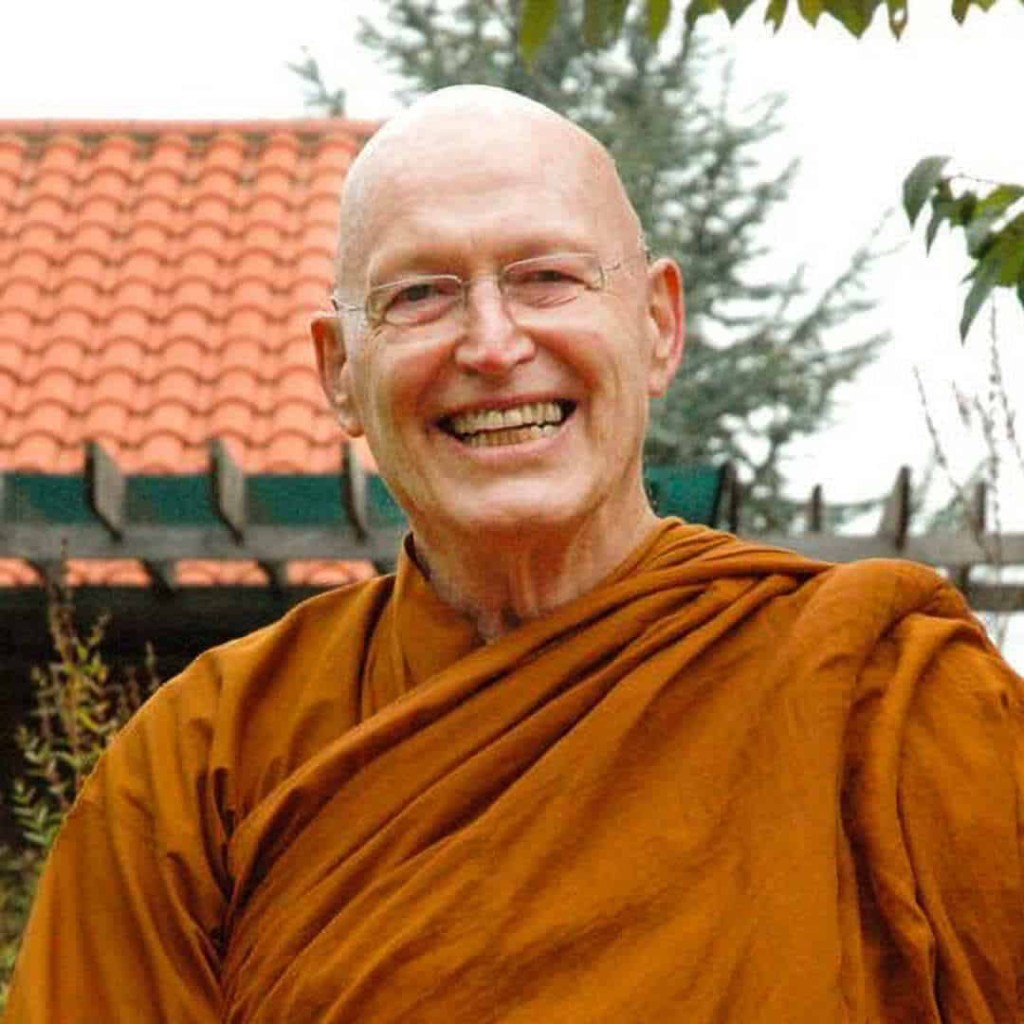
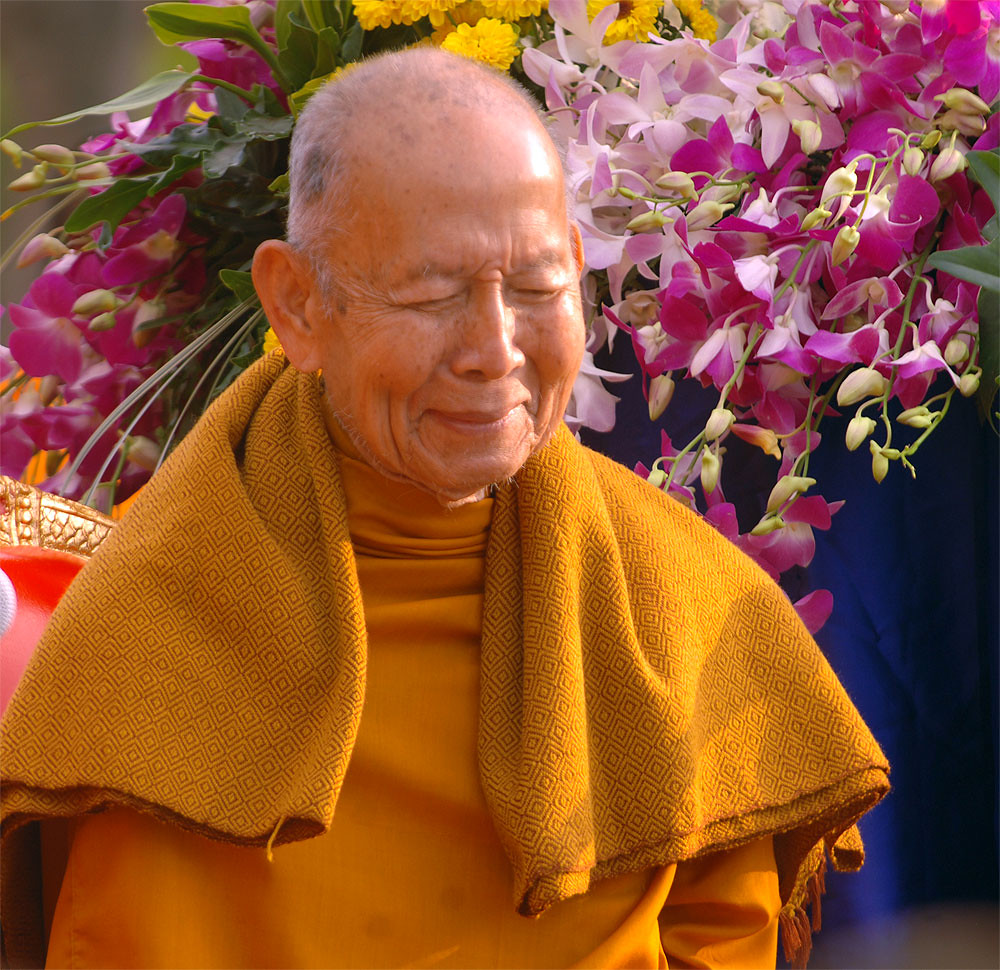
Ajahn Sumedho, the American-born Buddhist monk and disciple of Thailand’s Ajahn Chah, was already a remarkable figure when I attended retreats and Sunday talks he led at the Amaravati monastery in Great Gaddesden during the early 1980s. What struck me most was his equanimity. Not solemnity – he had a great sense of humour – but he emanated a peaceful stillness which, in my 20s, I aspired to without much of a clue how to find it.
About ten years earlier, during his sixth year as a monk in Thailand, he had gone looking for ideal conditions in which to practise, away from the noise and interruptions that disturbed his meditation. He found an island, caves, silence and isolation, and was already thinking about somewhere even more remote when an infected foot forced him to return to ‘civilisation’.
Later he wrote: “I contemplated my greed for peace. And I did not seek tranquillity anymore”.
Without knowing the story, the line loses most of its meaning. The point is that he had realised he was not simply enjoying peace. He wanted it, needed it, and had begun arranging his life to preserve it, resenting whatever disturbed it. The search for tranquillity had become another form of attachment. There is something of Hesse’s Siddhartha in that: the young ascetic looking down on people still entangled in money, status, pleasure, grief, family, loss, love – all the messy business of being human – only to discover later that renunciation can feed the ego just as easily as possession.
During the Samana period Siddhartha looks with contempt on the whole machinery of worldly existence: merchants trading, princes hunting, mourners grieving, prostitutes working, doctors tending the sick, lovers loving, mothers nursing children. To him it all seems false, transient, corrupt, almost beneath notice. Later, even after entering worldly life himself, he still regards people as “childlike”, absurdly consumed by money, pleasure, status, family, anxiety and small disappointments.
Hesse, Siddhartha
I asked Sumedho during one of those retreats how a lay person could possibly achieve the kind of equanimity he had, while dealing with family, work and all the complications of ordinary life.
He smiled. He was always smiling. Who was he, he said, living quietly as a monk in an ordered monastic community, to advise me, with all the trials and tribulations of family life, on how to achieve equanimity? I would find my own path.
Over four decades many memories fade, but his words and thoughts will always stay with me.
As a 20-something year old, I was rather in awe of him then. Watching him on YouTube four decades on, still giving talks from Amaravati in his nineties, my respect has grown. There is an extraordinary depth in both the story of the cave and the answer he gave me… but perhaps even that admiration needs to go.
For years I thought the question was how one reached that state of equanimity. It wasn’t. The desire to attain it was the problem.
And after all the philosophy, meditation, searching, and the ordinary battering of life, the answer turns out to be two words which are much easier to understand than to live.
Procrastination has had a bad press for far too long. People who delay answering emails, leave paperwork untouched for several weeks, stare thoughtfully at an overflowing laundry basket or decide that the garden can probably survive another day are accused of laziness, disorganisation and poor self-discipline, when in fact they are often doing something far more sensible: conserving energy.
Procrastinertia: from pro, meaning ‘forward’, cras, meaning ‘tomorrow’, and inertia, meaning inactivity: the strategic conservation of personal energy for a more urgent task that may arise unexpectedly, thereby rendering all current tasks temporarily inadvisable.
From this follows procrastinertialism, the general philosophical principle that both physical and mental energy are finite and should not be squandered on things that possibly need doing now when something more important may turn up later. What looks like idleness is really the maintenance of reserve capacity. The technical term for this is the Strategic Energy Reserve, or S.E.R.
The logic is obvious enough. Suppose that at ten o’clock in the morning you consider cleaning the kitchen. The kitchen needs cleaning and you are perfectly capable of doing it, but that tells you nothing about what may happen at eleven. You may need to find an important document, drive somewhere, deal with a leaking pipe, take the dog to the vet or spend forty-five minutes trying to remember a password you last used in 2019. If you have already expended perfectly good energy cleaning the kitchen, you are starting the real emergency at a disadvantage, so the more sensible course is to leave the kitchen alone and preserve your S.E.R.
That is not avoidance so much as preparedness, and if no emergency occurs, the decision is not thereby invalidated. A fire extinguisher is not judged useless because the house failed to burn down, and much the same principle can be applied to three hours spent on the sofa.
Do not confuse procrastinertia with laziness. Laziness is not wanting to make the effort, whereas procrastinertia is saving the effort for when it matters. Lazy people slouch on the sofa because they can’t be bothered to mow the lawn; procrastinertialists repose strategically on the sofa because mowing the lawn would reduce the energy available for a more pressing demand later. If that pressing demand turns out to be making a cuppa, the system has still worked exactly as intended.
Deadlines are an area where the whole subject becomes interesting, because they have somehow acquired a status they do not deserve. They are treated as fixed points in time when in reality many are elastic, negotiable or simply optimistic. They move, they are extended, they are forgotten, somebody else misses theirs first, and the person who said on Monday that they absolutely must have something by Friday quite often discovers by Friday afternoon that the following Monday will do just as well.
This gives us the Principle of Deadline Elasticity, according to which no deadline should be treated as final until somebody has tested whether it is movable. There are a few irritating exceptions, such as court appointments or French restaurants that stop serving lunch at 2pm and refuse to feed you again before 7pm. But most of real life is far less rigid. Forms come with reminders, appointments can be moved, editors extend copy dates and administrative deadlines regularly turn out to have more give in them than the wording suggests.
Finishing something early is therefore simply premature energy expenditure. The correct time to act is when urgency and inflexibility finally coincide, because before that point the energy is better kept in reserve. Once that point arrives, quite extraordinary amounts of previously unavailable energy suddenly appear, which explains why something that has resisted attention for six months can be completed in one furious burst late on the final evening. This clearly demonstrates that it would have been utterly wasteful spending ten times as long fretting over the task before.
As urgency increases, several previously separate tasks may eventually converge into one highly productive burst, particularly before a holiday, a tax deadline, the arrival of guests or any occasion involving somebody likely to notice the state of the bathroom. Drawers are emptied, emails are answered, floors are cleaned, forms are submitted and objects that have occupied the same surface for eleven months suddenly acquire a proper home. The important point remains that none of this activity was required earlier, because earlier it was not urgent.
Procrastinertialism is therefore not an excuse for doing nothing, but a system for refusing to do things before they have made a convincing case for themselves. Energy is conserved, deadlines are tested, urgency is allowed to develop naturally, and action begins only when reality has finally removed the option of postponement, which is surely a far more sensible arrangement than exhausting yourself in advance for reasons that may later turn out not to have mattered at all.
If you haven’t got a round tuit, they’re available on Etsy
I regularly watch Mehdi Hasan on his Zeteo channel. I have always admired him. He is quick-witted, combative, incisive, formidably well informed and, at his best, almost impossible to evade. He has a particular gift for pinning politicians to facts when they would much rather disappear into rhetoric, and for spotting the evasions, sleights of hand and carefully constructed non-answers that so many interviewers simply let pass.
And yet, whenever one of his debates pops up in my feed, irrespective of context, one exchange with Richard Dawkins comes back to me uninvited. Dawkins asked whether he believed that Mohammed had gone to heaven on a winged horse, adding that he would do Hasan “the compliment” of assuming that he did not. Hasan replied that indeed he did: he believed in miracles.
That answer has bothered me ever since, not because I find the broad idea that there may be something beyond our present understanding inherently absurd. Quite the opposite. The mystery of existence is so vast that I find certainty itself faintly ridiculous. Why there is something rather than nothing; why there are laws of physics at all; why consciousness exists; whether our universe is one among many; whether the word ‘before’ even has any meaning when discussing its origins. These are mysteries that reduce us to the magnificently insignificant creatures we are, and I rather like that feeling.
What I cannot understand is how one gets from there to a God who, despite presiding over an incomprehensible cosmos, apparently takes a peculiar interest in foreskins, masturbation, homosexuality, what women wear, who sleeps with whom, what we eat and when we eat it; a God whose supposed wishes have been invoked at various times to regulate slavery, sanction slaughter and, in some religious traditions, justify female genital mutilation, while His representatives on Earth claim divine authority to determine whether we are worshipping Him in precisely the approved manner. That is quite a leap.
The problem, for me, is not some vague deistic notion that there might be an originating intelligence, principle or dimension beyond our comprehension. One can speculate about such things without claiming to know much about them, or indeed anything at all. The problem begins when wonder becomes revelation, revelation becomes doctrine, doctrine becomes certainty, and certainty becomes power. Something deeply human and, in its original form, rather beautiful has then mutated into something else entirely.
I have used the analogy of a cancerous tumour before, and I mean it. Not because wonder itself is diseased, but because organised religion grew out of that wonder, fed on our fear and learned to exploit it, while slowly consuming its own host. The mystery that gave birth to religion was gradually diminished by the absolutist answers it claimed to possess, until wonder itself became a pale shadow of what it had been.
Christopher Hitchens caught the authoritarian absurdity rather neatly when he described the prospect as a “celestial North Korea”. And perhaps more ludicrously, given the unimaginable expanse of space and time, with our universe itself perhaps only one among innumerable others, we still somehow manage to cast this tiny, insignificant species of ours in the starring role of the cosmic drama.
Once that certainty hardens into doctrine, the consequences can become grotesque. An ordinary political enemy can at least be negotiated with; an infidel, apostate or heretic is something else. Once human conflict is given cosmic authority, murder can be renamed righteousness. History is littered with people persecuted, expelled, enslaved or killed because they had the misfortune to worship the wrong God, worship the ‘right’ God incorrectly, or worship no God at all.
The breathtaking part is that mutually incompatible religions have all managed to arrive at much the same certainty. I usually remain quiet, but faced with the more persistent believers who attempt to preach at me, I raise the argument from religious diversity, or more bluntly the argument from geography: had you been born somewhere else, there is a very good chance you would be defending a different revelation with exactly the same degree of certainty…
“You do realise that if fate had arranged for you to be born in New Delhi, Riyadh, Uzbekistan, Salt Lake City or the Philippines, you probably would now be standing there bombarding me with ‘facts’ based upon the incontrovertible truths contained in the sacred texts of a completely different religious tradition? Same confidence, same sincerity, different revelation”.
I have tried roughly that argument on Jehovah’s Witnesses more than once. One pair called at the house when I was at a particularly low ebb, finding me in no mood to smile politely and accept a leaflet. Their certainty has always fascinated me vastly more than whatever it was they had actually come to tell me. I try to get them to accept that, had they been deposited at birth into another family, another country and another religious culture, the chances are overwhelmingly in favour of their turning up at somebody else’s door years later with an entirely different collection of incontrovertible truths. At about this point an almost physically perceptible mist tends to sweep across the eyes, followed soon after by disengagement.
This reaction has changed remarkably little over the years. One freezing evening in late 1975, standing in the doorway of my room in ‘L’ Block at the UEA residences in Fifers Lane, Norwich, I had been conducting much the same discussion with some Christian evangelists, while becoming increasingly irritated by the amount of precious heat escaping into the corridor. Eventually my visitors gave up. As I closed the door on their retreating backs, I heard one say to the other, with magnificent condescension: “He’s lost…”
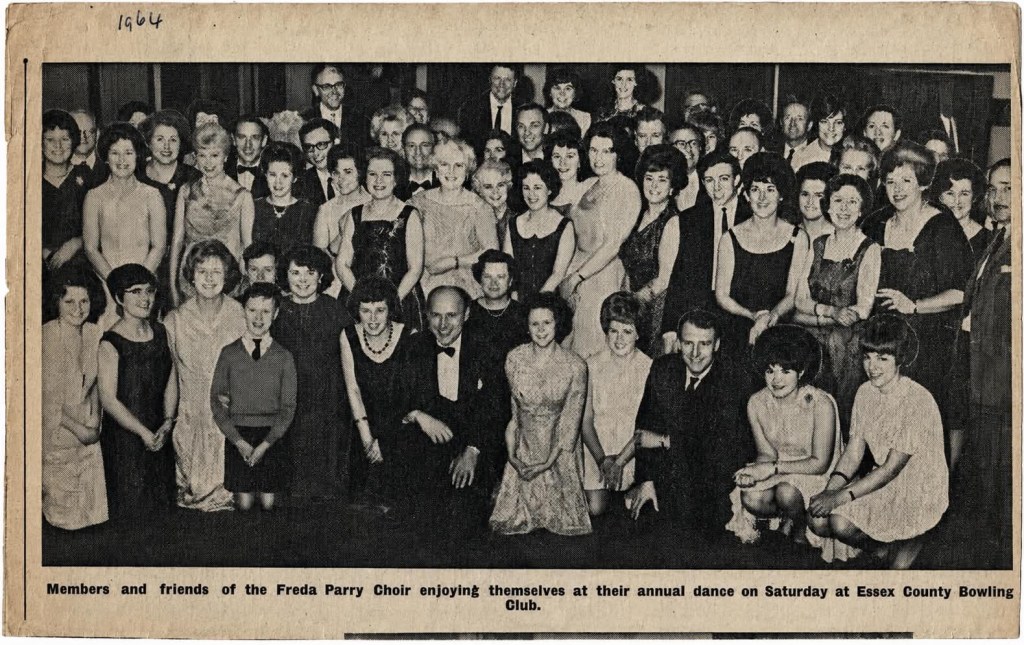
The Freda Parry Choir annual dance, Essex County Bowling Club, 1964. Me, aged eight, at the front, with Madame Freda Parry OBE immediately behind me, her hand tucked protectively under my right arm.
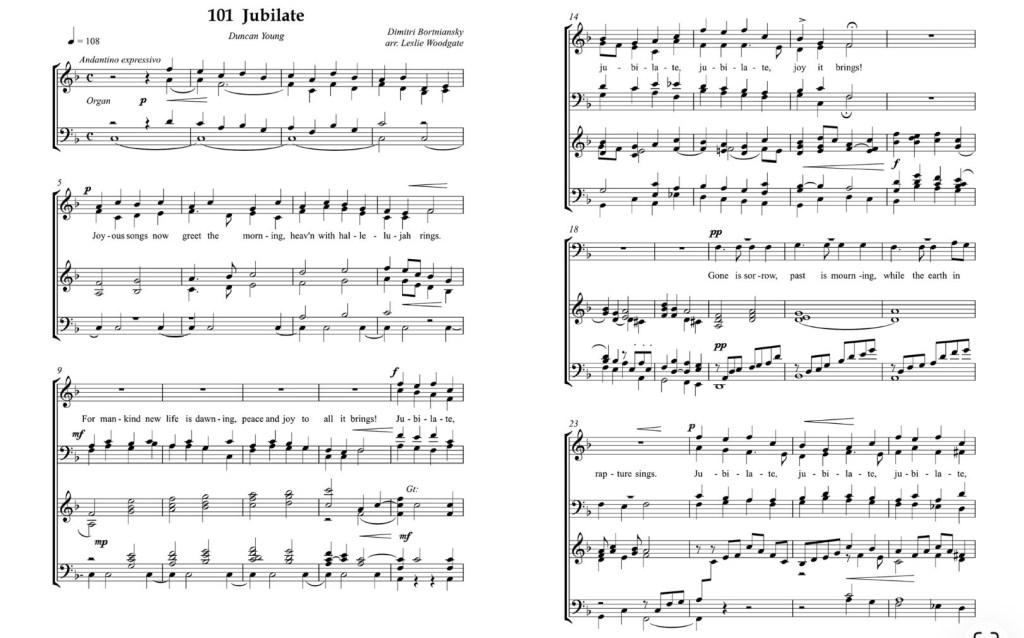
Yet none of this came from growing up outside religion and looking in. Quite the reverse. Mine was a thoroughly Church of England childhood: Sunday services twice, choir plus twice-weekly choir practice. Saturday mornings took me to Crusaders meetings – an evangelical Christian youth movement which, unsurprisingly, has since decided that the name needed a little twenty-first-century attention and now calls itself Urban Saints. Memories of my grandmother saying grace before Sunday lunch. I became head choirboy[1] at St Barnabas in Hadleigh and sang with Madame Freda Parry OBE’s Parry Singers in Southend-on-Sea. I can still remember the ridiculous pride I felt singing the descant to the Hallelujah Chorus above all those grown-up voices. I was sent around retirement homes to give my rendition of Jubilate — minus the organ — together with other mostly religious offerings, all performed entirely without reflection. I have not looked at the score of Jubilate for fifty-seven years, but I can still sing it and remember the words. Such is the power of indoctrination at an early age. The old Jesuit maxim comes rather uncomfortably to mind: ‘Give me the child until he is seven and I will give you the man’. In my case they failed to get the man, but they certainly did a remarkably durable job on the soundtrack. The falsetto top notes are another matter: what was once a top A now seems to have negotiated itself down to somewhere around E-flat, while my perfect pitch has evolved into perfectly out-of-tune pitch. I also remember the faces of the old people in those retirement homes, people who seemed impossibly ancient to me then. I am now among their number.
So religion was not some external doctrine being forced upon a naturally sceptical child. It was simply part of the architecture of my world. We moved to Harrogate when I was thirteen. I soon recovered my status as head choirboy, this time at St Luke’s. Yet barely a year later my whole belief structure collapsed.
It happened during a Sunday evening service while I was singing a psalm. I remember the book in my hands, the separately printed sheet of musical notation and, with extraordinary clarity, looking at the words beneath it and suddenly thinking that they were not merely questionable but absurd. Nonsensical. I stopped singing; before long a few people around me noticed, and on the way out I was asked whether I was unwell. I muttered something incoherent and escaped home.
Then it all came flooding out to my parents. The whole thing was ludicrous. They tried to reason with me, but every attempt merely exposed another fault line, and within days my newly discovered thirteen-year-old scepticism had arrived at what seemed to me the fundamental circularity: this ancient book was true because it was divinely inspired, while we knew it was divinely inspired because the book and the religion built around it told us so.
There was also the problem of evil. Why would a compassionate God permit the suffering of innocents? Why would an all-powerful Father stand by while children suffered? The vicar came round a few days later and specifically explained to me that “God moves in mysterious ways”. It was precisely the answer I did not need to hear. He tried to talk me back into the spiritual home I had so abruptly vacated, but by then it was too late. The previous Sunday had been the last time I would ever enter a church as a believer.
I do not remember emerging from this at thirteen with some triumphant conviction that I had solved the mystery of existence and proved there was no God. I had done nothing of the kind. Quite the opposite: something foundational had been demolished almost overnight, and the experience was deeply unsettling rather than liberating. The beliefs themselves went, but with them went a large part of the framework through which I had understood the world, and some of the trust I had placed in the people who had helped construct it. My parents had acted lovingly and sincerely, but they had also played a major role in teaching me, as truth, a complete account of reality long before I had the intellectual equipment to examine it properly.
Looking back, I cannot entirely separate that experience from what now seems to me a darker question about the religious indoctrination of children. I know that describing it as something approaching psychological abuse will sound extreme to many people, but that is how it feels to me from the inside. A child is told who created him, what happens after death, which behaviours are sinful, which doubts are dangerous and what eternal consequences may follow from getting any of it wrong. None of this is presented as one possible interpretation among many; it is presented as truth by the adults upon whom the child depends for his understanding of the world. When that structure later failed to survive examination, there was no epiphany, no triumphant victory of reason over superstition, only loss, disorientation and the discovery that something I had trusted absolutely was no longer trustworthy. Once that had happened, there was no easy way of putting it back.
Which perhaps explains why, more than half a century later, Hasan’s winged horse still gets under my skin. Here is a man I admire precisely because he applies ruthless scepticism to unsupported claims, notices contradictions, demands evidence and refuses to let clever people disappear into rhetorical fog; and yet when Dawkins asks whether he literally believes Mohammed went to heaven on a winged horse, Hasan says yes. No explanation required. Mohammed, apparently, moves in mysterious ways too.
What disappointed me even more was what came afterwards. A few weeks later, Hasan returned directly to the exchange in a New Statesman article (non-paywalled access) which began with Dawkins’s winged-horse question and set out his defence of belief in God, miracles and revelation. Nor was I alone in finding the apparent contradiction jarring. As the exchange spread online, Dawkins himself eventually put the problem to Hasan in almost exactly those terms: why, he asked, should religious beliefs be “uniquely exempt from the critical eye which you deploy everywhere else in your journalism?”
That, precisely, is what bothers me. Hasan’s longer answer seemed to do exactly what I have watched him stop politicians doing for years: move away from the narrow, awkward proposition towards broader and much safer ground. Dawkins had not asked whether some conception of God could be defended philosophically, whether the universe required explanation or whether miracles were logically possible. He had asked whether Hasan genuinely believed that Mohammed had gone to heaven on a winged horse. Hasan’s answer was yes. None of the broader arguments seemed to me to answer the obvious next question: why believe that particular event actually happened?
Much of the discussion that followed managed the same evasive shift, wandering off into scientism, atheist fundamentalism, prejudice against religion and the philosophical possibility of God. All interesting questions, perhaps, but none of them answered the one Dawkins had actually exposed: why believe that this particular miraculous journey happened? Somewhere along the way, the horse quietly left the room.
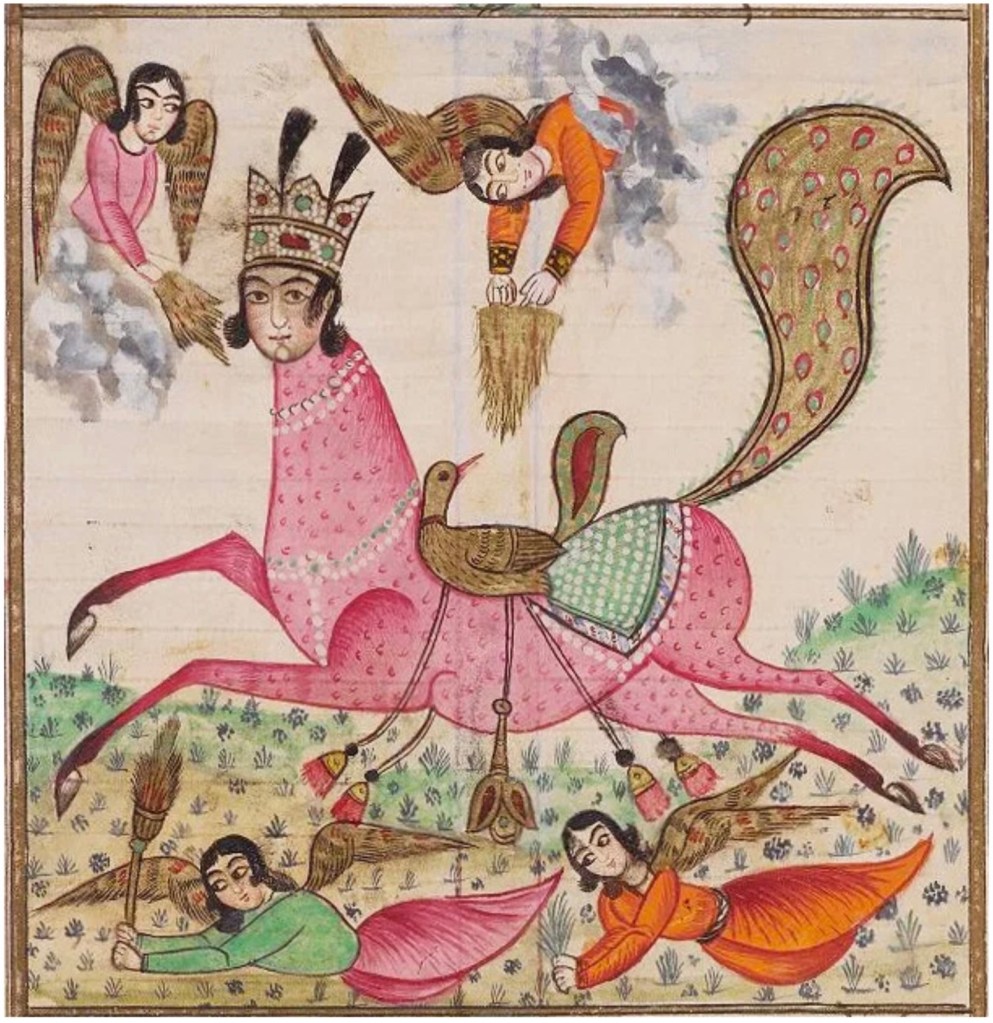
There is a certain irony in the fact that historical Islamic art sometimes depicted Mohammed riding Buraq quite openly, while a modern image search for the creature tends to leave its most important passenger discreetly out of the picture. Plenty of Buraq, remarkably little Mohammed. The miraculous journey may be accepted as literal; in certain Islamic traditions, illustrating the passenger is where one begins wandering towards haram.
Al-Buraq, c. 1770. Deccan painting, anonymous. National Museum, New Delhi. Public domain. Minus its most famous passenger.
All of which leads to an irresistible thought: I would dearly love to watch Mehdi Hasan interview Mehdi Hasan on the subject. The interviewer Hasan would surely be on him within seconds. “That wasn’t my question”. “You’re changing the subject”. “What is your evidence for this specific claim?” “Isn’t that circular?” And if interviewee Hasan tried to retreat into the existence of God, revelation or the philosophical possibility of miracles, interviewer Hasan would surely cut him off and drag him straight back to the horse. Now that really would be worth watching.
And this is why simply explaining cognitive dissonance to me does not resolve anything. I understand perfectly well that intelligent people compartmentalise beliefs, protect things bound up with identity and subject different parts of their worldview to different evidential standards. I understand how the exemption gets there. What I cannot understand is why anyone genuinely committed to understanding reality would knowingly continue granting it.
Faced with the mystery of existence, I want to understand, within the obvious constraints imposed upon me, as much as I possibly can. I do not need certainty. I need to know what can be known, and to recognise what cannot. If some cherished belief, comforting story, inherited tradition or flattering opinion of myself gets in the way, I would rather lose the belief than accommodate the contradiction.
The mystery itself deserves better than the answers we have invented for it. I would rather stand in awe before what I do not understand than fill the void with answers inherited by geographical accident and then call them truth.
[1] By 1967 or 1968 I had worked my way through the RSCM Chorister Training Scheme to the red ribbon, then its highest grade. I had something of a head start: my mother taught music and ran the school choir, while I had been having private singing and piano lessons from an early age. Music, in other words, was simply part of childhood.
I was watching one of my favourite journalists Mehdi Hasan of Zeteo the other day in discussion with the Pakistani-American writer and political commentator Wajahat Ali, when they wandered off on an amusing tangent about racism, cleanliness and the curious habit racists have of describing whichever nationality, race or religion happens to be on the receiving end as “dirty”.
Ali was talking about American white supremacists, the KKK and Patriot Front, and their belief that they represent some sort of “master race”. “They say you’re dirty Indians,” he said, before happily accepting the insult ‘for the sake of argument’: “So, say I’m a dirty Indian even though I’m Pakistani-American. But okay, we’re all dirty. We’re all filthy, right?” Then came his rather more interesting challenge to the master race: “My one question… do you wash your ass?”
The answer, he suggested, was no. “If you don’t wash your ass, but we’re the dirty ones…” at which point the logic rather speaks for itself. “You cannot be the master race,” he continued. “Come back to me with a clean ass and then I’ll entertain your argument.”
Hasan agreed there was “a pure logic to it”, recalling a white man he’d seen on Twitter making much the same point about the French bidet: if you had shit on your arm, would you simply wipe it off with a piece of toilet paper? Of course you wouldn’t. You would wash it. Yet when faeces come into contact with that other part of the anatomy, a quick wipe around with dry paper apparently does the trick.
This struck a chord, not least because after years of living in France with bidets, followed by Thailand, with bum guns, I now find the idea of not thoroughly washing after a number two pretty disgusting. I don’t mean that I have carefully considered the relative merits of the two systems and concluded that washing is preferable. I mean that the idea of wiping with dry toilet paper, pulling trousers up and walking away genuinely feels unsanitary. For those occasions when washing may not be possible, I carry a pack of unscented hypoallergenic or baby wipes. I don’t particularly need my arse to smell of roses, but I do prefer it to be clean.
There was also something strangely familiar about the whole discussion, and after a little digging through my memory archives, I recalled an old blog I wrote while living in Thailand. Back on October 28th 2008 I had written a piece called Clean Thais, Smelly Foreign ‘Farangs’…, and apparently I had already been exercised by pretty much the same topic. Not only that, but I had devoted a substantial part of the article to what amounted to an instruction manual for using a sai chit gon, the Thai bum gun, including advice about water pressure, firing range, sun-heated plumbing and the inadvisability of mistaking the apparatus for an enema. So rather than pretend these are entirely new thoughts, much of what follows is what I wrote then, with the benefit of another decade living in Thailand and a little more knowledge about just how culturally peculiar our ideas of cleanliness can be…
Visitors to Thailand from so-called “civilisation” will have heeded all the dire warnings about not drinking the tap water, dengue fever and various other scary diseases, nasty tropical parasites, and usually come equipped with enough pharmaceuticals to stock a small chemist’s. They will have heard the stories about squalid third- and developing-world shanty towns, with rudimentary sanitary systems. Strangely though, it is the Thai who tends to look upon the farang, the white foreigner, as more often than not unclean.
Of course the average Thai would never be so rude as to say so, particularly to the person concerned. But when you have more than a smattering of Thai, their good-natured, slightly embarrassed banter about these strange white giants from afar can be very revealing.
A practice attributed to white foreigners by Thais that I’d hear referred to as the “farang shower” was a case in point. Perspiring, middle-aged, overweight North American, British, Australian, Russian and some European males were as a result the object of considerable humour. Unfortunately the farang shower, the application of copious quantities of expensive aftershave in lieu of actually having a real shower, isn’t always enough to disguise the fact that many do, in fact, well… not to put too fine a point upon it… stink.
Thais generally seem to smell of remarkably little, although Thai women, when they can afford it, will of course happily use perfume as well. Clean-shaven and spotless, no matter what their station in life, they somehow manage to maintain a level of personal hygiene that puts many Western visitors and self-styled ‘expats’ to shame. Much of it boils down to necessity; a tropical climate with invariably high humidity encourages the proliferation of all manner of unfriendly and aggressive microscopic creatures, and if you are foolish enough not to keep scrupulously clean, you are asking for trouble. Frequent showers aren’t regarded as some particularly admirable display of personal hygiene. They are simply part of everyday life.
And “shower” doesn’t necessarily mean a shower in the Western sense. I’ve been in plenty of rural Thai washing outhouses, and even some massage establishments in towns, where there was no electric shower at all, merely a large barrel of water with a wooden or plastic ladle, bowl or whatever other suitable container happened to be floating in it. You simply scoop up the water and pour it over yourself, repeatedly, which does the job perfectly well and has the considerable technological advantage of continuing to function during a power cut. Thai bathrooms are designed for water anyway, with tiled floors and a drain in the corner, so nobody worries about splashing it everywhere. The only slight drawback is that, despite Thailand’s reputation for heat, tipping the first ladleful of unheated water over yourself can occasionally produce a surprisingly rapid intake of breath.
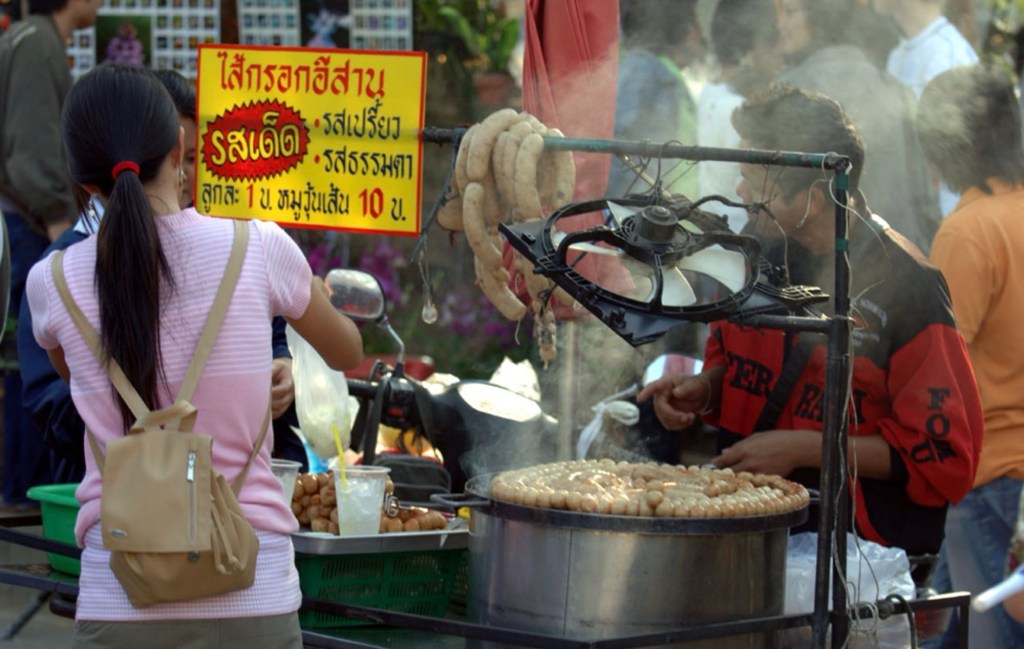
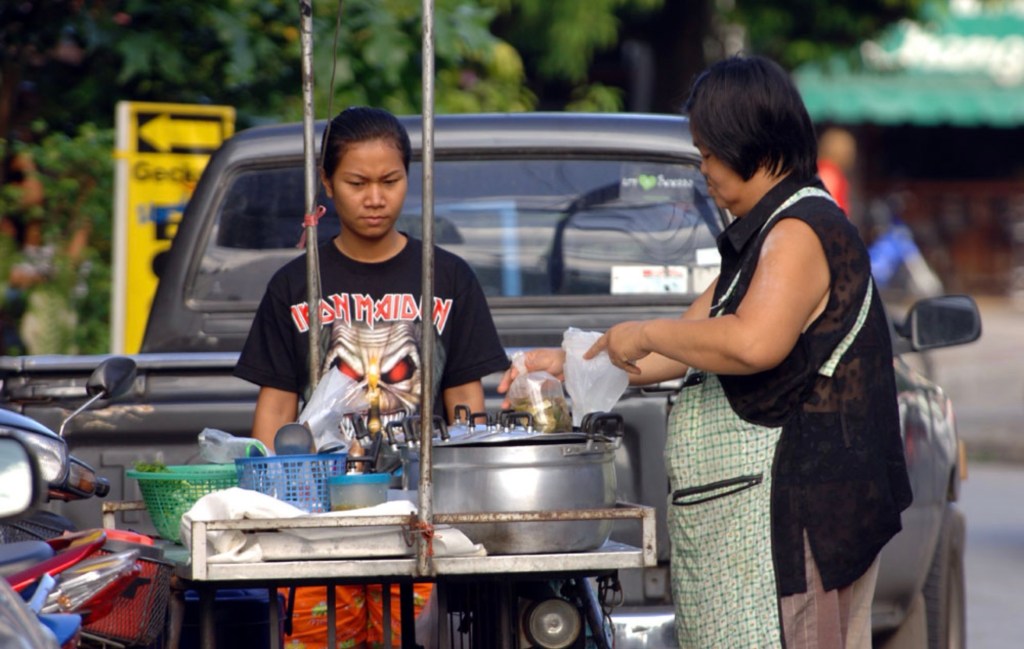
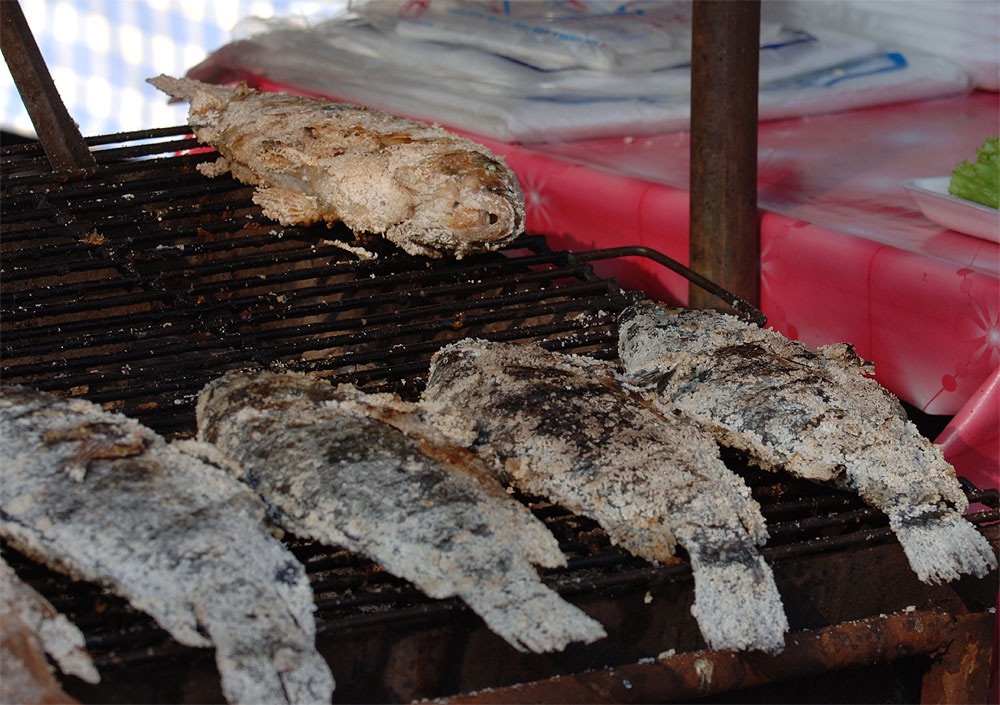
I originally wandered off at this point into food hygiene, and on rereading it I see no particular reason not to do so again, because it was another example of the same assumption working in reverse. Vendors with cooking pots brimming with unrecognisable and strange, spicy-smelling concoctions lined the streets day and night, and many farang tourists gave them a wide berth, preferring the more familiar restaurants and those selling European-style cuisine. Big mistake. The reason those street sellers were so numerous was because Thais bought from them constantly. They were busy, their turnover was rapid, and ingredients didn’t generally hang around for very long before being cooked and sold.
Some Westernised restaurants, on the other hand, attempted to maintain an expensive range of dishes they couldn’t possibly dispose of quickly enough to their rather infrequent patrons, giving those aforementioned microscopic creatures plenty of time to get to work in the tropical climate. As I discovered to my cost in a Chiang Mai English pub/restaurant the night before writing the original article.
The garlicky sauce disguised both the smell and peculiar colour of the flesh, but one bite of the fish fillet was enough. To say it had “gone off” didn’t begin to do its level of putrefaction justice. It had decayed, rotted, decomposed, and was weeks overdue for burial. Or preferably cremation, to avoid poisoning the water table.
I didn’t point the finger at the establishment then and won’t now, despite the English boss eventually managing a reluctant, “Oh well, it can happen, you know”. (Pythonesque visions of John Cleese and Michael Palin resurrecting the parrot sketch…)
“This fish has gone off”. “No it hasn’t. It’s still there. It couldn’t have gone anywhere anyway. It was frozen”.“I am not suggesting it made a bid for freedom. I am suggesting that at some point, possibly before it was frozen, it ceased to be suitable for human consumption”. “Well, it looks ok to me”.“It smells!” “Smells a bit fishy. That’s normal for a fish”.“This doesn’t just smell of fish! This smells of fish whose next of kin should have been notified some time ago”. “That’ll be the garlic”…“The garlic is performing an act of public service! Without it, your neighbours would already have called in pest control”. “It was fresh when it was frozen”.“When was that?” “Recently”.“Recently as measured by whom? A geologist?” “Look, perhaps it’s a little past its best”..“Past its best? It has swum serenely past its best, left its eat-by date somewhere in the Mariana Trench; even sharks would swim an extra mile to avoid it!”“Oh well, it can happen, you know. Have a steak and kidney pie. It’s on the house”…
Thanks, but no thanks. Having established the establishment’s approach to freshness, I wasn’t sufficiently adventurous to investigate the state of the cow’s innards as well, so I left and bought a delicious dish of moo daeng (sliced pork marinated in spices, soy sauce, then grilled or roasted) from a nearby street vendor.
[Edit: just checked the map, and the establishment on the north stretch of the moat no longer exists. Somewhat unsurprisingly, and perhaps fortunately, for Chiang Mai residents and visitors]…
But enough about decomposing fish. Back to human cleanliness, or the lack of it, with feet being one important source of the problem according to inside information from a selection of Thai friends.
Maybe it is something to do with Westerners’ greater average height, or possibly the inability of many to see these extremities at all, the view of which can be obstructed by large fleshy beer- or hamburger-induced pot-shaped bellies. Perhaps it is due to a complete lack of fitness and flexibility, as a result of which they are simply unattainable. Or in vain ignorance, maybe some believe that by pointing the shower in that general direction for a quick blast, despite the fact that soon-to-be-ingrowing toenails provide perfectly sheltered accommodation for all manner of rapidly breeding micro-organisms, they are achieving a satisfactory level of cleanliness. Another problem is that Western feet may be so far away that their owners can’t actually smell them themselves… or perhaps they have simply become so accustomed to the odour that they no longer notice it. It doesn’t help that tourists newly arrived in the tropical climate often insist on wearing both shoes and socks, so that even the most thorough morning scrubbing can be undone within an hour as their feet begin to perspire profusely and the bugs joyfully return.
In 2008 I wrote, with an entirely spurious degree of statistical confidence, that I had it on good authority from street masseuses that the feet of nine out of ten European and American men smelled pretty rank, while women could relax a little because apparently only five out of ten pairs of theirs were similarly offensive. I doubt any of my informants had been keeping spreadsheets, so I wouldn’t attach too much scientific importance to the percentages, but what is interesting in retrospect is that another ten years of living in Thailand did absolutely nothing to make me doubt the underlying observation.
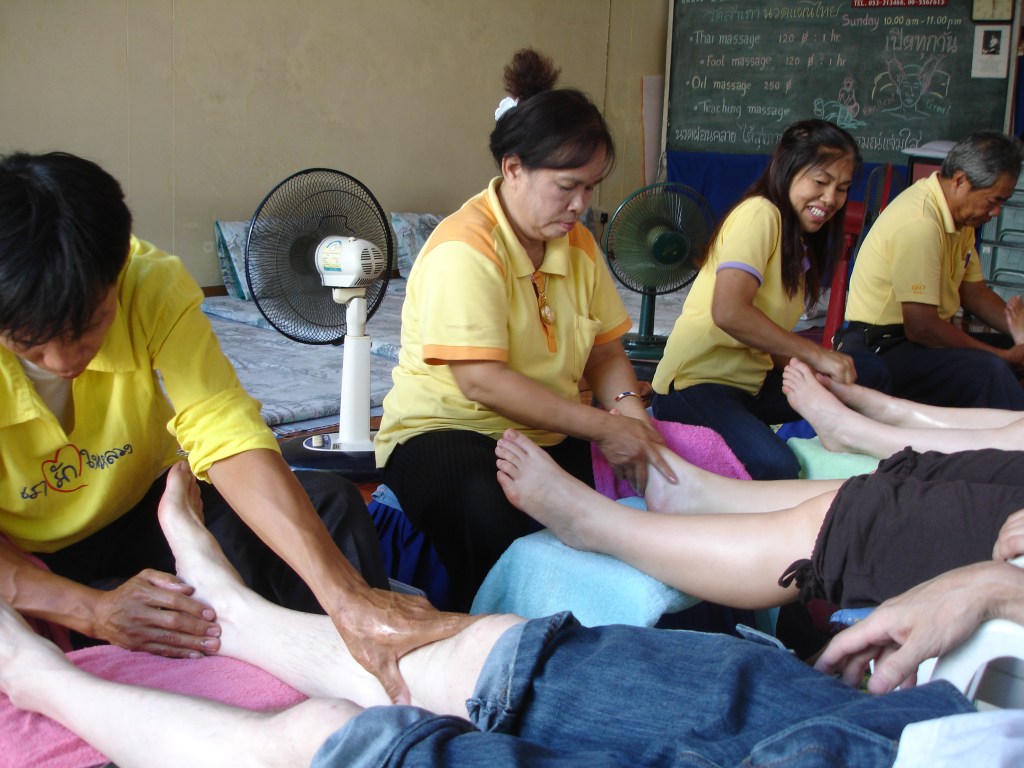
In fact, quite the reverse. I had massages virtually every day for those years, which sounds spectacularly decadent until you remember that an hour cost around €5, and I had a manicure and pedicure roughly twice a month, generally for €8–10 for the pair. At those prices, doing it yourself seemed less an admirable display of self-reliance than an inexplicable decision to deprive somebody of an income while making a considerably worse job of your own toenails. Consequently I spent an absurd number of hours over the years sitting or lying around while Thai masseuses, manicurists and pedicurists talked amongst themselves, and cleanliness, particularly the cleanliness of farangs, came up often enough for me to know that I hadn’t imagined it.
I could see the difference for myself as well. Thai customers generally arrived with feet which were already washed and looked after, whereas a surprising number of Western customers, by no means all elderly or overweight, plainly hadn’t given theirs the same attention.
The staff wouldn’t normally dream of telling an unfamiliar foreign customer this, of course, because deliberately embarrassing somebody runs contrary to the Thai instinct to avoid causing loss of face. But in places where I became a long-standing regular, once the staff knew me well enough and, more importantly, knew that I wasn’t going to become offended on behalf of Western civilisation if they suggested that some farangs were less than fragrant, they didn’t hold back. After ten years of listening to the people who actually had to sit inches away from the evidence, I wasn’t inclined to argue.
But now I have to move on to a more sensitive subject, still related to cleanliness, or the lack of it.
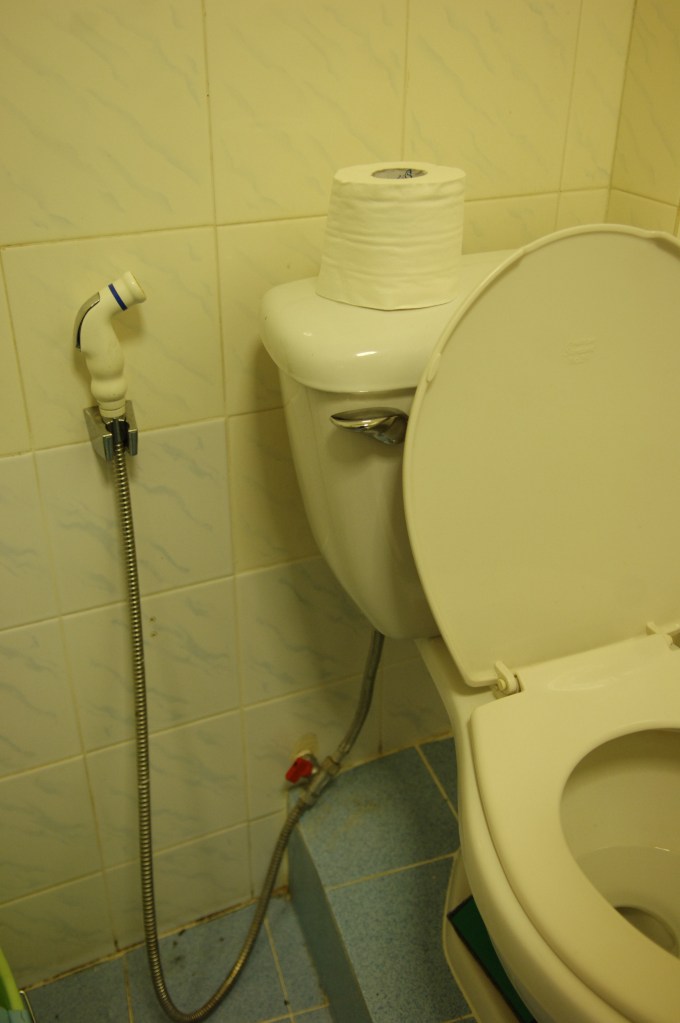
When you visit Thailand for the first time, you may be surprised to find something that resembles a shower hose, complete with high-pressure nozzle, attached to the wall of the bathroom next to the toilet. You would be excused for wondering what purpose this could possibly serve.
The little lever or button is indeed for releasing a powerful jet of water, so should you be tempted to experiment as you meditate from a sitting-down position, make sure to point the device at a distant wall. Nearby targets tend to have a ricochet effect and are likely to result in you emerging from your contemplations looking as if you forgot to get undressed before taking a shower. And it goes without saying that you shouldn’t squeeze the lever while looking directly into the nozzle.
The main purpose of this device is to avoid having to apply reams of toilet paper to the posterior, with potentially rather smelly consequences. Used with skill, posterior showering while sitting down takes some mastery and, to avoid embarrassment, is best practised within the safety of your hotel bathroom until you get the hang of it, but it is a vast improvement on the toilet-paper alternative. For obvious reasons it results in the sort of rear-end cleanliness I had previously encountered in France with the bidet.
A few tips for the uninitiated.
In unfamiliar surroundings it may be worth first testing the water pressure with a quick single downward burst into the toilet bowl. Excessively powerful jets can have undesirable effects, so do this before spending a penny, rather than afterwards when it may be rather too late to reconsider the wisdom of the exercise. Having established that the apparatus isn’t capable of removing paint, ensure that you have the nozzle pointing in the right direction; somewhere between an inch and a couple of inches is the correct firing range, and for the sake of those who may visit the bathroom after your departure, do try to avoid actual contact between nozzle and rear passage.
Bear in mind too that Thai plumbing may involve routing cold-water pipes through outside areas exposed to direct sunlight, so during daylight hours be prepared to abort the operation rapidly should the water temperature suddenly begin to climb. What entered the pipe as cold water can have undergone a fairly impressive transformation by the time it reaches the business end. Then, assuming pressure, direction and temperature have all passed inspection, fire.
Please also bear in mind that this is not the Thai version of an enema wash. Consequently a short burst of between five and ten seconds is usually ample, irrespective of any pleasure you might be experiencing. Ladies, of course, have an excuse to use the device rather more frequently than men, but whether your sex lives are wanting or not, and irrespective of whether the sensations involved prove somewhat more exciting than those produced by earlier activities of an intimate nature with your partner, please bear in mind that a growing queue of desperate people may be waiting outside.
Finally, the disposal basket marked with words to the effect of “please place your used toilet paper in here and not in the bowl” is for the benefit of those who have used this implement to good effect, and not an invitation to squeamish Anglo-Saxons to deposit the results of the old-fashioned method in an open basket beside the toilet for subsequent visitors to admire.
I finished that section in 2008 by writing: “Once you’ve got into the habit of using this device, you’ll never want to go back to your old ways, believe me. You’ll be looking around the local plumbing supply outlets for one to take home with you.” Nearly eighteen years later, I can report that the prediction proved entirely accurate.
What I wasn’t aware of when I wrote it was quite how large a proportion of humanity would regard the Thai approach as unremarkable. The bum gun itself is only one manifestation of a practice found across much of Asia, the Middle East and elsewhere, using hoses, sprays, jugs, dippers, bidets and, increasingly, toilets sophisticated enough to do most of the work themselves.
This is where Hasan and Ali’s discussion added something to my old observations that hadn’t occurred to me at the time. In Muslim societies, washing after urination and defecation isn’t merely a Thai-style cultural preference but has deep religious roots. Islamic practice has a name for cleansing oneself after going to the toilet, istinja, and although water isn’t the only permissible means in every circumstance, washing with it has been part of Islamic hygiene for centuries. Across much of the Muslim world a hand spray, jug or other water container beside the toilet is therefore entirely ordinary. Hasan and Ali, both of Pakistani heritage, spent part of their conversation laughing about the lota, the little water vessel familiar across South Asia, and about the improvised alternatives used when one isn’t available. Ali even recalled going to the communal bathroom at university carrying a green watering can.
Hasan supplied an even more revealing little cultural collision. Growing up in America, he said that right up until college he had no idea what people meant by “streaky underwear”. He simply hadn’t encountered the phenomenon. His explanation was wonderfully uncomplicated: when you wash your arse with a lota, “you don’t have these problems.” In other words, he had reached college without becoming acquainted with that evocative little expression familiar to generations of British schoolchildren, the “skid mark”. It is difficult to think of a better illustration of how completely normal one culture’s lavatorial habits can seem until somebody brought up with different ones looks at the consequences and asks the obvious question.
The practice isn’t specifically Muslim either, which makes any attempt to turn this into another competition between civilisations rather pointless. Washing after defecation has long traditions across South Asia, including Hindu ones, and is commonplace across large parts of Southeast Asia. Thailand is predominantly Buddhist, the Philippines has its tabo, Indonesia and Malaysia have their own variations, while Japan took the basic idea that perhaps water might clean a bottom rather better than dry paper and did what Japan sometimes does with simple technology: added heated seats, adjustable jets, dryers and enough controls to make an unsuspecting visitor wonder whether he is about to wash his arse or launch something into orbit.
Europe has its own history. The bidet was invented in France, where I became accustomed to using one long before Thailand, although curiously the French have increasingly removed them from modern bathrooms. Italy has remained considerably more attached to the idea, and the bidet became firmly established in various other countries, notably Argentina. There is no neat religious or racial division here at all; there are simply different cultures which arrived at different definitions of what constitutes being clean after going to the toilet.
Which brings me back to Ali’s “dirty Indians”, and to all the other variations on the same insult. The British “smelly Frog” is a relatively mild and often jokey example, but “dirty”, “filthy” and “smelly” have always been particularly effective ways of denigrating outsiders because disgust is such a powerful human reaction. Dirt and physical contamination slide remarkably easily into ideas of moral contamination; the language itself gives the game away when people talk about dirty thoughts, filthy habits, clean living and moral purity. Colonial powers repeatedly described colonised populations as dirty, diseased or unhygienic, and immigrants and racial or religious minorities have been subjected to much the same language ever since. The foreigner’s food smells peculiar, his house is dirty, his habits are filthy, and from there it is a remarkably short psychological journey to suggesting that the people themselves are somehow contaminating. The accusation is particularly useful because the person making it rarely thinks of his own habits as cultural habits at all; they are simply ‘normal’.
This is the peculiar thing about cleanliness: much of it is learnt rather than objectively examined. If you grow up in Britain using toilet paper, wiping yourself thoroughly after having a shit feels perfectly clean because that is what “finished” has always meant. There is no reason to sit there contemplating whether rubbing faecal matter from skin with pieces of dry paper really represents the pinnacle of sanitary technology, because everyone else does it too. The ritual has been completed, therefore you are clean. Live for long enough somewhere where washing is normal, and the definition changes. Mine certainly did. What once seemed an entirely ordinary British procedure now seems to me physically disgusting, which is why Hasan’s comparison with getting shit on your arm is so effective. If it happened to virtually any other part of the body, nobody would seriously suggest that several passes with dry tissue constituted washing. There is apparently one small area of Anglo-Saxon anatomy where, historically, an exception has been made.
It also makes the largely Anglo-Saxon tradition of “mooning” considerably less appealing. There is something faintly heroic about a culture which not only decided that dry paper was sufficient for cleaning its arses, and coined a familiar expression for what sometimes ends up in the underwear when it isn’t, but subsequently invented a form of comic insult involving pulling down that underwear and presenting the inadequately washed area itself to friends, passing motorists, opposing football supporters and assorted strangers. Viewed from a bum-gun culture, it does rather take some of the gaiety out of the gesture.
None of this proves that Muslims are cleaner than Christians, South Asians cleaner than Britons, Thais cleaner than Americans or Japanese owners of electronic lavatories morally superior to people armed with a roll of Andrex. That would simply replace one stupid cultural stereotype with another, and cleanliness encompasses rather more than what happens after a bowel movement. But there is something irresistibly absurd about calling another people “dirty” while remaining completely unaware that one of your own most intimate everyday habits may strike them as considerably more revolting than anything you imagine about theirs.
Back in 2008 I thought I was writing a mildly irreverent piece about Thai attitudes towards smelly farangs and, for reasons which seemed perfectly reasonable at the time, providing detailed instructions on the safe operation of a bum gun. I didn’t realise that nearly eighteen years later I would listen to two Muslim Americans discussing white supremacists, “dirty Indians” and the rather fundamental problem of claiming to be the master race while apparently neglecting to wash their arses, and discover that the joke contained a rather larger point.
If you get shit on your arm, you wash it. Perhaps before deciding which races, religions or nationalities are dirty, it might be worth considering why the same principle suddenly becomes optional when the shit is on your own arse.
I was 18 and living in France when I first heard Antoine Pol’s poem put to music by Brassens.
Along with Graeme Allwright, Dylan, Moustaki, Cohen and a few others, their words spoke to me, stirred something deep inside. Voices from an impenetrable and cloudy unlived future, beautiful yet disturbing in a way that I could not yet pin down. Hesse’s Siddhartha that same year blew this 18-year-old’s mind, touching the heart of a reality I could sense but had not yet lived.
It is so hard to describe the sensation, other than that I knew that they knew. Without yet knowing myself.
In 1973 I understood the words. I didn’t understand why.
Today, more than 50 years later, understanding and knowing merge into a poignant and painful whole.
I spent a night recently at the Sofitel Le Faubourg in Paris, invited by someone I am very fond of and respect. The hotel is next door to the American Embassy, in that small and polished part of the city where wealth, power, diplomacy and fashion seem to have gathered together for mutual reassurance.
Approaching from Madeleine Métro, I found the road guarded by gendarmes carrying sub-machine guns. It was a suitably symbolic entrance. One crossed an invisible line from ordinary Paris into a world whose buildings, guests and institutions required armed protection.
The hotel itself was beautiful, outwardly discreet and faintly unreal inside. Everything worked. Staff were gracious, almost obsequiously so. Invisible yet omnipresent. Wandering the corridors, the instant I lost my sense of direction I was discretely guided on my way. The lighting softened both the furniture and the guests. People moved through the bar with the ease of those accustomed to being born to be served. Some were probably famous. Others merely possessed the posture, grooming and expense accounts required to make fame seem plausible.
While waiting in the Sofitel bar for my cousins to arrive, I rattled off a message to a friend saying that I could probably buy back L’Eau Salée, my much loved old home that I had lost to dwindling finances, by pawning the jewellery of one of the women in the bar. Humour is often the only available response when reality becomes too surreal to absorb directly. I sipped their cheapest offering on the drinks menu, a glass of Vacqueras white, that would have paid for a three course meal in my local Cavaillon bistrot. With wine.
After dinner we wandered around the surrounding streets. Maxim’s was nearby, as were Hermès and the other great temples of luxury, their windows displaying objects of such distinction that attaching a price to them would presumably have been considered vulgar. If one needed to ask, one had already misunderstood the nature of the establishment. Wealth and glamour adorned and paraded these streets. Owned their soul. I listened in to an utterly serious discussion about which of the latest Lanvin handbags would be secured the following day. A surreptitious Google revealed one went for €3390.
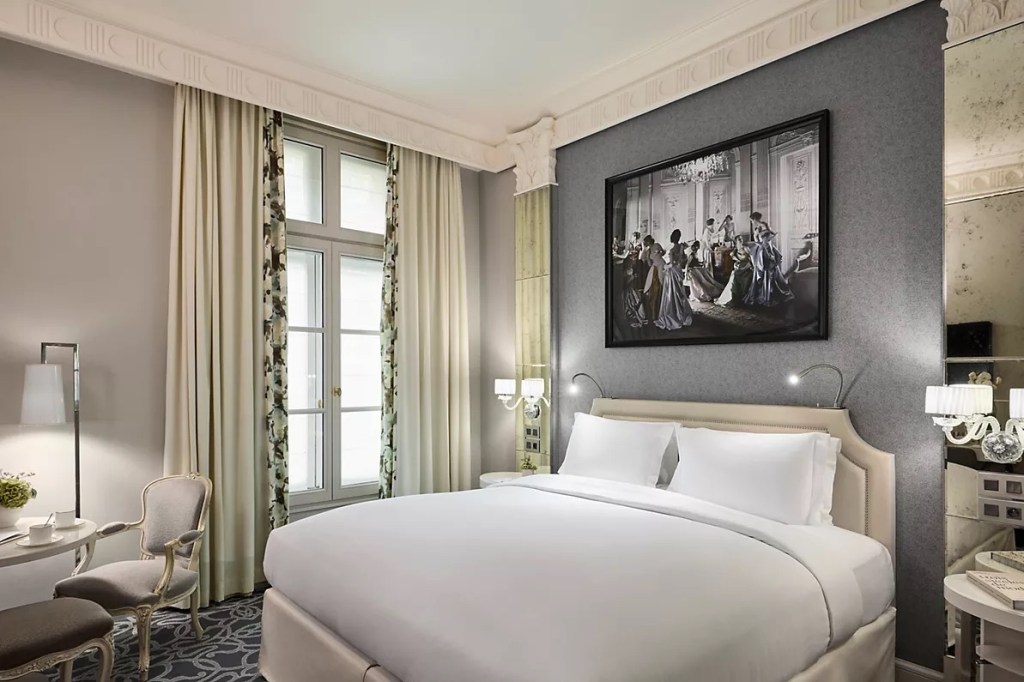
I had no idea what my room cost. I had been invited. I discovered later that the same category was advertised from €745.09 for one night. It was a very pleasant room, although I cannot say that I immediately identified €745 worth of nightly experience. The bed was excellent, the bathroom elegant and the silence almost complete. There was, however, no apparent means of turning off the air-conditioning. I eventually solved the problem by climbing into bed beneath the quilt wearing the luxuriously heavy Sofitel dressing gown: extravagance deployed to solve a problem created by extravagance. I slept my usual six hours. By morning I remained essentially the same person, merely one who had slept between more expensive sheets at €2 per minute.
I enjoyed my stay. That is important. I was among people whose company I enjoyed, treated with great generosity, surrounded by beauty, comfort and attention. I do not begrudge anyone a good meal, a fine hotel or a beautiful object. Life is brief. Pleasure in itself is not a moral failure.
Nor do I care very much about rich people as a category. Some inherit wealth, some create it, some stumble into it, some spend their lives fearing its loss. People in business take risks. I have done so myself, on a smaller scale. I know the anxiety of wages, rent, tax, cash flow, competition and the knowledge that one bad season can undo years of work. It is too easy to condemn individuals for participating in a system from which almost none of us is truly isolated.
What troubles me is not wealth itself. It is impertinence. It is the scale of our presumption towards the world that sustains us, the confidence with which we treat the planet as inventory, the future as collateral and other forms of life as scenery. We behave less like temporary inhabitants than owners who have somehow acquired the freehold.
Free-market capitalism cannot restrain itself where wages, protections and costs differ radically between countries. A company that chooses to pay more, pollute less or keep production in a higher-cost economy may behave more decently, but it also risks being undercut by one that does not. The customer demands a lower price. The retailer must remain competitive. The manufacturer cuts costs. The investor demands growth. Production moves to wherever labour is cheapest, regulation weakest and damage easiest to conceal.
Nobody needs to be especially wicked. That is part of the horror. Each decision can be defended as reasonable. Each participant can say that somebody else would have done the same. The business owner cannot stop because his competitors will overtake him. The consumer cannot stop because the culture has taught him or her that consumerism and ownership are identity. Governments cannot stop because only growth can pay for promises already made. Investors will not stop because stillness leads to failure. And I cannot pretend to stand outside it. I own things made cheaply elsewhere, replace things that might have lasted longer and enjoy comforts whose origins I rarely investigate. The carousel is whizzing around so fast that no one can get off, even if they want to.
We have seen the principle before. Colonialism and slavery also converted disparities of power into wealth. Labour, land and human life were taken cheaply or by force, and the rewards accumulated in the hands of the vanishingly few. The comparison is one of mechanism, not equivalence; a badly paid worker with a contract is not a slave. But the ancient temptation remains recognisable – where enormous differences in power exist, those with the greater power discover remarkably persuasive reasons for taking advantage of them. The modern version is cleaner to look at. It has contracts instead of chains, supply agreements instead of plantations, sustainability statements instead of imperial proclamations. Exploitation has learned to speak the language of opportunity, development and consumer choice.
The veneer of civilisation and respectability is real, but wafer thin, and transient. The handbag arrives immaculate. Its history less so.
Yet even that is not quite the source of the sadness I felt. Human beings have exploited one another for most of recorded history. We have always loved display, hierarchy and possession. What makes our present behaviour so difficult to comprehend is that we now understand, with greater clarity than any previous generation, how fragile and ephemeral our existence is. Our ancestors could plead ignorance. Increasingly, we cannot.
Life on Earth has taken roughly four billion years to develop from chemistry into organisms capable of self-awareness, curiosity, memory, imagination and love. Matter has somehow reached the point at which it can look back at the universe and ask where it came from. We have built instruments capable of seeing galaxies whose light began its journey before the Earth existed. We can examine the structure of cells, listen for signals from other worlds and reconstruct the first moments after the birth of the cosmos.
And still so many believe that mankind is at the centre of things, that we were somehow meant to be here, that this vast and almost entirely hostile universe was arranged with us in mind.
Almost everything beyond the thin skin of our atmosphere would kill us. There is no breathable air, no shelter, no warmth, no audience. Distances are so great that we can write them down but cannot truly imagine them. Our entire history has taken place on a fleck of dust, beneath a wafer-thin layer of gases clinging temporarily to its surface, during a fraction of an instant in the eternity of time and space.
Everything we have ever loved is here. Every child, every song, every animal, every tree, every act of kindness, every remembered face, every lost voice, every question we have asked of the darkness. All of it exists within that fragile boundary.
And we want Lanvin handbags.
The absurdity is not that people want beautiful things. Beauty matters. Craftsmanship matters. Colour, pleasure, adornment and celebration are part of being human. A world reduced to bare subsistence would not be a triumph of wisdom. The tragedy is that we have confused pleasure with purpose, abundance with permanence and price with value. We are prepared to risk bread tomorrow for handbags today.
We treat clean air, a stable climate, fertile soil and functioning ecosystems as though they were background conditions guaranteed by some benevolent authority. Economists call the damage an ‘externality’, a word of almost perfect moral emptiness. Carbon emissions are external. Poisoned water is external. Exhausted workers are external. Vanishing species and unborn generations are external. The product appears affordable only because much of its true cost has been passed to someone who cannot refuse it or send us the bill. Perhaps these were not shops without prices after all. The price was simply absent from the label.
Walking those immaculate streets, I had the strange sensation that the shops were not merely selling objects. They were displaying the end result of an entire civilisation’s arrangement with reality. Materials extracted elsewhere, labour performed elsewhere and consequences suffered elsewhere had been gathered, refined, branded and placed behind flawless glass. Perhaps that is what luxury increasingly means – insulation from origins, consequences and limits.
I generally leave this part of Paris with an enhanced sense of the absurd. There are armed men protecting streets lined with handbags worth several months’ wages. There are hotel rooms costing far more than my €745 a night, shops whose customers need not ask the price and an economic system presenting all of it as normal, desirable and infinitely reproducible.
For a while, one can be dazzled by it. Paris does splendour very well. The windows seduce, the service is perfect. Then something shifts. The elegance begins to feel like stage scenery erected at the edge of an approaching storm.
That is the sadness of it. Not that people are foolish, although often we are. Not that they are wicked, because most are not. It is that a species capable of understanding so much seems unable to act upon what it knows. We can see the danger. We can measure it, model it and watch it drawing closer. Yet the machinery continues, driven less by any single will than by millions of individually rational choices combining into collective insanity. Perhaps what has died in me is not hope itself, but the simpler faith I once had that knowledge would eventually make us wiser. I used to think that once people understood a danger clearly enough, reason would do the rest. I no longer believe that.
Sometimes, holding these two realities in mind at once, I feel detached from the world around me. People discuss leather, colour and exclusivity, while somewhere behind the conversation stands the silent knowledge that the only known home of conscious life is being damaged for things nobody truly needs. Social life carries on with immense confidence. Menus are studied. Purchases are considered. Cars arrive. Champagne is poured. Nobody is fiddling while Rome burns. That would at least require noticing the fire.
Perhaps that is why the sadness is difficult to express. It is grief without a funeral, mourning for something not yet entirely lost. Because it is not entirely lost. We remain capable of wonder. We remain capable of restraint, generosity and foresight. We can still recognise beauty without needing to own it, prosperity without endless growth, and pleasure without pretending that consequences belong to someone else. We have built the machinery, but machinery can be altered. The carousel can be slowed, however loudly those upon it insist that speed is life. That is not optimism. Optimism expects things to turn out well. Hope merely refuses to accept that they cannot.
We are the part of the universe that has begun to understand itself. And as far as we are aware, the only part. That ought to have made us careful.
I hope against hope, for the future of all of our children, that it still might.
I moved from Leigh-on-Sea to Harrogate in about 1969. Not long before that, when I was ten or eleven, my parents had organised a solo trip to London for me, including an overnight stay with a relative, for reasons I can no longer remember. Having never travelled alone anywhere before, except a five minute stroll to Grindley’s bookshop in the High Street, I proudly took the train from Westcliff to Fenchurch Street, then skilfully negotiated the Tube into central London.
At some point, with time to kill, I found myself wandering up Shaftesbury Avenue from Trafalgar Square. A small group of men had gathered around a box on the pavement, apparently playing cards. I would now recognise them instantly as a thoroughly shady collection of individuals. At that age, however, I merely saw an intriguing game and an easy way to double my money.
It was the three-card trick. I watched closely and correctly identified the jack each time. Naturally, this was because I was being allowed to. Then, in a moment of catastrophic confidence, I slid my entire travelling fund onto the box: the princely sum of £10, which in those days was a considerable amount of money.
I lost.
The box, the cards and the entire little crowd disappeared almost simultaneously. I was left virtually penniless, with barely enough money to telephone home.
My mother answered. Tearfully, I confessed what had happened. She told me to wait by the telephone box and said she would call me back as soon as possible.
In the meantime, she telephoned my Auntie Joan, the mother of my cousins Susan and Jenny. Joan was not a police officer, but worked as personal assistant and administrator to the Commissioner at Scotland Yard. When the telephone rang again, emergency funding had been arranged. I was to present myself at Scotland Yard at a fixed time, where Auntie Joan would meet me in reception.
I had always found her rather intimidating. Her forceful personality was matched by an equally commanding physical presence, and I approached Scotland Yard with considerable trepidation. I made absolutely certain that I arrived early.
At the appointed hour, to the second, Auntie Joan materialised.
She handed over the money, delivered a brief, stern and entirely unsmiling lecture, then turned on her heel and strode back to work.
Although I have since learned exactly how the tricksters perform their trick, I never dared gamble on the three-card con again. Sixty years on, the memory of Auntie Joan’s withering stare and terrifying voice remains more than sufficient deterrent.
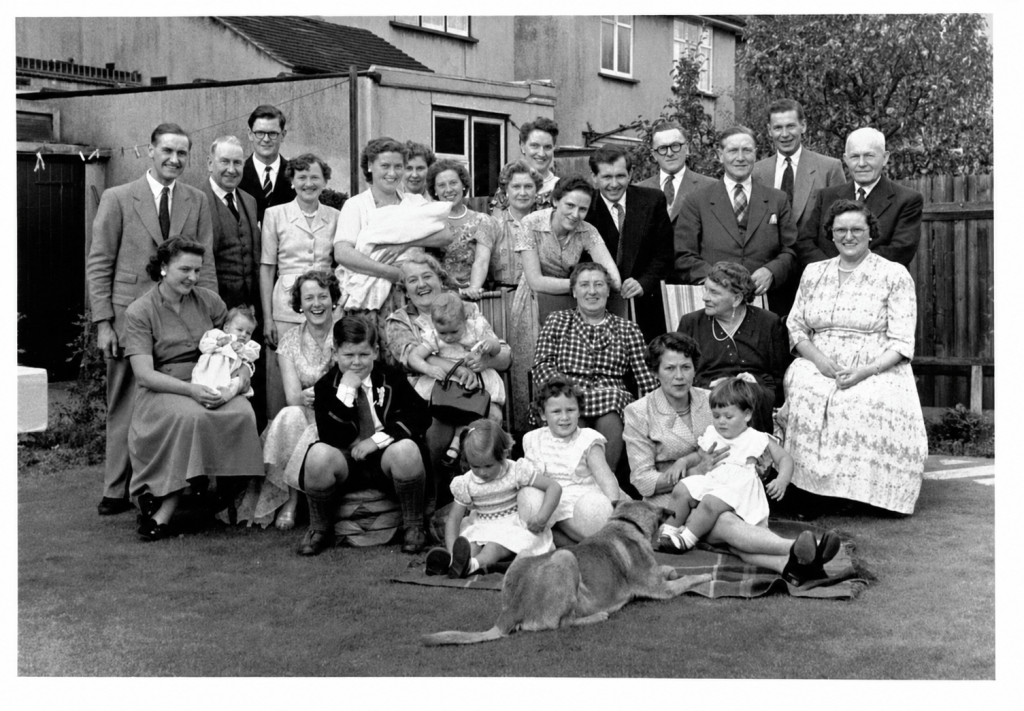
Photo: 1956, Lee, London. Joan – standing centre back row, over 6’ tall. Her smile for this photo is not the look I remember! Her daughter Susan who has had a most distinguished career, centre front looking at the camera, with her younger sister Jenny on her right (checking out her shoes). I am hidden in the arms of my mother (standing), just a few months old.
The deeper and broader thought becomes, the harder it is to sustain the rigid binaries on which much of the populist right depends: native and foreign, deserving and undeserving, loyal and traitorous, normal and deviant. “Us” and “them”.
Greater understanding reveals causes, alternatives, competing perspectives and unintended consequences. It makes scapegoating more difficult because it prevents people from being flattened into categories. Complexity does not make judgement impossible, but it makes absolute certainty less defensible.
“The fundamental cause of the trouble is that in the modern world the stupid are cocksure while the intelligent are full of doubt” – Bertrand Russell
Doubt, in this sense, is not weakness. It is the recognition that one’s own perspective is limited. The more alternatives a mind can perceive, the less plausible simple explanations become. The more perspectives it can inhabit, the harder it becomes to divide the world confidently into the wholly righteous and the wholly contemptible.
Have you ever wondered why so many scientists, philosophers, historians, writers, musicians, actors, comedians, film-makers and public intellectuals seem instinctively to recoil from authoritarian and far-right politics? Perhaps it is because their disciplines require them to step outside themselves, to test assumptions, imagine other lives, tolerate ambiguity, revise conclusions and recognise structures larger than their own experience.
“I can live with doubt and uncertainty and not knowing” – Richard Feynman
“The presence of those seeking the truth is infinitely to be preferred to the presence of those who think they’ve found it” – Terry Pratchett
The scientist learns that knowledge remains provisional. Philosophers, psychologists and anthropologists discover the assumptions concealed within apparent certainties. The historian learns that the past is never as simple as the myths made from it. The artist enters lives unlike their own, while the comedian notices the absurdity of those who mistake their particular prejudices for the natural order of the universe.
Empathy begins in that decentralisation. It is not merely an emotion directed towards other human beings, but a recognition that reality is experienced from more than one centre. Other people, other animals and perhaps forms of consciousness we have not yet encountered are not merely objects within our world. They are centres of value within worlds of their own, and no centre becomes morally negligible merely because it is not ours.
Reactionary politics resists this enlargement. It promises restored boundaries, recovered purity and a return to an imaginary past. It reduces historical and social complexity to enemies, betrayals and slogans, deriving much of its emotional force from narrowing the moral circle while presenting that narrowing as strength.
Science and art generally move in the opposite direction. They enlarge the world faster than we can accommodate it.
“Isn’t this enough? Just this world? Just this beautiful, complex, wonderfully unfathomable natural world?” – Tim Minchin
We have scarcely begun to understand that world. Every veil removed reveals another order of complexity, and every discovery opens another universe of questions. Artificial intelligence may eventually surpass us on a scale we have yet to fathom, yet even a vastly superior intelligence may find itself confronting horizons that recede forever. Knowledge may not culminate in certainty at all, but in an ever deeper awareness of mystery.
The cosmic perspective makes our political pretensions seem smaller still. Carl Sagan placed every human claim to grandeur within a single devastating perspective:
“Every ‘supreme leader’ in the history of our species lived there – on a mote of dust suspended in a sunbeam”
Every emperor, conqueror, dictator, revolutionary, prophet, king, billionaire, nationalist strongman and self-appointed saviour of civilisation lived briefly upon the same almost invisible particle, along with every border ever fought over, every flag ever waved and every certainty ever proclaimed.
For Sagan, this was not an argument for nihilism, but for humility and kindness. Cosmic insignificance does not make experience worthless – it makes our claims to supremacy ridiculous. We may occupy an infinitesimal place while remaining, to one another, centres of consciousness and value.
Seen against that scale, the politics of Trump, Farage, Putin, Kim Jong Un and their kind is simply pathetic: grievance mistaken for insight, domination for greatness, exclusion for order and confidence for truth.
This is where an interesting pattern emerges. As a thought experiment, choose your idol – perhaps a thinker, scientist, philosopher, historian, writer, musician, comedian, actor, film-maker or public intellectual who enlarged your sense of the world. Pick Socrates, Aristotle, Confucius, Gandhi, Mandela, Sagan, Attenborough, Jane Goodall, Einstein, Hawking, Brian Cox, Neil deGrasse Tyson, Rachel Carson, Oppenheimer, Russell, Camus, Hannah Arendt, Simone de Beauvoir, Noam Chomsky, Orwell, Václav Havel, Umberto Eco, Gabriel García Márquez, Vonnegut, Ursula Le Guin, Margaret Atwood, James Baldwin, Huxley, Virginia Woolf, Salman Rushdie, Toni Morrison, Pratchett, Douglas Adams, Kurosawa, Miyazaki, Chaplin, Orson Welles, Kubrick, Richard Attenborough, Emma Thompson, Ian McKellen, Ken Loach, Mike Leigh, Lennon, Nina Simone, Joan Baez, Dylan, Leonard Cohen, Paul Robeson, Woody Guthrie, Pete Seeger, Joni Mitchell, Tracy Chapman, Springsteen, Sting, Peter Gabriel, Annie Lennox, Joe Strummer, Billy Bragg, Stephen Fry, Tim Minchin, Billy Connolly, David Mitchell, George Carlin, Bill Hicks, Stewart Lee, Armando Iannucci, Alexei Sayle, John Oliver, Jon Stewart, Mary Beard, David Olusoga, Simon Schama, Jacob Bronowski, James Burke, Adam Curtis, Louis Theroux or Jon Ronson… the list is virtually endless.
Of course they are not politically identical. Some disagreed profoundly with one another, and some would undoubtedly have disliked being grouped together at all. Yet across this extraordinarily varied company, similar instincts repeatedly emerge: curiosity rather than certainty, complexity rather than slogans, empathy rather than exclusion, scepticism towards power, concern for those beyond their own tribe, and an awareness that reality is vastly larger, stranger and more interconnected than the stories told by authoritarians.
The list proves nothing by itself, but it is suggestive. Especially if you attempt the reverse exercise. Try assembling an equally long list of humanity’s most admired scientists, philosophers, historians, writers, musicians, comedians and artists whose work naturally leads towards Farage, Trump, Putin, Orbán, Le Pen, Reform, Restore or similar movements. You will struggle to do so without stretching the categories, confusing traditional conservatism with authoritarian populism, or deceiving yourself about the beliefs of the people you enlist. The difficulty of attempting to do so should itself tell you something.
Intelligence does not inevitably produce progressive politics, creativity does not inevitably produce compassion, and science does not inevitably produce wisdom. Yet again and again, those who spend their lives exploring reality in all its complexity seem to emerge with a similar understanding – that certainty is dangerous, that other perspectives matter, that human beings are not the centre of everything, and that the world is always larger than the story currently being told about it.
The reality from which we derive purpose and meaning is larger than nations, ideologies and humanity itself, larger than any intelligence we may one day create and larger than anything we can presently imagine. We remain what Sagan saw us to be – inhabitants of a mote of dust suspended in a sunbeam, briefly wondering about the universe before disappearing back into it.
“For small creatures such as we, the vastness is bearable only through love” – Ann Druyan, in Carl Sagan’s Contact
What kind of Britain are we trying to build? Before answering that, it is worth asking what happened to the Britain many people once thought they were living in.
For much of the post-war period there was a growing assumption that life would gradually improve. Not in a straight line and not for everyone, but in the main each generation expected to be a little more prosperous, a little more secure and a little more optimistic than the one before. Scientific and technological progress would improve lives, eventually beyond recognition. Democracy would spread. International cooperation would gradually replace old rivalries. War was over. Our children would inherit opportunities that we ourselves never had.
Today that confidence has largely evaporated. Young people increasingly struggle to buy homes. Many working people feel they are running ever faster, simply to stand still. Public services are visibly strained. Older people often speak of a loss of community and belonging. Trust in politicians has collapsed. International tensions are rising. Environmental warnings that were once dismissed as problems for future generations are beginning to unfold within our own lifetimes, yet remain politically marginal compared with the endless parade of daily outrages and manufactured controversies.
The result is not just economic frustration. It is a growing sense that something has gone wrong, even if Britons today disagree profoundly about what that something is. And when societies become anxious, people look for explanations. When they become angry, they look for somebody to blame. None of this is new. Throughout history there have always been politicians, movements and media outlets willing to provide convenient villains. Immigrants. Foreigners. Elites. Welfare claimants. Billionaires. Brussels. Royalty. London. The woke. The establishment. The list changes according to political fashion, but the mechanism remains remarkably familiar. Complex problems are reduced to simple stories and uncertainty is replaced by certainty in the form of comfortable delusions.
Some of those targets may occasionally deserve criticism. But when every problem has a single cause and every cause has a single enemy, doubt and scepticism are clearly required.
Britain’s difficulties are not the product of one group, one party or one ideology. Nor are they uniquely British. Across much of the developed world we see many of the same patterns: declining trust, political polarisation, rising inequality, social fragmentation, an increasingly toxic information environment, and institutions struggling to adapt to rapid economic and technological change.
That does not mean that the decline was inevitable, or that responsibility is so widely dispersed that nobody can be held accountable. Governments made choices. Markets were regulated in particular ways. Public assets were sold, investment was postponed, local government was weakened and short-term financial returns were frequently valued above long-term social resilience. Different parties contributed in different degrees, sometimes through ideology and sometimes through simple political timidity. But the deeper failure has been cumulative. Britain has spent decades consuming political, institutional and physical inheritance while investing too little in what would replace it.
Many of the achievements that transformed post-war Britain required governments to think beyond the next election: the National Health Service, council housing, new towns, expanded education, scientific research, transport networks and the rebuilding of national infrastructure. They were imperfect, but they rested upon the assumption that government could plan, build and act on behalf of generations not yet able to vote. Modern politics has increasingly retreated from that ambition. Governments announce initiatives, oppositions oppose them almost by reflex, policies are repeatedly redesigned, and long-term projects are subjected to short-term fiscal rules, ministerial turnover and the rhythms of the daily news cycle. Yet housing, education, energy, infrastructure, demographic change and environmental resilience develop over decades. A country that cannot think beyond the next election gradually loses the ability to shape its own future.
Yet much of our political debate remains oddly superficial. We argue endlessly about symptoms while paying far less attention to causes. We debate immigration while housing becomes increasingly unaffordable. We debate culture wars while wealth and influence continue to concentrate. We debate national identity while local communities weaken. We obsess over today’s controversy and neglect problems that develop over decades. Meanwhile, social media rewards outrage over understanding, political parties focus on the next election cycle, and news organisations compete for attention in a market where anger often sells better than nuance.
Behind many of these arguments lies a less dramatic but more fundamental problem – Britain has struggled for years to become more productive. Productivity sounds like the sort of bloodless economic term designed to end a conversation, but it determines how much value can be created from the work people do. When it stagnates, wages struggle to rise without inflation, businesses invest less, tax revenues disappoint and governments find it harder to improve public services without continually increasing the burden elsewhere. Britain’s weak productivity is not a failure of ordinary people to work hard enough. It reflects low and inconsistent investment, inadequate infrastructure, skills shortages, regional imbalance, policy instability and an economy too often rewarded for extracting value from existing assets rather than creating anything new.
This is connected to another increasingly obvious weakness – Britain has become remarkably bad at building. Not simply houses, although the shortage of secure and affordable homes distorts almost every stage of life, but reservoirs, electricity networks, transport links, laboratories, hospitals and other essential infrastructure. Projects become trapped for years between fragmented responsibility, political indecision, planning disputes, legal challenges, changing regulations and understandable local resistance from communities that are too often asked to absorb development while receiving few of its benefits. The answer is not to abolish environmental protection or silence local people. It is to develop a planning system capable of making timely, democratic decisions, compensating affected communities fairly and recognising that refusing to build also carries economic, social and environmental costs. A country cannot promise more homes, cleaner energy, secure water supplies and modern public services while opposing almost every physical structure required to provide them.
None of this means that immigration, identity, taxation, welfare or national sovereignty are unimportant questions. They are important. But they are not the whole story, and pretending otherwise has done little except deepen division.
Demography also imposes constraints that no slogan can repeal. People are living longer, which is an achievement, but an ageing population increases demand for pensions, health care and social care while reducing the proportion of working-age people supporting them. Rising long-term illness adds further pressure. Immigration may affect that arithmetic, but it cannot permanently solve it, and simply restricting immigration does not make an ageing society younger. A serious politics would explain these trade-offs honestly rather than promising Scandinavian public services, American levels of taxation, early retirement, controlled immigration and permanently balanced budgets as though all could be achieved simultaneously without difficult choices.
A better Britain would also have to confront the weakening of the institutions through which people once encountered one another as citizens rather than as competing political identities. Trade unions, churches, clubs, local newspapers, youth organisations, libraries, community associations and political parties once provided imperfect but important forms of connection. Their decline has not left an empty space. It has left more people isolated, more dependent upon commercial platforms for information and belonging, and more likely to encounter one another through algorithms designed to maximise attention rather than understanding. Close personal relationships remain strong for many people, but that is not quite the same thing as belonging to a functioning community or possessing confidence in the wider society around us.
Trust matters here, not because institutions should be obeyed uncritically, but because no complex society can function if every institution is assumed to be corrupt, every expert dishonest and every unfavourable fact fabricated. Trust reduces the friction of ordinary life. It allows strangers to cooperate, contracts to be honoured, elections to be accepted, public health advice to be followed and political opponents to be regarded as mistaken rather than treasonous. Trust must be earned through competence, transparency and accountability. But once destroyed, it cannot be restored merely through better public relations. Institutions have to become demonstrably more trustworthy.
A better Britain will not emerge from finding a new enemy to hate. We already have plenty of those. Nor will it emerge from nostalgia. The Britain of the past contained its own injustices, failures and myths. There is no golden age waiting to be rediscovered.
It will not emerge from technological optimism alone either. Artificial intelligence, automation and other advances may increase productivity, improve medicine and remove some of the most repetitive forms of work. They may also displace employment, narrow entry routes into skilled professions, concentrate wealth and power still further, and overwhelm the public sphere with cheaply manufactured falsehoods. Technology does not arrive with its social consequences predetermined. Those consequences depend upon who owns it, who regulates it, whose work it replaces, who receives its benefits and whether education and public institutions can adapt quickly enough. Britain must decide whether it intends merely to consume technologies developed elsewhere, or to help shape them in the public interest.
That makes education central to any serious project of national renewal. Education cannot be reduced to producing employable units for the labour market, important though skills are. A democracy also needs citizens able to evaluate evidence, recognise manipulation, understand probability, distinguish expertise from assertion and change their minds without experiencing it as humiliation. Scientific, civic, political and media literacy are no longer optional refinements. In an information system capable of placing endless quantities of persuasive nonsense in every pocket, they are part of the basic infrastructure of democracy.
What is needed is something less dramatic and probably less satisfying. A willingness to think beyond tribes, slogans and scapegoats. A willingness to value evidence even when it challenges our assumptions. A willingness to judge ideas on their merits rather than on who proposed them. Above all, a willingness to think beyond the next headline and ask what sort of country we want future generations to inherit.
That requires a more realistic understanding of Britain’s place in the world. Britain remains a wealthy country with considerable diplomatic, cultural, scientific and institutional strengths. But it is no longer an imperial power able to dictate the terms of its engagement with others, and pretending otherwise merely converts reduced influence into theatrical defiance. In a world shaped increasingly by continental economies, technological blocs, climate pressures, migration, pandemics and geopolitical rivalry, national resilience and international cooperation are not opposites. Sovereignty is not simply the freedom to act alone. It is the practical capacity to achieve results, which frequently requires countries to act together.
Because the uncomfortable truth is that many of the challenges we face today cannot be solved within a single parliamentary term. Some may take decades. That requires patience, honesty and a degree of political maturity that has become increasingly rare.
Environmental change makes that need for maturity unavoidable. Climate disruption, water insecurity, soil degradation, biodiversity loss and threats to food production are often treated as separate green concerns, to be considered when economic conditions permit. In reality they are conditions upon which every economy and society depends. Flood protection, heat-resistant homes, secure water supplies, resilient agriculture and a functioning natural environment are not luxuries. They are forms of national insurance. The costs of preparation may be politically inconvenient, but the costs of permanent reaction to repeated emergencies will be far greater.
None of this offers the emotional satisfaction of a revolution or the reassuring simplicity of a five-point plan. It requires choices, compromise and institutions capable of maintaining direction across changes of government. There will always be legitimate disagreement about taxation, ownership, public spending, regulation and the appropriate balance between national and local control. A mature democracy does not eliminate those disagreements. It develops the capacity to resolve them without abandoning evidence, inventing enemies or restarting the country from first principles every few years.
Perhaps that is where rebuilding begins? Not with more promises to make Britain great again. Not with endlessly recycled phantom villains. But with the recognition that a healthy society depends upon trust, competence, critical thinking and a shared sense of responsibility for the future.
It also depends upon recovering the habit of solving real problems together. Democracy does not require citizens to agree about everything, or even to like one another very much. It requires enough common ground to accept that reality exists independently of political allegiance, that opponents may sometimes be right and that compromise is not necessarily betrayal. Without that foundation, every difficult decision becomes another battle in an endless culture war and the future is steadily sacrificed to the performance of present grievance.
The question is not whether Britain can be made perfect. It cannot. The question is whether we can leave it wiser, fairer, more resilient and better prepared than we found it. Perhaps that is ambition enough for one generation?
Why Did British Political Debate Become So Superficial?
Watching France 24 or Euronews discuss Brexit can be a mildly disorientating experience for a British viewer. Not because they are always right, or because European journalism is somehow immune from bias, laziness or theatrical nonsense. It plainly is not. Germany has Bild; France has BFM TV and CNews; every country has its own mixture of tabloids, rolling-news panic, billionaire vanity projects, ideological performers and glossy personality journalism. But France 24, Euronews, Deutsche Welle, Arte and similar international or cross-border public-service formats belong to a different category. Their job is not to reproduce each country’s domestic rows, but to make political events intelligible beyond its national echo chamber. There is usually more context, more explanation, more patience with complexity, and less of the frantic Westminster pantomime in which the main questions become who has been humiliated, who has landed a telling blow, who is in crisis, who has betrayed the base, and who is winning the day.
The difference is not virtue. It is partly institutional purpose and partly audience. International channels cannot assume that viewers understand the local tribal code, the Westminster gossip or the emotional shorthand. They have to explain the institutions, geography, history, legal framework and consequences, because otherwise the story does not travel.
That contrast points towards a larger problem in British political culture. Increasingly, politics is not explained. It is compressed.
Compression is not the same as ordinary simplification. All journalism simplifies; it has to. The question is what survives the process. Useful simplification removes clutter while preserving the structure of a problem: its causes, constraints, alternatives and trade-offs. Political compression removes precisely those things. Complex choices are reduced to emotionally legible binaries, tactical drama and symbolic gestures. The question becomes not ‘what does this policy mean?’ but ‘who does this hurt?’; not ‘will it work?’ but ‘how will it play?’ Politics becomes a horse race, a leadership drama, a moral panic or a tribal loyalty test. Policy is reduced to background scenery.
Tactics do matter. Politics is partly about power, and power depends on numbers, timing and public reaction in a democracy. But when tactical framing becomes dominant, it changes what the public is invited to notice. People are encouraged to follow the contest before they have been given the machinery needed to understand what is actually at stake. This does not mean that voters are empty vessels into which newspapers pour opinions. They bring their own experiences, identities, interests, hopes and resentments. Media influence is rarely mechanical. But media systems do shape salience: they repeatedly decide which aspects of a question are made visible, urgent and emotionally available, and which remain difficult to see.
Brexit was the purest British example of political compression, although hardly the only one. It combined exceptional constitutional complexity with a binary ballot. Trade, regulation, migration, diplomacy, devolution, borders, rights and economic policy were compressed into two short words: Leave and Remain. One described an existing, if imperfectly understood, settlement. The other contained several mutually incompatible futures. The ballot offered no means of choosing among them.
For years, British coverage of the European Union had often been less an explanation of a political, legal and economic structure than a running national cartoon. Brussels. Red tape. Sovereignty. Meddling judges. Straight bananas. Foreigners telling us what to do. The details varied, but the associations became familiar. Europe meant interference. Migration meant loss of control. Sovereignty meant escape.
This did not happen by accident, nor did it begin with the referendum campaign. The British tabloid press had spent decades acting not merely as a mirror of Eurosceptic feeling but as one of its suppliers. There is unusually strong evidence that this influence was causal rather than merely reflective. After The Sun’s reporting of the Hillsborough disaster produced a sustained boycott across Merseyside, its readership there fell sharply for reasons unrelated to Europe. Over the following decades, Euroscepticism declined relative to comparable areas of northern England. The effect was strongest among working-class voters, who had previously been the paper’s principal readership, and among generations that came of political age during the boycott. Merseyside also voted substantially less heavily for Leave in 2016 than its earlier referendum position and regional characteristics would otherwise have predicted.
This does not mean that The Sun caused Brexit, or that economic insecurity, immigration, austerity and regional inequality were unimportant. It does show that tabloid campaigning was more than background noise. Repeated exposure helped shape political attitudes, while the removal of that exposure produced a measurable difference. The press did not simply discover a ready-made Eurosceptic public and give it what it wanted. Over time, it helped make that public.
The tabloid press helped set the agenda, repeat the vocabulary, select the villains and make particular associations feel natural. The relationship was reciprocal rather than one-way: newspapers amplified themes supplied by politicians and campaigns, while politicians adapted their rhetoric to frames the press had already normalised. By the time the referendum arrived, much of the emotional groundwork had been laid.
Research into the referendum press supports that broad picture. Reuters Institute analysis found a pronounced imbalance towards pro-Leave coverage in the national press and a heavy dependence on campaigners, politicians and familiar public figures. Experts, academics and foreign voices appeared much less prominently than might be expected in a decision of such constitutional weight. Other analysis, including work by Loughborough University, rightly complicates any claim that the campaign ignored economics. Economic coverage was extensive and, through much of the campaign, exceeded immigration coverage.
But discussion is not the same as explanation, and quantity is not the same as quality. Economics was everywhere, but it was often presented through competing campaign claims, selective forecasts, false equivalence and headline figures detached from the assumptions beneath them. The £350 million NHS bus was an economic claim. So were warnings that were reported less as arguments to be examined than as ammunition in a contest between ‘Project Fear’ and ‘taking back control’. Some economic assessments were careful and evidence-based; others were exaggerated, misleading or plainly false. Once the information environment had been saturated by misinformation, disinformation and mutually incompatible promises, the mere presence of economic language could not guarantee economic understanding. Visibility without dependable context may confuse public perception as effectively as silence.
What was the single market? What did customs-union membership actually do? How did regulatory alignment work? What was the difference between sovereignty in constitutional theory and sovereignty in a world of supply chains, treaties, standards and reciprocal obligations? What kind of Brexit was being authorised: participation in the European Economic Area, a customs union, a bespoke association, or a much harder separation? What did ‘taking back control’ mean when every modern state exercises power through agreements that simultaneously enable and constrain it? These questions were covered at times, sometimes very well. But they were too rarely the organising centre of the national conversation.
The dominant campaign language was emotional and performative. Brexit became freedom to some, catastrophe to others, betrayal to others still. The Leave campaign benefited most obviously from seductive simplicity, but Remain often answered with a barrage of economic danger rather than a confident account of what European membership was, how shared sovereignty worked, or why interdependence could enlarge rather than diminish national agency. One side offered a fantasy of liberation; the other too often offered risk management. Neither was well designed to produce public understanding.
This is where the idea of an island mind becomes relevant, although geography alone cannot explain it. Ireland, Iceland, Malta and Japan are islands, and each has developed a very different relationship with its neighbours and the wider world. Nor is the United Kingdom politically or culturally uniform. Scotland, Wales, England and Northern Ireland have distinct histories, political traditions and experiences of Europe. Northern Ireland is not even located on the island of Great Britain. ‘Island mind’ therefore cannot be a geographical law. It is better understood as a historically produced habit of political imagination: the recurrent representation of Europe as something external acting upon Britain, rather than as a shared political space in which Britain itself was an influential participant.
What distinguishes Britain from those other islands is not water but history. Britain was not merely separated from continental Europe; it had once governed a global empire and had long imagined itself as the centre of a worldwide political, commercial and military system. The empire disappeared, but many of its symbols and habits of thought survived: the monarchy, the Commonwealth, nuclear weapons, a permanent seat on the United Nations Security Council, the City of London, the global reach of the English language and the repeatedly invoked ‘special relationship’ with the United States. These are real sources of influence. They have also made it easier for political rhetoric to exaggerate Britain’s freedom of action and understate its dependence upon neighbouring markets, institutions and regulatory systems.
Brexit drew heavily upon this post-imperial exceptionalism. The promise was not simply that Britain could function outside the European Union, but that departure would release a naturally global nation from an unnaturally European confinement. ‘Global Britain’ would recover sovereignty, negotiate superior trade agreements and resume a role supposedly diminished by membership of a regional bloc. Europe was presented as something Britain had become trapped inside, rather than the geographical, economic and political environment in which Britain continued to exist. The Channel supplied the physical distance; imperial memory supplied the story Britain told itself about what that distance meant.
Even here, however, ‘Britain’ can conceal as much as it reveals. The strongest electoral expression of Brexit came from England outside its largest cities, while Scotland and Northern Ireland voted to remain and Wales contained its own regional and demographic divisions. Much of the sovereignty language was therefore entangled with English nationalism, yet was routinely spoken in the name of Britain as a whole. That constitutional ambiguity mattered. A campaign promising to restore the authority of the United Kingdom also exposed how unevenly that kingdom imagined itself.
Too much British political media has treated Europe as ‘over there’, not as the surrounding context. Other countries appear as examples, warnings, rivals, holiday destinations, markets, threats or props in a domestic drama. Even Ireland, the state with which the United Kingdom shares its only land border, was frequently treated as an awkward historical complication rather than as a political reality central to the practical meaning of Brexit.
The Irish border was not an incidental technicality. It connected the European legal order, the UK’s territorial constitution, the peace settlement, customs policy and the daily lives of communities on both sides. Decades of common European structures had allowed the border to become less visible without making it politically meaningless. Yet it was repeatedly discussed as though goodwill, technology or British improvisation could dissolve the underlying conflict between leaving the EU’s economic structures and preserving a frictionless border.
The issue was not wholly absent before the vote. Specialists, Irish politicians and some journalists raised it. The deeper failure was that its implications were never absorbed into the popular meaning of Brexit. After the vote, reality returned inconveniently and at full size. The border became central because it had always been central. The political debate had merely compressed it out of view.
Continental proximity can alter the mental map, although it does not automatically produce wisdom or internationalism. Across much of the European Union, neighbouring countries are not distant abstractions but part of the ordinary political, economic and cultural landscape. People commute across borders, trade across them, study across them, marry across them and live within regions shaped by constant cross-border exchange. Even those who rarely cross a frontier themselves inhabit economies and societies organised through shared markets, supply chains, laws and institutions. ‘Abroad’ may be half an hour down the road, but interdependence extends far beyond the border regions themselves.
Language reinforces that exposure, especially in northern Europe. Multilingual competence allows people to read neighbouring media, work and study across frontiers, follow political arguments outside their own national setting and encounter other societies with less dependence on translation or domestic interpretation. Britain has historically been unusually weak in this respect. In the last directly comparable EU-wide survey before Brexit, the European Commission’s 2012 Special Eurobarometer on languages found that 61 per cent of UK respondents said they could not hold a conversation in any language other than their mother tongue. Only Hungary and Italy recorded clearly higher proportions, while Portugal matched the UK and Ireland was close behind. At the other end of the scale, more than 90 per cent of respondents in Luxembourg, Latvia, the Netherlands, Malta, Slovenia, Lithuania and Sweden said they could hold a conversation in at least one foreign language. The global reach of English gave Britain an immense practical advantage, but it also reduced the pressure to look outward linguistically. A population able to make itself understood almost everywhere can still become unusually dependent on other people explaining the world back to it in English.
For many continental states, the European Union is therefore not merely an external bureaucracy. It is part of the machinery through which cross-border life is organised. It may be disliked, criticised, mocked or blamed, but it is harder to pretend that it is simply foreign. The United Kingdom’s political culture often did precisely that. A country that had helped write the rules spent years talking as though it had merely been ruled by them.
The British media system intensified this habit, but it did not act alone. Britain has a distinctive press culture: commercially aggressive, highly competitive, tabloid-heavy, adversarial, personality-driven and exceptionally skilled at turning politics into drama. Broadcast journalism is more regulated and often more careful, but it does not exist in isolation. The rhythms of the tabloids, the Westminster lobby, leadership psychodrama and social media bleed into everything. Political parties and campaign organisations actively exploit those incentives; they are not merely their victims. Britain’s weak tradition of constitutional education also left many citizens being asked to decide the future of institutions they had rarely been helped to understand. The result is a political news cycle constantly looking for conflict, humiliation, division and emotional heat.
This is not the same as saying that British journalism is uniformly bad. Britain still has excellent reporters, serious public-service broadcasting, strong investigative traditions and first-rate specialist journalism. The Financial Times, Channel 4 News, Private Eye, parts of the BBC and many individual journalists continue to produce work of real value. The problem is ecological rather than personal. A system can contain outstanding journalism while rewarding a general atmosphere of shallowness.
A minister gives an interview. The first question is not necessarily whether the policy works, how it compares internationally or what evidence supports it. The first question is whether the prime minister has been weakened, whether the opposition has landed a blow, whether the party is split, whether a focus group will like it, or whether a phrase will survive on social media. Politics is treated as theatre because theatre produces clips. Clips produce attention. Attention produces relevance. Relevance produces bookings, advertising, subscriptions, outrage and another round of clips.
The deeper issue is not simply bias. Bias can be identified and argued with. The deeper problem is compression. A biased but detailed argument can still expose its assumptions and be tested. A compressed slogan arrives stripped of the machinery needed to test it. Immigration becomes numbers without labour markets, universities, demography or public-service staffing. Climate policy becomes a cost-of-living ambush without energy security, adaptation or the cost of inaction. Public spending becomes ‘black hole’ versus ‘tax raid’. The NHS becomes waiting lists without workforce planning, social care, ageing or taxation. Crime becomes outrage without prevention, courts, prisons, policing capacity or mental health. Brexit became sovereignty without trade-offs.
Political journalism often fails, in that sense, not because every statement is a lie but because simplification continues until the structure of the problem disappears. The distinction matters. Lies can be corrected, although rarely as loudly as they were first announced. Compression is harder to correct because the missing information is not always visible. The public may never know which questions were not asked.
This is why international European outlets can feel refreshing. They are not magically purer. They can be cautious, formulaic, bland or partial in their own ways. But their format often requires explanation. Distance from the domestic psychodrama helps. Brexit becomes an object of analysis rather than a loyalty test. What happened? Why did it happen? What did it do to trade? How did it affect Northern Ireland? What did it reveal about the British constitution, nationalism, nostalgia and democratic consent? What lessons did the European Union draw from it? Those are better questions than ‘who won the day?’
The intellectual failure of the referendum debate was that too much of it confused emotional clarity with political understanding. All democratic choices simplify. General elections do too. But Brexit was unusual because the ballot compressed an entire constitutional, economic and diplomatic settlement into a single act of yes-or-no symbolism. Leaving was not a policy but an instruction to invent one later. Voters could support the same word while imagining entirely different destinations.
That is democracy at its most dangerous, not when people vote, but when they are invited to vote on a fantasy version of the choice before them. The danger lies less in popular sovereignty than in a decision environment where feasible alternatives, implementation constraints and distributive consequences are obscured. A democratic mandate cannot be more precise than the question and information environment that produced it.
The aftermath exposed the weakness of the original debate. The Irish border became unavoidable. Supply chains proved less romantic than slogans. Sovereignty did not abolish constraint. Trade agreements involved trade-offs. Regulatory autonomy created regulatory friction. Small businesses discovered forms, certifications and costs that had barely featured in the emotional vocabulary of liberation. Farmers, universities, musicians, exporters, hauliers, scientists and British citizens living in Europe found that ‘taking back control’ had material consequences.
Migration offered an especially revealing example. Ending free movement sharply reduced EU migration, but the post-Brexit system deliberately opened or widened global routes for skilled workers, health and care staff, students and, for a period, many dependants. The result was not the simple reduction implied by much referendum rhetoric. It was a change in the composition and legal organisation of migration. Formal control had indeed returned to Westminster, but control was never synonymous with reduction. It meant political ownership of the rules, including decisions that increased non-EU migration. Some of the outcome resulted from underestimating how extensively new routes would be used; some resulted from deliberate choices made to meet labour-market, university and public-service needs.
Asylum belonged to a separate legal and political system, but it exposed the same confusion between formal sovereignty and practical capacity. Leaving shared European arrangements increased the UK’s freedom to set policy while removing mechanisms that had depended on cooperation and reciprocal obligations. The wider lesson was not that supranational cooperation always works well. It was that shared machinery is much easier to denounce than to replace.
Yet even after these consequences became visible, much of the British discussion remained trapped in performance. Brexit had to be vindicated or denounced, rather than understood. Supporters attributed every difficulty to Remainers, civil servants, judges, Brussels or insufficient ideological purity. Opponents sometimes repeated moral condemnation without examining why the campaign had succeeded, which grievances had been real, or why institutional explanations had failed to travel. Blame displaced audit.
This is where Brexit stops being merely the subject and becomes the warning. The same habits now distort arguments about growth, regional inequality, housing, the NHS, climate adaptation, public investment, infrastructure and democratic trust. These problems are structural. They involve time horizons, institutional capacity, distributional conflict and unavoidable trade-offs. They cannot be solved by changing the cast while leaving the machinery untouched. Yet the public is repeatedly offered villains, betrayals, relaunches, crackdowns, pledges and carefully rehearsed fury.
The public is not stupid. It is busy, tired, anxious and repeatedly offered bad tools. Most people cannot spend their days studying customs law, energy systems, fiscal multipliers, housing supply or demographic projections. Democratic societies create journalism, universities, civil services and representative institutions partly because no citizen can master everything alone. When those institutions translate complexity badly, outrage fills the space. If politics is presented mainly as outrage, it is hardly surprising when outrage becomes the language in which politics is understood.
That gives populism a natural advantage. Populism does not arise from media habits alone. It feeds on real experiences of insecurity, neglect, inequality, cultural change and powerlessness, particularly where people feel ignored or patronised. But a compressed media culture makes those grievances easier to redirect towards simple enemies and impossible promises. Populism divides society morally between an authentic people and a corrupt or treacherous elite, then explains complexity as deliberate obstruction. Foreigners, judges, migrants, civil servants, experts, metropolitan institutions, Brussels or London can be inserted as required. If the media environment has already taught people to expect politics in short emotional bursts, populism enters a prepared room.
The conclusion is not that European media is virtuous and British media uniquely stupid. That would be another compressed argument. The real distinction is between political journalism that explains and political journalism that performs, and most outlets do both in varying proportions. One treats politics as a system of institutions, incentives, constraints and consequences. The other treats it primarily as theatre. Britain has too much of the second.
Its tabloid tradition, Westminster centralisation, adversarial political style, post-imperial exceptionalism, English nationalism expressed as British sovereignty, historically externalised conception of Europe and social-media-driven news cycle reinforce one another. Island geography is a background condition, not a destiny. The Channel made psychological separation easier to imagine, but empire gave that separation grandeur and political meaning. The more immediate causes remain institutional: the incentives under which political actors, campaign organisations and media outlets work, together with a thin culture of constitutional explanation. The result is a debate that becomes narrower, louder and more self-referential. Britain talks to itself about itself, then seems surprised when the rest of the world has moved on.
Brexit revealed what happens when decades of caricature, grievance and poor exposition meet a binary constitutional choice. It also revealed that misinformation need not eliminate serious subjects from public debate. Economics was discussed constantly. But when reliable analysis, campaign propaganda, selective forecasts and demonstrably misleading claims are poured into the same theatrical format, public attention can be abundant while public understanding remains poor. Noise is not knowledge.
A healthier political media would do something unfashionable. It would slow down. It would explain before provoking. It would compare internationally without using other countries as props. It would distinguish policy from tactics, evidence from anecdote, formal power from practical capacity, and democratic choice from emotional manipulation. It would admit uncertainty without treating uncertainty as weakness. It would preserve trade-offs rather than editing them out. It would treat viewers and readers as adults.
A dangerous experiment, admittedly. But perhaps one worth trying.
Selected sources and evidence
Allen, William L. A Decade of Immigration in the British Press. The Migration Observatory, University of Oxford, 7 November 2016.
Borchardt, Alexandra, Felix M. Simon and Diego Bironzo. Interested but Not Engaged: How Europe’s Media Cover Brexit. Reuters Institute for the Study of Journalism and PRIME Research, University of Oxford, 2018.
Deacon, David, et al. UK News Coverage of the 2016 EU Referendum: Report 5 (6 May-22 June 2016). Centre for Research in Communication and Culture, Loughborough University, 27 June 2016.
Electoral Commission. Results and Turnout at the EU Referendum. First published 16 July 2019; updated 25 September 2019.
European Commission. Europeans and Their Languages. Special Eurobarometer 386, June 2012.
Gamble, Andrew. Between Europe and America: The Future of British Politics. Palgrave Macmillan, 2003.
Gilroy, Paul. Postcolonial Melancholia. Columbia University Press, 2005.
Hallin, Daniel C., and Paolo Mancini. Comparing Media Systems: Three Models of Media and Politics. Cambridge University Press, 2004.
House of Commons Northern Ireland Affairs Committee. Northern Ireland and the EU Referendum. First Report of Session 2016-17, HC 48, 26 May 2016.
Home Office. The UK’s Points-Based Immigration System: Policy Statement. CP 220, 19 February 2020; and UK Points-Based Immigration System: Further Details Statement, 4 August 2020.
Kumar, Krishan. The Making of English National Identity. Cambridge University Press, 2003.
Levy, David A. L., Billur Aslan and Diego Bironzo. UK Press Coverage of the EU Referendum. Reuters Institute for the Study of Journalism, University of Oxford, 2016.
Simpson, Kathryn, and Nick Startin. ‘Tabloid Tales: How the British Tabloid Press Shaped the Brexit Vote.’ JCMS: Journal of Common Market Studies, vol. 61, no. 2, 2023, pp. 302-322. doi:10.1111/jcms.13386.
Sumption, Madeleine. ‘Essay: Migration Ten Years after the EU Referendum.’ The Migration Observatory, University of Oxford, 17 June 2026. Edited from a chapter in Anthony Seldon, ed., The Brexit Effect (2016-2026), Cambridge University Press, 2026.
UK Statistics Authority. ‘Statement on the Use of Official Statistics on Contributions to the European Union.’ 27 May 2016.
Wellings, Ben. English Nationalism, Brexit and the Anglosphere: Wider Still and Wider. Manchester University Press, 2019.
Edgerton, David. The Rise and Fall of the British Nation: A Twentieth-Century History. Allen Lane, 2018.
Florian Foos and Daniel Bischof, “Tabloid Media Campaigns and Public Opinion: Quasi-Experimental Evidence on Euroscepticism in England”, American Political Science Review, 116(1), 2022, pp. 19–37, first published online 26 August 2021, DOI: 10.1017/S000305542100085X.