
Why Did British Political Debate Become So Superficial?
Watching France 24 or Euronews discuss Brexit can be a mildly disorientating experience for a British viewer. Not because they are always right, or because European journalism is somehow immune from bias, laziness or theatrical nonsense. It plainly is not. Germany has Bild; France has BFM TV and CNews; every country has its own mixture of tabloids, rolling-news panic, billionaire vanity projects, ideological performers and glossy personality journalism. But France 24, Euronews, Deutsche Welle, Arte and similar international or cross-border public-service formats belong to a different category. Their job is not to reproduce each country’s domestic rows, but to make political events intelligible beyond its national echo chamber. There is usually more context, more explanation, more patience with complexity, and less of the frantic Westminster pantomime in which the main questions become who has been humiliated, who has landed a telling blow, who is in crisis, who has betrayed the base, and who is winning the day.
The difference is not virtue. It is partly institutional purpose and partly audience. International channels cannot assume that viewers understand the local tribal code, the Westminster gossip or the emotional shorthand. They have to explain the institutions, geography, history, legal framework and consequences, because otherwise the story does not travel.
That contrast points towards a larger problem in British political culture. Increasingly, politics is not explained. It is compressed.
Compression is not the same as ordinary simplification. All journalism simplifies; it has to. The question is what survives the process. Useful simplification removes clutter while preserving the structure of a problem: its causes, constraints, alternatives and trade-offs. Political compression removes precisely those things. Complex choices are reduced to emotionally legible binaries, tactical drama and symbolic gestures. The question becomes not ‘what does this policy mean?’ but ‘who does this hurt?’; not ‘will it work?’ but ‘how will it play?’ Politics becomes a horse race, a leadership drama, a moral panic or a tribal loyalty test. Policy is reduced to background scenery.
Tactics do matter. Politics is partly about power, and power depends on numbers, timing and public reaction in a democracy. But when tactical framing becomes dominant, it changes what the public is invited to notice. People are encouraged to follow the contest before they have been given the machinery needed to understand what is actually at stake. This does not mean that voters are empty vessels into which newspapers pour opinions. They bring their own experiences, identities, interests, hopes and resentments. Media influence is rarely mechanical. But media systems do shape salience: they repeatedly decide which aspects of a question are made visible, urgent and emotionally available, and which remain difficult to see.
Brexit was the purest British example of political compression, although hardly the only one. It combined exceptional constitutional complexity with a binary ballot. Trade, regulation, migration, diplomacy, devolution, borders, rights and economic policy were compressed into two short words: Leave and Remain. One described an existing, if imperfectly understood, settlement. The other contained several mutually incompatible futures. The ballot offered no means of choosing among them.
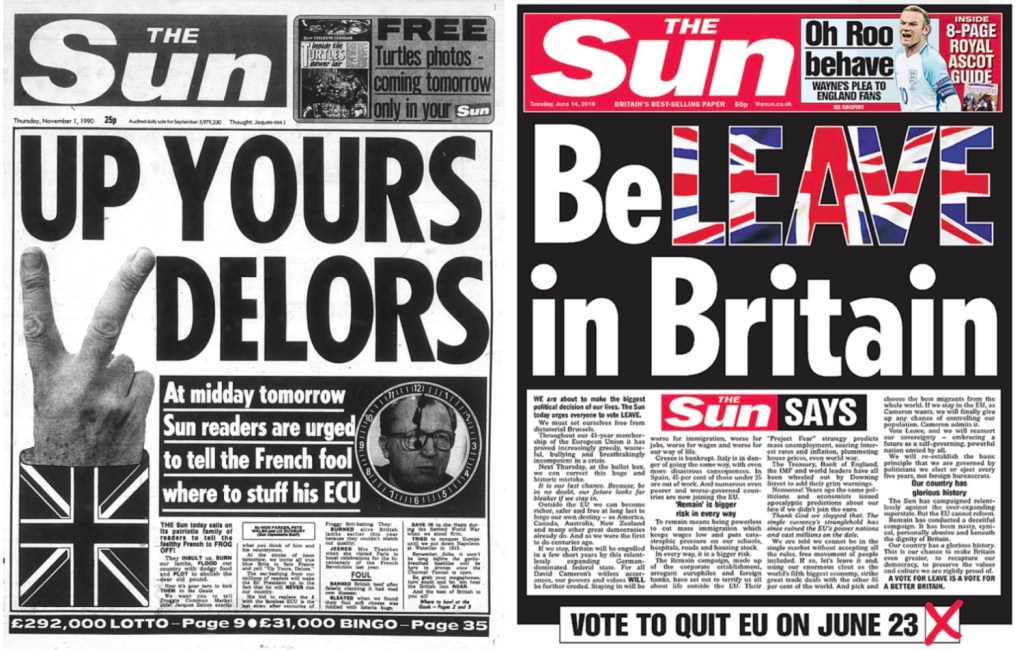
For years, British coverage of the European Union had often been less an explanation of a political, legal and economic structure than a running national cartoon. Brussels. Red tape. Sovereignty. Meddling judges. Straight bananas. Foreigners telling us what to do. The details varied, but the associations became familiar. Europe meant interference. Migration meant loss of control. Sovereignty meant escape.
This did not happen by accident, nor did it begin with the referendum campaign. The British tabloid press had spent decades acting not merely as a mirror of Eurosceptic feeling but as one of its suppliers. There is unusually strong evidence that this influence was causal rather than merely reflective. After The Sun’s reporting of the Hillsborough disaster produced a sustained boycott across Merseyside, its readership there fell sharply for reasons unrelated to Europe. Over the following decades, Euroscepticism declined relative to comparable areas of northern England. The effect was strongest among working-class voters, who had previously been the paper’s principal readership, and among generations that came of political age during the boycott. Merseyside also voted substantially less heavily for Leave in 2016 than its earlier referendum position and regional characteristics would otherwise have predicted.
This does not mean that The Sun caused Brexit, or that economic insecurity, immigration, austerity and regional inequality were unimportant. It does show that tabloid campaigning was more than background noise. Repeated exposure helped shape political attitudes, while the removal of that exposure produced a measurable difference. The press did not simply discover a ready-made Eurosceptic public and give it what it wanted. Over time, it helped make that public.
The tabloid press helped set the agenda, repeat the vocabulary, select the villains and make particular associations feel natural. The relationship was reciprocal rather than one-way: newspapers amplified themes supplied by politicians and campaigns, while politicians adapted their rhetoric to frames the press had already normalised. By the time the referendum arrived, much of the emotional groundwork had been laid.
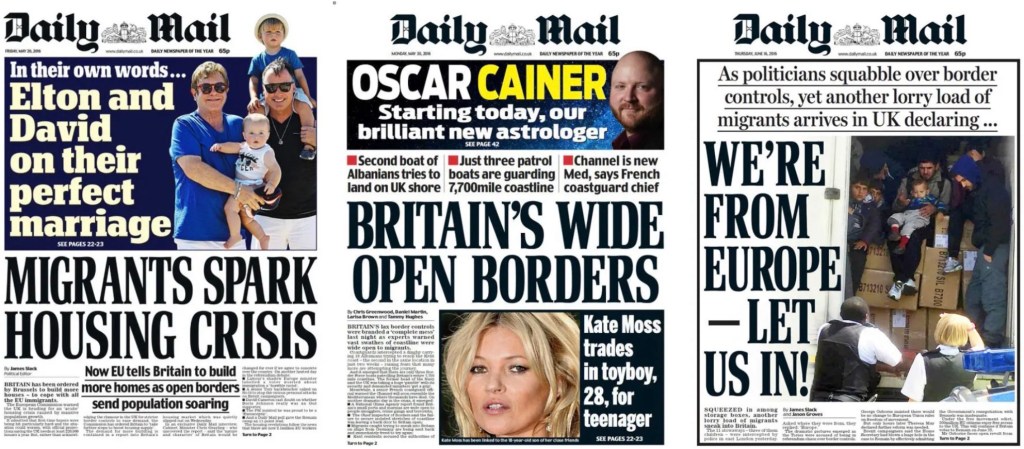
Research into the referendum press supports that broad picture. Reuters Institute analysis found a pronounced imbalance towards pro-Leave coverage in the national press and a heavy dependence on campaigners, politicians and familiar public figures. Experts, academics and foreign voices appeared much less prominently than might be expected in a decision of such constitutional weight. Other analysis, including work by Loughborough University, rightly complicates any claim that the campaign ignored economics. Economic coverage was extensive and, through much of the campaign, exceeded immigration coverage.
But discussion is not the same as explanation, and quantity is not the same as quality. Economics was everywhere, but it was often presented through competing campaign claims, selective forecasts, false equivalence and headline figures detached from the assumptions beneath them. The £350 million NHS bus was an economic claim. So were warnings that were reported less as arguments to be examined than as ammunition in a contest between ‘Project Fear’ and ‘taking back control’. Some economic assessments were careful and evidence-based; others were exaggerated, misleading or plainly false. Once the information environment had been saturated by misinformation, disinformation and mutually incompatible promises, the mere presence of economic language could not guarantee economic understanding. Visibility without dependable context may confuse public perception as effectively as silence.
What was the single market? What did customs-union membership actually do? How did regulatory alignment work? What was the difference between sovereignty in constitutional theory and sovereignty in a world of supply chains, treaties, standards and reciprocal obligations? What kind of Brexit was being authorised: participation in the European Economic Area, a customs union, a bespoke association, or a much harder separation? What did ‘taking back control’ mean when every modern state exercises power through agreements that simultaneously enable and constrain it? These questions were covered at times, sometimes very well. But they were too rarely the organising centre of the national conversation.
The dominant campaign language was emotional and performative. Brexit became freedom to some, catastrophe to others, betrayal to others still. The Leave campaign benefited most obviously from seductive simplicity, but Remain often answered with a barrage of economic danger rather than a confident account of what European membership was, how shared sovereignty worked, or why interdependence could enlarge rather than diminish national agency. One side offered a fantasy of liberation; the other too often offered risk management. Neither was well designed to produce public understanding.
This is where the idea of an island mind becomes relevant, although geography alone cannot explain it. Ireland, Iceland, Malta and Japan are islands, and each has developed a very different relationship with its neighbours and the wider world. Nor is the United Kingdom politically or culturally uniform. Scotland, Wales, England and Northern Ireland have distinct histories, political traditions and experiences of Europe. Northern Ireland is not even located on the island of Great Britain. ‘Island mind’ therefore cannot be a geographical law. It is better understood as a historically produced habit of political imagination: the recurrent representation of Europe as something external acting upon Britain, rather than as a shared political space in which Britain itself was an influential participant.
What distinguishes Britain from those other islands is not water but history. Britain was not merely separated from continental Europe; it had once governed a global empire and had long imagined itself as the centre of a worldwide political, commercial and military system. The empire disappeared, but many of its symbols and habits of thought survived: the monarchy, the Commonwealth, nuclear weapons, a permanent seat on the United Nations Security Council, the City of London, the global reach of the English language and the repeatedly invoked ‘special relationship’ with the United States. These are real sources of influence. They have also made it easier for political rhetoric to exaggerate Britain’s freedom of action and understate its dependence upon neighbouring markets, institutions and regulatory systems.
Brexit drew heavily upon this post-imperial exceptionalism. The promise was not simply that Britain could function outside the European Union, but that departure would release a naturally global nation from an unnaturally European confinement. ‘Global Britain’ would recover sovereignty, negotiate superior trade agreements and resume a role supposedly diminished by membership of a regional bloc. Europe was presented as something Britain had become trapped inside, rather than the geographical, economic and political environment in which Britain continued to exist. The Channel supplied the physical distance; imperial memory supplied the story Britain told itself about what that distance meant.
Even here, however, ‘Britain’ can conceal as much as it reveals. The strongest electoral expression of Brexit came from England outside its largest cities, while Scotland and Northern Ireland voted to remain and Wales contained its own regional and demographic divisions. Much of the sovereignty language was therefore entangled with English nationalism, yet was routinely spoken in the name of Britain as a whole. That constitutional ambiguity mattered. A campaign promising to restore the authority of the United Kingdom also exposed how unevenly that kingdom imagined itself.
Too much British political media has treated Europe as ‘over there’, not as the surrounding context. Other countries appear as examples, warnings, rivals, holiday destinations, markets, threats or props in a domestic drama. Even Ireland, the state with which the United Kingdom shares its only land border, was frequently treated as an awkward historical complication rather than as a political reality central to the practical meaning of Brexit.
The Irish border was not an incidental technicality. It connected the European legal order, the UK’s territorial constitution, the peace settlement, customs policy and the daily lives of communities on both sides. Decades of common European structures had allowed the border to become less visible without making it politically meaningless. Yet it was repeatedly discussed as though goodwill, technology or British improvisation could dissolve the underlying conflict between leaving the EU’s economic structures and preserving a frictionless border.
The issue was not wholly absent before the vote. Specialists, Irish politicians and some journalists raised it. The deeper failure was that its implications were never absorbed into the popular meaning of Brexit. After the vote, reality returned inconveniently and at full size. The border became central because it had always been central. The political debate had merely compressed it out of view.
Continental proximity can alter the mental map, although it does not automatically produce wisdom or internationalism. Across much of the European Union, neighbouring countries are not distant abstractions but part of the ordinary political, economic and cultural landscape. People commute across borders, trade across them, study across them, marry across them and live within regions shaped by constant cross-border exchange. Even those who rarely cross a frontier themselves inhabit economies and societies organised through shared markets, supply chains, laws and institutions. ‘Abroad’ may be half an hour down the road, but interdependence extends far beyond the border regions themselves.
Language reinforces that exposure, especially in northern Europe. Multilingual competence allows people to read neighbouring media, work and study across frontiers, follow political arguments outside their own national setting and encounter other societies with less dependence on translation or domestic interpretation. Britain has historically been unusually weak in this respect. In the last directly comparable EU-wide survey before Brexit, the European Commission’s 2012 Special Eurobarometer on languages found that 61 per cent of UK respondents said they could not hold a conversation in any language other than their mother tongue. Only Hungary and Italy recorded clearly higher proportions, while Portugal matched the UK and Ireland was close behind. At the other end of the scale, more than 90 per cent of respondents in Luxembourg, Latvia, the Netherlands, Malta, Slovenia, Lithuania and Sweden said they could hold a conversation in at least one foreign language. The global reach of English gave Britain an immense practical advantage, but it also reduced the pressure to look outward linguistically. A population able to make itself understood almost everywhere can still become unusually dependent on other people explaining the world back to it in English.
For many continental states, the European Union is therefore not merely an external bureaucracy. It is part of the machinery through which cross-border life is organised. It may be disliked, criticised, mocked or blamed, but it is harder to pretend that it is simply foreign. The United Kingdom’s political culture often did precisely that. A country that had helped write the rules spent years talking as though it had merely been ruled by them.
The British media system intensified this habit, but it did not act alone. Britain has a distinctive press culture: commercially aggressive, highly competitive, tabloid-heavy, adversarial, personality-driven and exceptionally skilled at turning politics into drama. Broadcast journalism is more regulated and often more careful, but it does not exist in isolation. The rhythms of the tabloids, the Westminster lobby, leadership psychodrama and social media bleed into everything. Political parties and campaign organisations actively exploit those incentives; they are not merely their victims. Britain’s weak tradition of constitutional education also left many citizens being asked to decide the future of institutions they had rarely been helped to understand. The result is a political news cycle constantly looking for conflict, humiliation, division and emotional heat.
This is not the same as saying that British journalism is uniformly bad. Britain still has excellent reporters, serious public-service broadcasting, strong investigative traditions and first-rate specialist journalism. The Financial Times, Channel 4 News, Private Eye, parts of the BBC and many individual journalists continue to produce work of real value. The problem is ecological rather than personal. A system can contain outstanding journalism while rewarding a general atmosphere of shallowness.
A minister gives an interview. The first question is not necessarily whether the policy works, how it compares internationally or what evidence supports it. The first question is whether the prime minister has been weakened, whether the opposition has landed a blow, whether the party is split, whether a focus group will like it, or whether a phrase will survive on social media. Politics is treated as theatre because theatre produces clips. Clips produce attention. Attention produces relevance. Relevance produces bookings, advertising, subscriptions, outrage and another round of clips.
The deeper issue is not simply bias. Bias can be identified and argued with. The deeper problem is compression. A biased but detailed argument can still expose its assumptions and be tested. A compressed slogan arrives stripped of the machinery needed to test it. Immigration becomes numbers without labour markets, universities, demography or public-service staffing. Climate policy becomes a cost-of-living ambush without energy security, adaptation or the cost of inaction. Public spending becomes ‘black hole’ versus ‘tax raid’. The NHS becomes waiting lists without workforce planning, social care, ageing or taxation. Crime becomes outrage without prevention, courts, prisons, policing capacity or mental health. Brexit became sovereignty without trade-offs.
Political journalism often fails, in that sense, not because every statement is a lie but because simplification continues until the structure of the problem disappears. The distinction matters. Lies can be corrected, although rarely as loudly as they were first announced. Compression is harder to correct because the missing information is not always visible. The public may never know which questions were not asked.
This is why international European outlets can feel refreshing. They are not magically purer. They can be cautious, formulaic, bland or partial in their own ways. But their format often requires explanation. Distance from the domestic psychodrama helps. Brexit becomes an object of analysis rather than a loyalty test. What happened? Why did it happen? What did it do to trade? How did it affect Northern Ireland? What did it reveal about the British constitution, nationalism, nostalgia and democratic consent? What lessons did the European Union draw from it? Those are better questions than ‘who won the day?’
The intellectual failure of the referendum debate was that too much of it confused emotional clarity with political understanding. All democratic choices simplify. General elections do too. But Brexit was unusual because the ballot compressed an entire constitutional, economic and diplomatic settlement into a single act of yes-or-no symbolism. Leaving was not a policy but an instruction to invent one later. Voters could support the same word while imagining entirely different destinations.
That is democracy at its most dangerous, not when people vote, but when they are invited to vote on a fantasy version of the choice before them. The danger lies less in popular sovereignty than in a decision environment where feasible alternatives, implementation constraints and distributive consequences are obscured. A democratic mandate cannot be more precise than the question and information environment that produced it.
The aftermath exposed the weakness of the original debate. The Irish border became unavoidable. Supply chains proved less romantic than slogans. Sovereignty did not abolish constraint. Trade agreements involved trade-offs. Regulatory autonomy created regulatory friction. Small businesses discovered forms, certifications and costs that had barely featured in the emotional vocabulary of liberation. Farmers, universities, musicians, exporters, hauliers, scientists and British citizens living in Europe found that ‘taking back control’ had material consequences.
Migration offered an especially revealing example. Ending free movement sharply reduced EU migration, but the post-Brexit system deliberately opened or widened global routes for skilled workers, health and care staff, students and, for a period, many dependants. The result was not the simple reduction implied by much referendum rhetoric. It was a change in the composition and legal organisation of migration. Formal control had indeed returned to Westminster, but control was never synonymous with reduction. It meant political ownership of the rules, including decisions that increased non-EU migration. Some of the outcome resulted from underestimating how extensively new routes would be used; some resulted from deliberate choices made to meet labour-market, university and public-service needs.
Asylum belonged to a separate legal and political system, but it exposed the same confusion between formal sovereignty and practical capacity. Leaving shared European arrangements increased the UK’s freedom to set policy while removing mechanisms that had depended on cooperation and reciprocal obligations. The wider lesson was not that supranational cooperation always works well. It was that shared machinery is much easier to denounce than to replace.
Yet even after these consequences became visible, much of the British discussion remained trapped in performance. Brexit had to be vindicated or denounced, rather than understood. Supporters attributed every difficulty to Remainers, civil servants, judges, Brussels or insufficient ideological purity. Opponents sometimes repeated moral condemnation without examining why the campaign had succeeded, which grievances had been real, or why institutional explanations had failed to travel. Blame displaced audit.
This is where Brexit stops being merely the subject and becomes the warning. The same habits now distort arguments about growth, regional inequality, housing, the NHS, climate adaptation, public investment, infrastructure and democratic trust. These problems are structural. They involve time horizons, institutional capacity, distributional conflict and unavoidable trade-offs. They cannot be solved by changing the cast while leaving the machinery untouched. Yet the public is repeatedly offered villains, betrayals, relaunches, crackdowns, pledges and carefully rehearsed fury.
The public is not stupid. It is busy, tired, anxious and repeatedly offered bad tools. Most people cannot spend their days studying customs law, energy systems, fiscal multipliers, housing supply or demographic projections. Democratic societies create journalism, universities, civil services and representative institutions partly because no citizen can master everything alone. When those institutions translate complexity badly, outrage fills the space. If politics is presented mainly as outrage, it is hardly surprising when outrage becomes the language in which politics is understood.
That gives populism a natural advantage. Populism does not arise from media habits alone. It feeds on real experiences of insecurity, neglect, inequality, cultural change and powerlessness, particularly where people feel ignored or patronised. But a compressed media culture makes those grievances easier to redirect towards simple enemies and impossible promises. Populism divides society morally between an authentic people and a corrupt or treacherous elite, then explains complexity as deliberate obstruction. Foreigners, judges, migrants, civil servants, experts, metropolitan institutions, Brussels or London can be inserted as required. If the media environment has already taught people to expect politics in short emotional bursts, populism enters a prepared room.
The conclusion is not that European media is virtuous and British media uniquely stupid. That would be another compressed argument. The real distinction is between political journalism that explains and political journalism that performs, and most outlets do both in varying proportions. One treats politics as a system of institutions, incentives, constraints and consequences. The other treats it primarily as theatre. Britain has too much of the second.
Its tabloid tradition, Westminster centralisation, adversarial political style, post-imperial exceptionalism, English nationalism expressed as British sovereignty, historically externalised conception of Europe and social-media-driven news cycle reinforce one another. Island geography is a background condition, not a destiny. The Channel made psychological separation easier to imagine, but empire gave that separation grandeur and political meaning. The more immediate causes remain institutional: the incentives under which political actors, campaign organisations and media outlets work, together with a thin culture of constitutional explanation. The result is a debate that becomes narrower, louder and more self-referential. Britain talks to itself about itself, then seems surprised when the rest of the world has moved on.
Brexit revealed what happens when decades of caricature, grievance and poor exposition meet a binary constitutional choice. It also revealed that misinformation need not eliminate serious subjects from public debate. Economics was discussed constantly. But when reliable analysis, campaign propaganda, selective forecasts and demonstrably misleading claims are poured into the same theatrical format, public attention can be abundant while public understanding remains poor. Noise is not knowledge.
A healthier political media would do something unfashionable. It would slow down. It would explain before provoking. It would compare internationally without using other countries as props. It would distinguish policy from tactics, evidence from anecdote, formal power from practical capacity, and democratic choice from emotional manipulation. It would admit uncertainty without treating uncertainty as weakness. It would preserve trade-offs rather than editing them out. It would treat viewers and readers as adults.
A dangerous experiment, admittedly. But perhaps one worth trying.
Selected sources and evidence
Allen, William L. A Decade of Immigration in the British Press. The Migration Observatory, University of Oxford, 7 November 2016.
Borchardt, Alexandra, Felix M. Simon and Diego Bironzo. Interested but Not Engaged: How Europe’s Media Cover Brexit. Reuters Institute for the Study of Journalism and PRIME Research, University of Oxford, 2018.
Deacon, David, et al. UK News Coverage of the 2016 EU Referendum: Report 5 (6 May-22 June 2016). Centre for Research in Communication and Culture, Loughborough University, 27 June 2016.
Electoral Commission. Results and Turnout at the EU Referendum. First published 16 July 2019; updated 25 September 2019.
European Commission. Europeans and Their Languages. Special Eurobarometer 386, June 2012.
Gamble, Andrew. Between Europe and America: The Future of British Politics. Palgrave Macmillan, 2003.
Gilroy, Paul. Postcolonial Melancholia. Columbia University Press, 2005.
Hallin, Daniel C., and Paolo Mancini. Comparing Media Systems: Three Models of Media and Politics. Cambridge University Press, 2004.
House of Commons Northern Ireland Affairs Committee. Northern Ireland and the EU Referendum. First Report of Session 2016-17, HC 48, 26 May 2016.
Home Office. The UK’s Points-Based Immigration System: Policy Statement. CP 220, 19 February 2020; and UK Points-Based Immigration System: Further Details Statement, 4 August 2020.
Kumar, Krishan. The Making of English National Identity. Cambridge University Press, 2003.
Levy, David A. L., Billur Aslan and Diego Bironzo. UK Press Coverage of the EU Referendum. Reuters Institute for the Study of Journalism, University of Oxford, 2016.
Simpson, Kathryn, and Nick Startin. ‘Tabloid Tales: How the British Tabloid Press Shaped the Brexit Vote.’ JCMS: Journal of Common Market Studies, vol. 61, no. 2, 2023, pp. 302-322. doi:10.1111/jcms.13386.
Sumption, Madeleine. ‘Essay: Migration Ten Years after the EU Referendum.’ The Migration Observatory, University of Oxford, 17 June 2026. Edited from a chapter in Anthony Seldon, ed., The Brexit Effect (2016-2026), Cambridge University Press, 2026.
UK Statistics Authority. ‘Statement on the Use of Official Statistics on Contributions to the European Union.’ 27 May 2016.
Wellings, Ben. English Nationalism, Brexit and the Anglosphere: Wider Still and Wider. Manchester University Press, 2019.
Edgerton, David. The Rise and Fall of the British Nation: A Twentieth-Century History. Allen Lane, 2018.
Florian Foos and Daniel Bischof, “Tabloid Media Campaigns and Public Opinion: Quasi-Experimental Evidence on Euroscepticism in England”, American Political Science Review, 116(1), 2022, pp. 19–37, first published online 26 August 2021, DOI: 10.1017/S000305542100085X.


Leave a Reply