
I was watching one of my favourite journalists Mehdi Hasan of Zeteo the other day in discussion with the Pakistani-American writer and political commentator Wajahat Ali, when they wandered off on an amusing tangent about racism, cleanliness and the curious habit racists have of describing whichever nationality, race or religion happens to be on the receiving end as “dirty”.
Ali was talking about American white supremacists, the KKK and Patriot Front, and their belief that they represent some sort of “master race”. “They say you’re dirty Indians,” he said, before happily accepting the insult ‘for the sake of argument’: “So, say I’m a dirty Indian even though I’m Pakistani-American. But okay, we’re all dirty. We’re all filthy, right?” Then came his rather more interesting challenge to the master race: “My one question… do you wash your ass?”
The answer, he suggested, was no. “If you don’t wash your ass, but we’re the dirty ones…” at which point the logic rather speaks for itself. “You cannot be the master race,” he continued. “Come back to me with a clean ass and then I’ll entertain your argument.”
Hasan agreed there was “a pure logic to it”, recalling a white man he’d seen on Twitter making much the same point about the French bidet: if you had shit on your arm, would you simply wipe it off with a piece of toilet paper? Of course you wouldn’t. You would wash it. Yet when faeces come into contact with that other part of the anatomy, a quick wipe around with dry paper apparently does the trick.
This struck a chord, not least because after years of living in France with bidets, followed by Thailand, with bum guns, I now find the idea of not thoroughly washing after a number two pretty disgusting. I don’t mean that I have carefully considered the relative merits of the two systems and concluded that washing is preferable. I mean that the idea of wiping with dry toilet paper, pulling trousers up and walking away genuinely feels unsanitary. For those occasions when washing may not be possible, I carry a pack of unscented hypoallergenic or baby wipes. I don’t particularly need my arse to smell of roses, but I do prefer it to be clean.
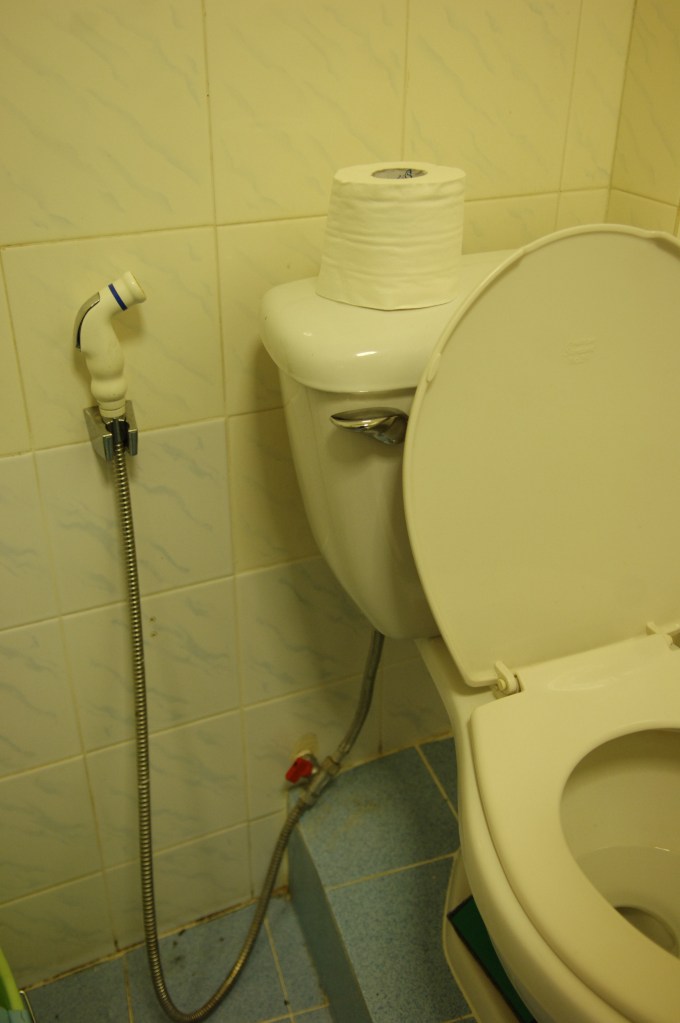
There was also something strangely familiar about the whole discussion, and after a little digging through my memory archives, I recalled an old blog I wrote while living in Thailand. Back on October 28th 2008 I had written a piece called Clean Thais, Smelly Foreign ‘Farangs’…, and apparently I had already been exercised by pretty much the same topic. Not only that, but I had devoted a substantial part of the article to what amounted to an instruction manual for using a sai chit gon, the Thai bum gun, including advice about water pressure, firing range, sun-heated plumbing and the inadvisability of mistaking the apparatus for an enema. So rather than pretend these are entirely new thoughts, much of what follows is what I wrote then, with the benefit of another decade living in Thailand and a little more knowledge about just how culturally peculiar our ideas of cleanliness can be…
Visitors to Thailand from so-called “civilisation” will have heeded all the dire warnings about not drinking the tap water, dengue fever and various other scary diseases, nasty tropical parasites, and usually come equipped with enough pharmaceuticals to stock a small chemist’s. They will have heard the stories about squalid third- and developing-world shanty towns, with rudimentary sanitary systems. Strangely though, it is the Thai who tends to look upon the farang, the white foreigner, as more often than not unclean.
Of course the average Thai would never be so rude as to say so, particularly to the person concerned. But when you have more than a smattering of Thai, their good-natured, slightly embarrassed banter about these strange white giants from afar can be very revealing.
A practice attributed to white foreigners by Thais that I’d hear referred to as the “farang shower” was a case in point. Perspiring, middle-aged, overweight North American, British, Australian, Russian and some European males were as a result the object of considerable humour. Unfortunately the farang shower, the application of copious quantities of expensive aftershave in lieu of actually having a real shower, isn’t always enough to disguise the fact that many do, in fact, well… not to put too fine a point upon it… stink.
Thais generally seem to smell of remarkably little, although Thai women, when they can afford it, will of course happily use perfume as well. Clean-shaven and spotless, no matter what their station in life, they somehow manage to maintain a level of personal hygiene that puts many Western visitors and self-styled ‘expats’ to shame. Much of it boils down to necessity; a tropical climate with invariably high humidity encourages the proliferation of all manner of unfriendly and aggressive microscopic creatures, and if you are foolish enough not to keep scrupulously clean, you are asking for trouble. Frequent showers aren’t regarded as some particularly admirable display of personal hygiene. They are simply part of everyday life.
And “shower” doesn’t necessarily mean a shower in the Western sense. I’ve been in plenty of rural Thai washing outhouses, and even some massage establishments in towns, where there was no electric shower at all, merely a large barrel of water with a wooden or plastic ladle, bowl or whatever other suitable container happened to be floating in it. You simply scoop up the water and pour it over yourself, repeatedly, which does the job perfectly well and has the considerable technological advantage of continuing to function during a power cut. Thai bathrooms are designed for water anyway, with tiled floors and a drain in the corner, so nobody worries about splashing it everywhere. The only slight drawback is that, despite Thailand’s reputation for heat, tipping the first ladleful of unheated water over yourself can occasionally produce a surprisingly rapid intake of breath.
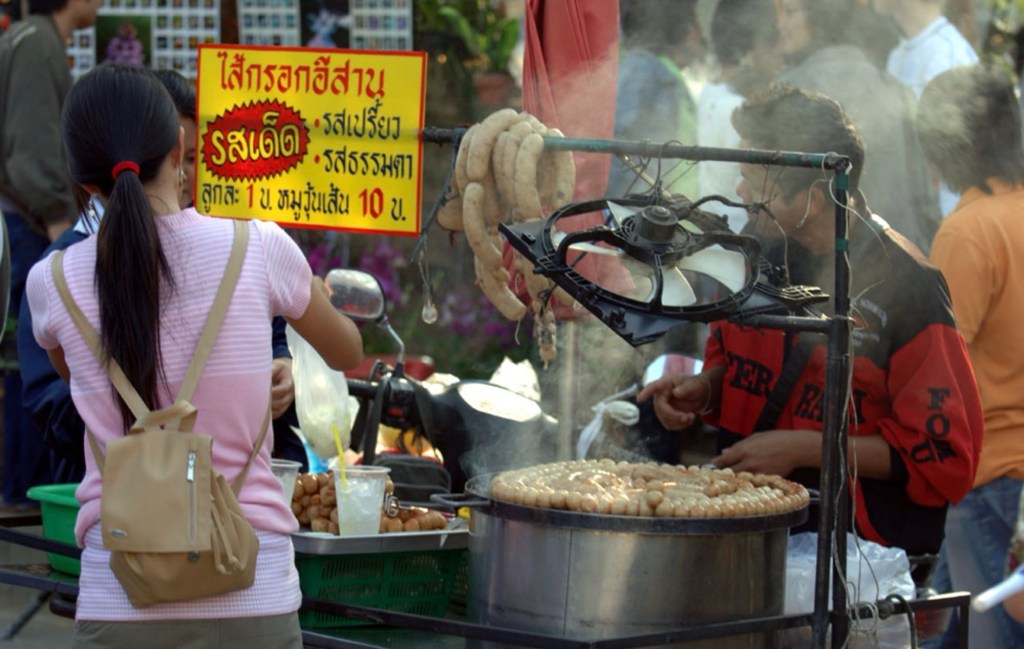
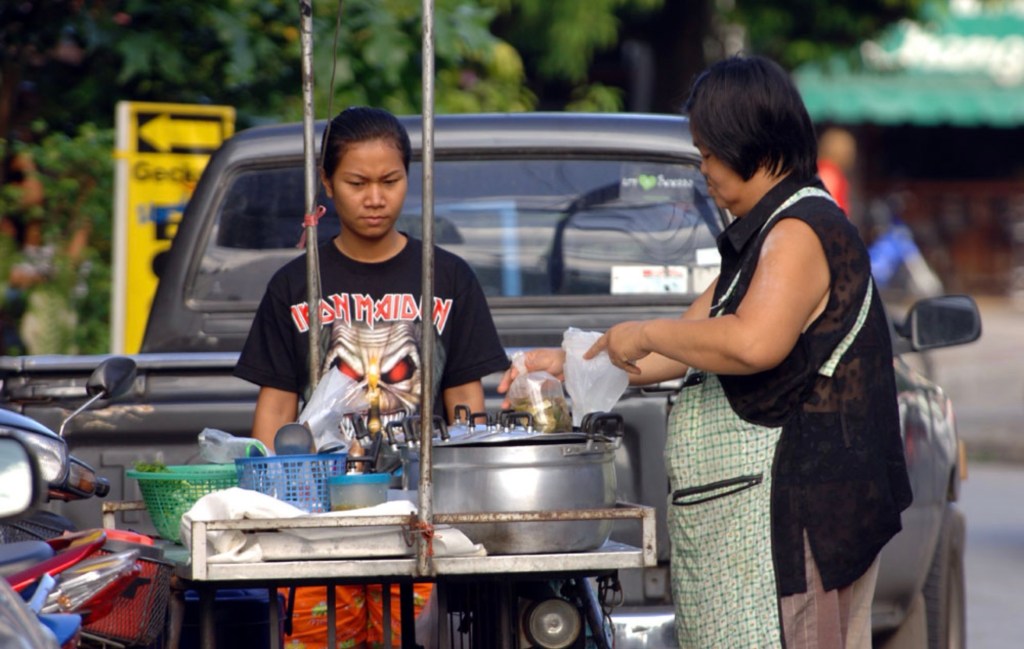
I originally wandered off at this point into food hygiene, and on rereading it I see no particular reason not to do so again, because it was another example of the same assumption working in reverse. Vendors with cooking pots brimming with unrecognisable and strange, spicy-smelling concoctions lined the streets day and night, and many farang tourists gave them a wide berth, preferring the more familiar restaurants and those selling European-style cuisine. Big mistake. The reason those street sellers were so numerous was because Thais bought from them constantly. They were busy, their turnover was rapid, and ingredients didn’t generally hang around for very long before being cooked and sold.
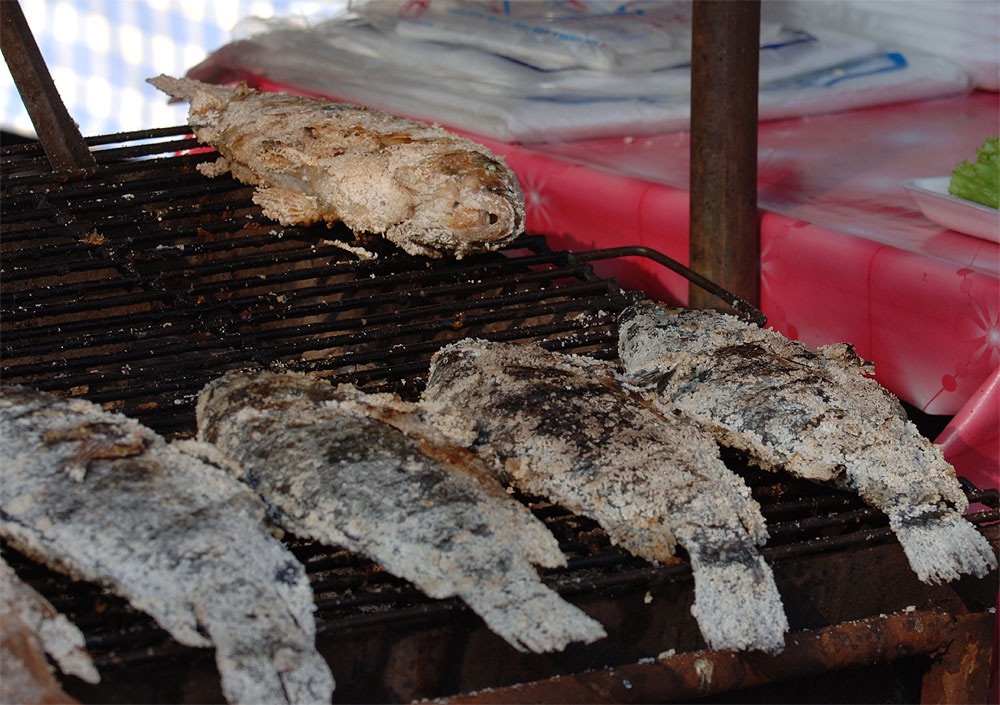
Some Westernised restaurants, on the other hand, attempted to maintain an expensive range of dishes they couldn’t possibly dispose of quickly enough to their rather infrequent patrons, giving those aforementioned microscopic creatures plenty of time to get to work in the tropical climate. As I discovered to my cost in a Chiang Mai English pub/restaurant the night before writing the original article.
The garlicky sauce disguised both the smell and peculiar colour of the flesh, but one bite of the fish fillet was enough. To say it had “gone off” didn’t begin to do its level of putrefaction justice. It had decayed, rotted, decomposed, and was weeks overdue for burial. Or preferably cremation, to avoid poisoning the water table.
I didn’t point the finger at the establishment then and won’t now, despite the English boss eventually managing a reluctant, “Oh well, it can happen, you know”. (Pythonesque visions of John Cleese and Michael Palin resurrecting the parrot sketch…)
“No it hasn’t. It’s still there. It couldn’t have gone anywhere anyway. It was frozen”. “I am not suggesting it made a bid for freedom. I am suggesting that at some point, possibly before it was frozen, it ceased to be suitable for human consumption”.
“Well, it looks ok to me”. “It smells!”
“Smells a bit fishy. That’s normal for a fish”. “This doesn’t just smell of fish! This smells of fish whose next of kin should have been notified some time ago”.
“That’ll be the garlic”… “The garlic is performing an act of public service! Without it, your neighbours would already have called in pest control”.
“It was fresh when it was frozen”. “When was that?”
“Recently”. “Recently as measured by whom? A geologist?”
“Look, perhaps it’s a little past its best”.. “Past its best? It has swum serenely past its best, left its eat-by date somewhere in the Mariana Trench; even sharks would swim an extra mile to avoid it!” “Oh well, it can happen, you know. Have a steak and kidney pie. It’s on the house”…
Thanks, but no thanks. Having established the establishment’s approach to freshness, I wasn’t sufficiently adventurous to investigate the state of the cow’s innards as well, so I left and bought a delicious dish of moo daeng (sliced pork marinated in spices, soy sauce, then grilled or roasted) from a nearby street vendor.
[Edit: just checked the map, and the establishment on the north stretch of the moat no longer exists. Somewhat unsurprisingly, and perhaps fortunately, for Chiang Mai residents and visitors]…
But enough about decomposing fish. Back to human cleanliness, or the lack of it, with feet being one important source of the problem according to inside information from a selection of Thai friends.
Maybe it is something to do with Westerners’ greater average height, or possibly the inability of many to see these extremities at all, the view of which can be obstructed by large fleshy beer- or hamburger-induced pot-shaped bellies. Perhaps it is due to a complete lack of fitness and flexibility, as a result of which they are simply unattainable. Or in vain ignorance, maybe some believe that by pointing the shower in that general direction for a quick blast, despite the fact that soon-to-be-ingrowing toenails provide perfectly sheltered accommodation for all manner of rapidly breeding micro-organisms, they are achieving a satisfactory level of cleanliness. Another problem is that Western feet may be so far away that their owners can’t actually smell them themselves… or perhaps they have simply become so accustomed to the odour that they no longer notice it. It doesn’t help that tourists newly arrived in the tropical climate often insist on wearing both shoes and socks, so that even the most thorough morning scrubbing can be undone within an hour as their feet begin to perspire profusely and the bugs joyfully return.
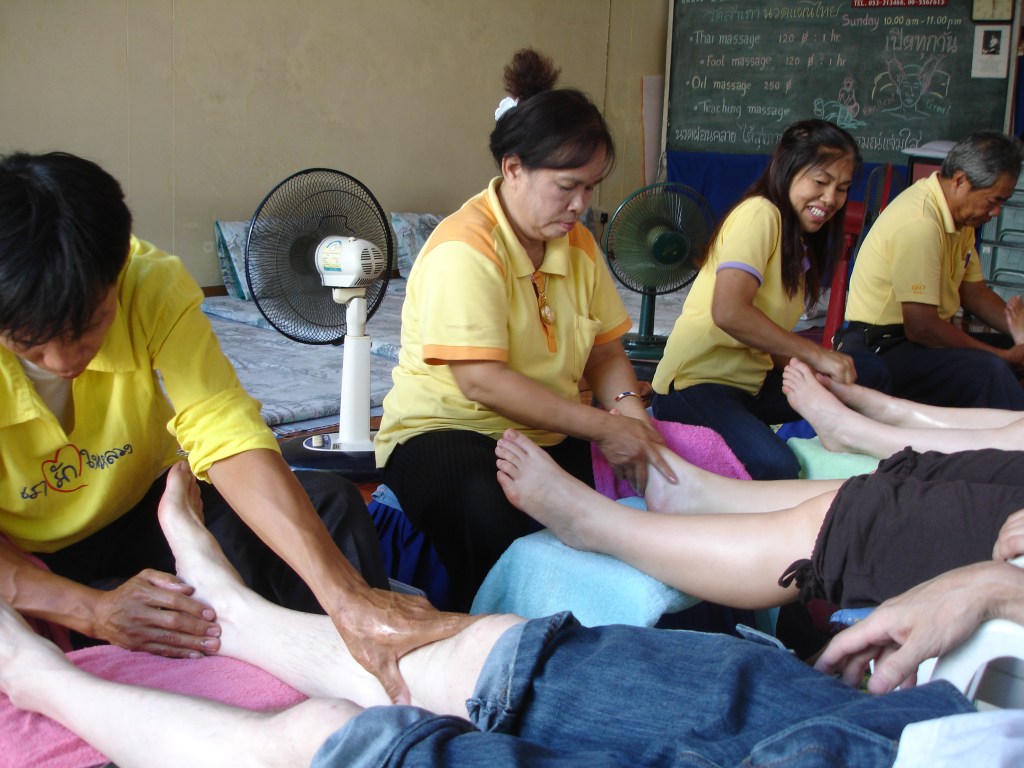
In 2008 I wrote, with an entirely spurious degree of statistical confidence, that I had it on good authority from street masseuses that the feet of nine out of ten European and American men smelled pretty rank, while women could relax a little because apparently only five out of ten pairs of theirs were similarly offensive. I doubt any of my informants had been keeping spreadsheets, so I wouldn’t attach too much scientific importance to the percentages, but what is interesting in retrospect is that another ten years of living in Thailand did absolutely nothing to make me doubt the underlying observation.
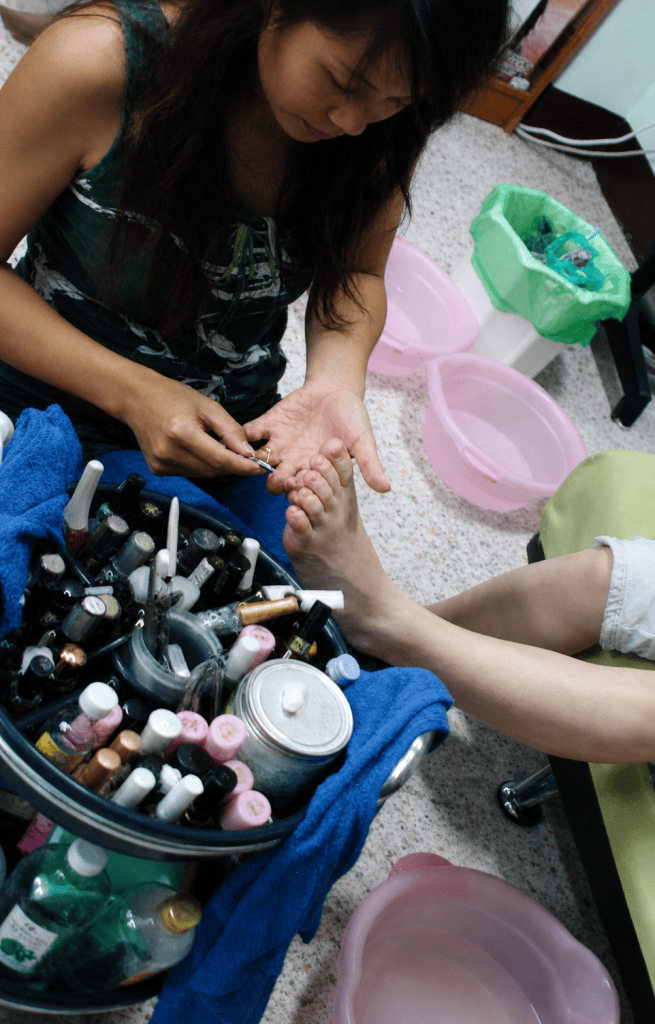
In fact, quite the reverse. I had massages virtually every day for those years, which sounds spectacularly decadent until you remember that an hour cost around €5, and I had a manicure and pedicure roughly twice a month, generally for €8–10 for the pair. At those prices, doing it yourself seemed less an admirable display of self-reliance than an inexplicable decision to deprive somebody of an income while making a considerably worse job of your own toenails. Consequently I spent an absurd number of hours over the years sitting or lying around while Thai masseuses, manicurists and pedicurists talked amongst themselves, and cleanliness, particularly the cleanliness of farangs, came up often enough for me to know that I hadn’t imagined it.
I could see the difference for myself as well. Thai customers generally arrived with feet which were already washed and looked after, whereas a surprising number of Western customers, by no means all elderly or overweight, plainly hadn’t given theirs the same attention.
The staff wouldn’t normally dream of telling an unfamiliar foreign customer this, of course, because deliberately embarrassing somebody runs contrary to the Thai instinct to avoid causing loss of face. But in places where I became a long-standing regular, once the staff knew me well enough and, more importantly, knew that I wasn’t going to become offended on behalf of Western civilisation if they suggested that some farangs were less than fragrant, they didn’t hold back. After ten years of listening to the people who actually had to sit inches away from the evidence, I wasn’t inclined to argue.
But now I have to move on to a more sensitive subject, still related to cleanliness, or the lack of it.
When you visit Thailand for the first time, you may be surprised to find something that resembles a shower hose, complete with high-pressure nozzle, attached to the wall of the bathroom next to the toilet. You would be excused for wondering what purpose this could possibly serve.
The little lever or button is indeed for releasing a powerful jet of water, so should you be tempted to experiment as you meditate from a sitting-down position, make sure to point the device at a distant wall. Nearby targets tend to have a ricochet effect and are likely to result in you emerging from your contemplations looking as if you forgot to get undressed before taking a shower. And it goes without saying that you shouldn’t squeeze the lever while looking directly into the nozzle.
The main purpose of this device is to avoid having to apply reams of toilet paper to the posterior, with potentially rather smelly consequences. Used with skill, posterior showering while sitting down takes some mastery and, to avoid embarrassment, is best practised within the safety of your hotel bathroom until you get the hang of it, but it is a vast improvement on the toilet-paper alternative. For obvious reasons it results in the sort of rear-end cleanliness I had previously encountered in France with the bidet.
A few tips for the uninitiated.
In unfamiliar surroundings it may be worth first testing the water pressure with a quick single downward burst into the toilet bowl. Excessively powerful jets can have undesirable effects, so do this before spending a penny, rather than afterwards when it may be rather too late to reconsider the wisdom of the exercise. Having established that the apparatus isn’t capable of removing paint, ensure that you have the nozzle pointing in the right direction; somewhere between an inch and a couple of inches is the correct firing range, and for the sake of those who may visit the bathroom after your departure, do try to avoid actual contact between nozzle and rear passage.
Bear in mind too that Thai plumbing may involve routing cold-water pipes through outside areas exposed to direct sunlight, so during daylight hours be prepared to abort the operation rapidly should the water temperature suddenly begin to climb. What entered the pipe as cold water can have undergone a fairly impressive transformation by the time it reaches the business end. Then, assuming pressure, direction and temperature have all passed inspection, fire.
Please also bear in mind that this is not the Thai version of an enema wash. Consequently a short burst of between five and ten seconds is usually ample, irrespective of any pleasure you might be experiencing. Ladies, of course, have an excuse to use the device rather more frequently than men, but whether your sex lives are wanting or not, and irrespective of whether the sensations involved prove somewhat more exciting than those produced by earlier activities of an intimate nature with your partner, please bear in mind that a growing queue of desperate people may be waiting outside.
Finally, the disposal basket marked with words to the effect of “please place your used toilet paper in here and not in the bowl” is for the benefit of those who have used this implement to good effect, and not an invitation to squeamish Anglo-Saxons to deposit the results of the old-fashioned method in an open basket beside the toilet for subsequent visitors to admire.
I finished that section in 2008 by writing: “Once you’ve got into the habit of using this device, you’ll never want to go back to your old ways, believe me. You’ll be looking around the local plumbing supply outlets for one to take home with you.” Nearly eighteen years later, I can report that the prediction proved entirely accurate.
What I wasn’t aware of when I wrote it was quite how large a proportion of humanity would regard the Thai approach as unremarkable. The bum gun itself is only one manifestation of a practice found across much of Asia, the Middle East and elsewhere, using hoses, sprays, jugs, dippers, bidets and, increasingly, toilets sophisticated enough to do most of the work themselves.
This is where Hasan and Ali’s discussion added something to my old observations that hadn’t occurred to me at the time. In Muslim societies, washing after urination and defecation isn’t merely a Thai-style cultural preference but has deep religious roots. Islamic practice has a name for cleansing oneself after going to the toilet, istinja, and although water isn’t the only permissible means in every circumstance, washing with it has been part of Islamic hygiene for centuries. Across much of the Muslim world a hand spray, jug or other water container beside the toilet is therefore entirely ordinary. Hasan and Ali, both of Pakistani heritage, spent part of their conversation laughing about the lota, the little water vessel familiar across South Asia, and about the improvised alternatives used when one isn’t available. Ali even recalled going to the communal bathroom at university carrying a green watering can.
Hasan supplied an even more revealing little cultural collision. Growing up in America, he said that right up until college he had no idea what people meant by “streaky underwear”. He simply hadn’t encountered the phenomenon. His explanation was wonderfully uncomplicated: when you wash your arse with a lota, “you don’t have these problems.” In other words, he had reached college without becoming acquainted with that evocative little expression familiar to generations of British schoolchildren, the “skid mark”. It is difficult to think of a better illustration of how completely normal one culture’s lavatorial habits can seem until somebody brought up with different ones looks at the consequences and asks the obvious question.
The practice isn’t specifically Muslim either, which makes any attempt to turn this into another competition between civilisations rather pointless. Washing after defecation has long traditions across South Asia, including Hindu ones, and is commonplace across large parts of Southeast Asia. Thailand is predominantly Buddhist, the Philippines has its tabo, Indonesia and Malaysia have their own variations, while Japan took the basic idea that perhaps water might clean a bottom rather better than dry paper and did what Japan sometimes does with simple technology: added heated seats, adjustable jets, dryers and enough controls to make an unsuspecting visitor wonder whether he is about to wash his arse or launch something into orbit.
Europe has its own history. The bidet was invented in France, where I became accustomed to using one long before Thailand, although curiously the French have increasingly removed them from modern bathrooms. Italy has remained considerably more attached to the idea, and the bidet became firmly established in various other countries, notably Argentina. There is no neat religious or racial division here at all; there are simply different cultures which arrived at different definitions of what constitutes being clean after going to the toilet.
Which brings me back to Ali’s “dirty Indians”, and to all the other variations on the same insult. The British “smelly Frog” is a relatively mild and often jokey example, but “dirty”, “filthy” and “smelly” have always been particularly effective ways of denigrating outsiders because disgust is such a powerful human reaction. Dirt and physical contamination slide remarkably easily into ideas of moral contamination; the language itself gives the game away when people talk about dirty thoughts, filthy habits, clean living and moral purity. Colonial powers repeatedly described colonised populations as dirty, diseased or unhygienic, and immigrants and racial or religious minorities have been subjected to much the same language ever since. The foreigner’s food smells peculiar, his house is dirty, his habits are filthy, and from there it is a remarkably short psychological journey to suggesting that the people themselves are somehow contaminating. The accusation is particularly useful because the person making it rarely thinks of his own habits as cultural habits at all; they are simply ‘normal’.
This is the peculiar thing about cleanliness: much of it is learnt rather than objectively examined. If you grow up in Britain using toilet paper, wiping yourself thoroughly after having a shit feels perfectly clean because that is what “finished” has always meant. There is no reason to sit there contemplating whether rubbing faecal matter from skin with pieces of dry paper really represents the pinnacle of sanitary technology, because everyone else does it too. The ritual has been completed, therefore you are clean. Live for long enough somewhere where washing is normal, and the definition changes. Mine certainly did. What once seemed an entirely ordinary British procedure now seems to me physically disgusting, which is why Hasan’s comparison with getting shit on your arm is so effective. If it happened to virtually any other part of the body, nobody would seriously suggest that several passes with dry tissue constituted washing. There is apparently one small area of Anglo-Saxon anatomy where, historically, an exception has been made.
It also makes the largely Anglo-Saxon tradition of “mooning” considerably less appealing. There is something faintly heroic about a culture which not only decided that dry paper was sufficient for cleaning its arses, and coined a familiar expression for what sometimes ends up in the underwear when it isn’t, but subsequently invented a form of comic insult involving pulling down that underwear and presenting the inadequately washed area itself to friends, passing motorists, opposing football supporters and assorted strangers. Viewed from a bum-gun culture, it does rather take some of the gaiety out of the gesture.
None of this proves that Muslims are cleaner than Christians, South Asians cleaner than Britons, Thais cleaner than Americans or Japanese owners of electronic lavatories morally superior to people armed with a roll of Andrex. That would simply replace one stupid cultural stereotype with another, and cleanliness encompasses rather more than what happens after a bowel movement. But there is something irresistibly absurd about calling another people “dirty” while remaining completely unaware that one of your own most intimate everyday habits may strike them as considerably more revolting than anything you imagine about theirs.
Back in 2008 I thought I was writing a mildly irreverent piece about Thai attitudes towards smelly farangs and, for reasons which seemed perfectly reasonable at the time, providing detailed instructions on the safe operation of a bum gun. I didn’t realise that nearly eighteen years later I would listen to two Muslim Americans discussing white supremacists, “dirty Indians” and the rather fundamental problem of claiming to be the master race while apparently neglecting to wash their arses, and discover that the joke contained a rather larger point.
If you get shit on your arm, you wash it. Perhaps before deciding which races, religions or nationalities are dirty, it might be worth considering why the same principle suddenly becomes optional when the shit is on your own arse.


Leave a Reply