
I regularly watch Mehdi Hasan on his Zeteo channel. I have always admired him. He is quick-witted, combative, incisive, formidably well informed and, at his best, almost impossible to evade. He has a particular gift for pinning politicians to facts when they would much rather disappear into rhetoric, and for spotting the evasions, sleights of hand and carefully constructed non-answers that so many interviewers simply let pass.
And yet, whenever one of his debates pops up in my feed, irrespective of context, one exchange with Richard Dawkins comes back to me uninvited. Dawkins asked whether he believed that Mohammed had gone to heaven on a winged horse, adding that he would do Hasan “the compliment” of assuming that he did not. Hasan replied that indeed he did: he believed in miracles.
That answer has bothered me ever since, not because I find the broad idea that there may be something beyond our present understanding inherently absurd. Quite the opposite. The mystery of existence is so vast that I find certainty itself faintly ridiculous. Why there is something rather than nothing; why there are laws of physics at all; why consciousness exists; whether our universe is one among many; whether the word ‘before’ even has any meaning when discussing its origins. These are mysteries that reduce us to the magnificently insignificant creatures we are, and I rather like that feeling.
What I cannot understand is how one gets from there to a God who, despite presiding over an incomprehensible cosmos, apparently takes a peculiar interest in foreskins, masturbation, homosexuality, what women wear, who sleeps with whom, what we eat and when we eat it; a God whose supposed wishes have been invoked at various times to regulate slavery, sanction slaughter and, in some religious traditions, justify female genital mutilation, while His representatives on Earth claim divine authority to determine whether we are worshipping Him in precisely the approved manner. That is quite a leap.
The problem, for me, is not some vague deistic notion that there might be an originating intelligence, principle or dimension beyond our comprehension. One can speculate about such things without claiming to know much about them, or indeed anything at all. The problem begins when wonder becomes revelation, revelation becomes doctrine, doctrine becomes certainty, and certainty becomes power. Something deeply human and, in its original form, rather beautiful has then mutated into something else entirely.
I have used the analogy of a cancerous tumour before, and I mean it. Not because wonder itself is diseased, but because organised religion grew out of that wonder, fed on our fear and learned to exploit it, while slowly consuming its own host. The mystery that gave birth to religion was gradually diminished by the absolutist answers it claimed to possess, until wonder itself became a pale shadow of what it had been.
Christopher Hitchens caught the authoritarian absurdity rather neatly when he described the prospect as a “celestial North Korea”. And perhaps more ludicrously, given the unimaginable expanse of space and time, with our universe itself perhaps only one among innumerable others, we still somehow manage to cast this tiny, insignificant species of ours in the starring role of the cosmic drama.
Once that certainty hardens into doctrine, the consequences can become grotesque. An ordinary political enemy can at least be negotiated with; an infidel, apostate or heretic is something else. Once human conflict is given cosmic authority, murder can be renamed righteousness. History is littered with people persecuted, expelled, enslaved or killed because they had the misfortune to worship the wrong God, worship the ‘right’ God incorrectly, or worship no God at all.
The breathtaking part is that mutually incompatible religions have all managed to arrive at much the same certainty. I usually remain quiet, but faced with the more persistent believers who attempt to preach at me, I raise the argument from religious diversity, or more bluntly the argument from geography: had you been born somewhere else, there is a very good chance you would be defending a different revelation with exactly the same degree of certainty…
“You do realise that if fate had arranged for you to be born in New Delhi, Riyadh, Uzbekistan, Salt Lake City or the Philippines, you probably would now be standing there bombarding me with ‘facts’ based upon the incontrovertible truths contained in the sacred texts of a completely different religious tradition? Same confidence, same sincerity, different revelation”.
I have tried roughly that argument on Jehovah’s Witnesses more than once. One pair called at the house when I was at a particularly low ebb, finding me in no mood to smile politely and accept a leaflet. Their certainty has always fascinated me vastly more than whatever it was they had actually come to tell me. I try to get them to accept that, had they been deposited at birth into another family, another country and another religious culture, the chances are overwhelmingly in favour of their turning up at somebody else’s door years later with an entirely different collection of incontrovertible truths. At about this point an almost physically perceptible mist tends to sweep across the eyes, followed soon after by disengagement.
This reaction has changed remarkably little over the years. One freezing evening in late 1975, standing in the doorway of my room in ‘L’ Block at the UEA residences in Fifers Lane, Norwich, I had been conducting much the same discussion with some Christian evangelists, while becoming increasingly irritated by the amount of precious heat escaping into the corridor. Eventually my visitors gave up. As I closed the door on their retreating backs, I heard one say to the other, with magnificent condescension: “He’s lost…”
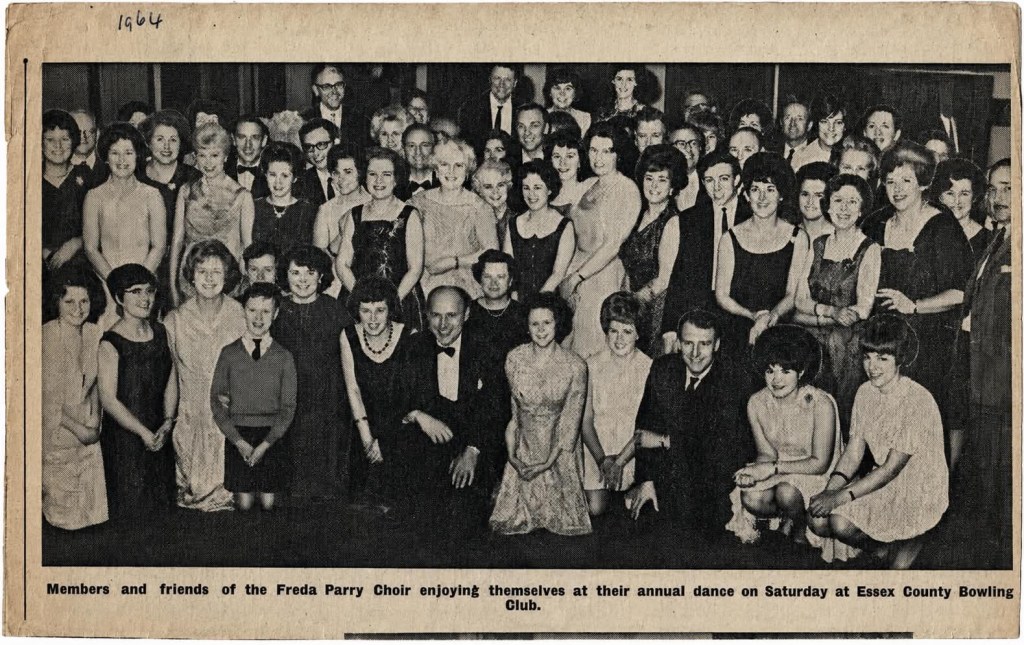
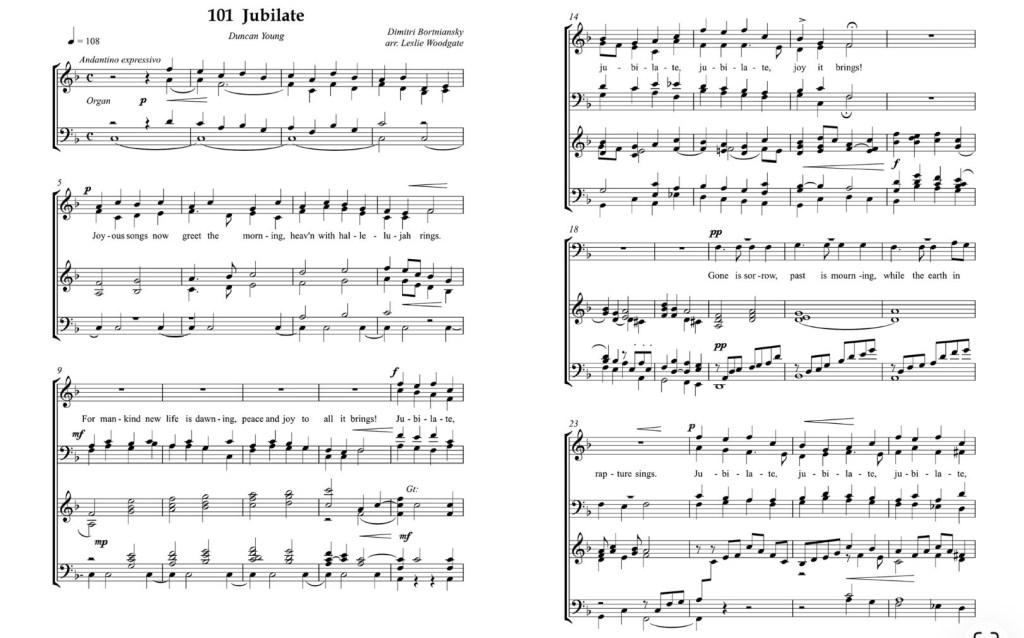
Yet none of this came from growing up outside religion and looking in. Quite the reverse. Mine was a thoroughly Church of England childhood: Sunday services twice, choir plus twice-weekly choir practice. Saturday mornings took me to Crusaders meetings – an evangelical Christian youth movement which, unsurprisingly, has since decided that the name needed a little twenty-first-century attention and now calls itself Urban Saints. Memories of my grandmother saying grace before Sunday lunch. I became head choirboy[1] at St Barnabas in Hadleigh and sang with Madame Freda Parry OBE’s Parry Singers in Southend-on-Sea. I can still remember the ridiculous pride I felt singing the descant to the Hallelujah Chorus above all those grown-up voices. I was sent around retirement homes to give my rendition of Jubilate — minus the organ — together with other mostly religious offerings, all performed entirely without reflection. I have not looked at the score of Jubilate for fifty-seven years, but I can still sing it and remember the words. Such is the power of indoctrination at an early age. The old Jesuit maxim comes rather uncomfortably to mind: ‘Give me the child until he is seven and I will give you the man’. In my case they failed to get the man, but they certainly did a remarkably durable job on the soundtrack. The falsetto top notes are another matter: what was once a top A now seems to have negotiated itself down to somewhere around E-flat, while my perfect pitch has evolved into perfectly out-of-tune pitch. I also remember the faces of the old people in those retirement homes, people who seemed impossibly ancient to me then. I am now among their number.
So religion was not some external doctrine being forced upon a naturally sceptical child. It was simply part of the architecture of my world. We moved to Harrogate when I was thirteen. I soon recovered my status as head choirboy, this time at St Luke’s. Yet barely a year later my whole belief structure collapsed.
It happened during a Sunday evening service while I was singing a psalm. I remember the book in my hands, the separately printed sheet of musical notation and, with extraordinary clarity, looking at the words beneath it and suddenly thinking that they were not merely questionable but absurd. Nonsensical. I stopped singing; before long a few people around me noticed, and on the way out I was asked whether I was unwell. I muttered something incoherent and escaped home.
Then it all came flooding out to my parents. The whole thing was ludicrous. They tried to reason with me, but every attempt merely exposed another fault line, and within days my newly discovered thirteen-year-old scepticism had arrived at what seemed to me the fundamental circularity: this ancient book was true because it was divinely inspired, while we knew it was divinely inspired because the book and the religion built around it told us so.
There was also the problem of evil. Why would a compassionate God permit the suffering of innocents? Why would an all-powerful Father stand by while children suffered? The vicar came round a few days later and specifically explained to me that “God moves in mysterious ways”. It was precisely the answer I did not need to hear. He tried to talk me back into the spiritual home I had so abruptly vacated, but by then it was too late. The previous Sunday had been the last time I would ever enter a church as a believer.
I do not remember emerging from this at thirteen with some triumphant conviction that I had solved the mystery of existence and proved there was no God. I had done nothing of the kind. Quite the opposite: something foundational had been demolished almost overnight, and the experience was deeply unsettling rather than liberating. The beliefs themselves went, but with them went a large part of the framework through which I had understood the world, and some of the trust I had placed in the people who had helped construct it. My parents had acted lovingly and sincerely, but they had also played a major role in teaching me, as truth, a complete account of reality long before I had the intellectual equipment to examine it properly.
Looking back, I cannot entirely separate that experience from what now seems to me a darker question about the religious indoctrination of children. I know that describing it as something approaching psychological abuse will sound extreme to many people, but that is how it feels to me from the inside. A child is told who created him, what happens after death, which behaviours are sinful, which doubts are dangerous and what eternal consequences may follow from getting any of it wrong. None of this is presented as one possible interpretation among many; it is presented as truth by the adults upon whom the child depends for his understanding of the world. When that structure later failed to survive examination, there was no epiphany, no triumphant victory of reason over superstition, only loss, disorientation and the discovery that something I had trusted absolutely was no longer trustworthy. Once that had happened, there was no easy way of putting it back.
Which perhaps explains why, more than half a century later, Hasan’s winged horse still gets under my skin. Here is a man I admire precisely because he applies ruthless scepticism to unsupported claims, notices contradictions, demands evidence and refuses to let clever people disappear into rhetorical fog; and yet when Dawkins asks whether he literally believes Mohammed went to heaven on a winged horse, Hasan says yes. No explanation required. Mohammed, apparently, moves in mysterious ways too.
What disappointed me even more was what came afterwards. A few weeks later, Hasan returned directly to the exchange in a New Statesman article (non-paywalled access) which began with Dawkins’s winged-horse question and set out his defence of belief in God, miracles and revelation. Nor was I alone in finding the apparent contradiction jarring. As the exchange spread online, Dawkins himself eventually put the problem to Hasan in almost exactly those terms: why, he asked, should religious beliefs be “uniquely exempt from the critical eye which you deploy everywhere else in your journalism?”
That, precisely, is what bothers me. Hasan’s longer answer seemed to do exactly what I have watched him stop politicians doing for years: move away from the narrow, awkward proposition towards broader and much safer ground. Dawkins had not asked whether some conception of God could be defended philosophically, whether the universe required explanation or whether miracles were logically possible. He had asked whether Hasan genuinely believed that Mohammed had gone to heaven on a winged horse. Hasan’s answer was yes. None of the broader arguments seemed to me to answer the obvious next question: why believe that particular event actually happened?
Much of the discussion that followed managed the same evasive shift, wandering off into scientism, atheist fundamentalism, prejudice against religion and the philosophical possibility of God. All interesting questions, perhaps, but none of them answered the one Dawkins had actually exposed: why believe that this particular miraculous journey happened? Somewhere along the way, the horse quietly left the room.
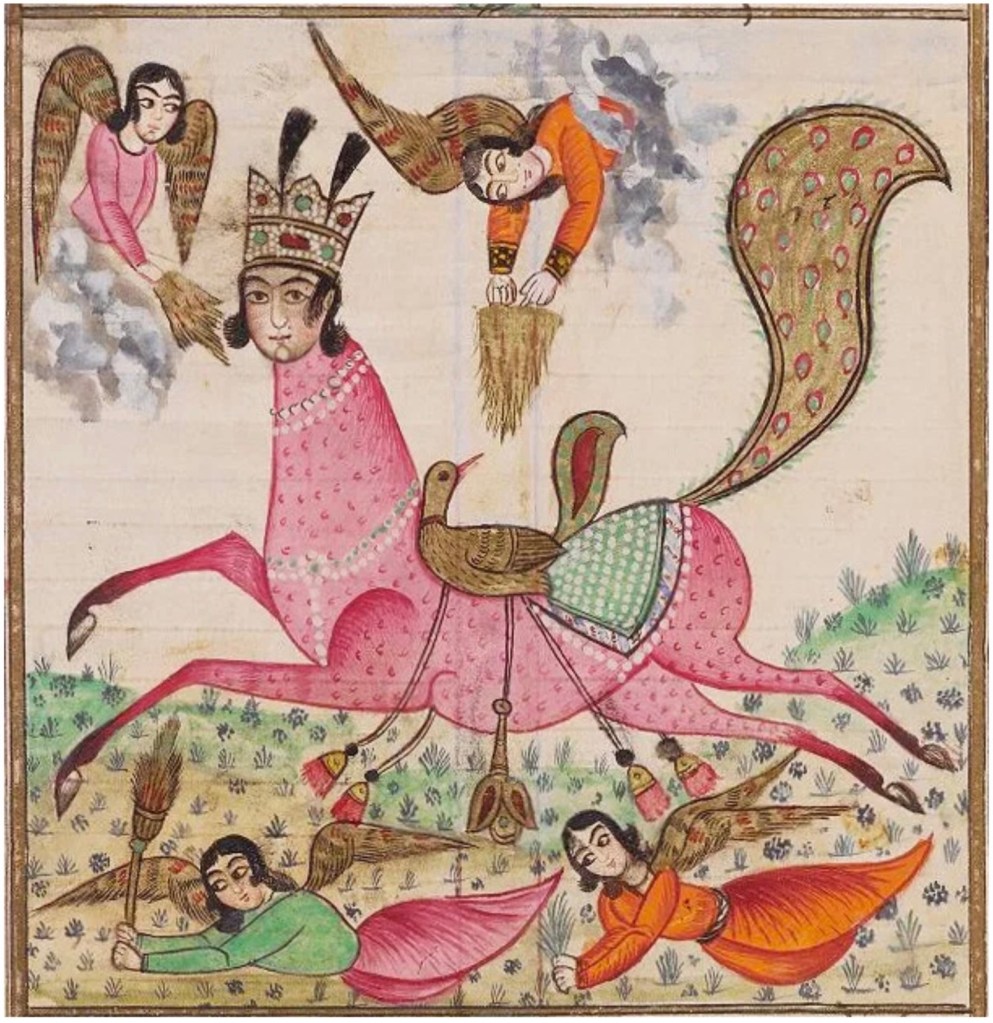
There is a certain irony in the fact that historical Islamic art sometimes depicted Mohammed riding Buraq quite openly, while a modern image search for the creature tends to leave its most important passenger discreetly out of the picture. Plenty of Buraq, remarkably little Mohammed. The miraculous journey may be accepted as literal; in certain Islamic traditions, illustrating the passenger is where one begins wandering towards haram.
All of which leads to an irresistible thought: I would dearly love to watch Mehdi Hasan interview Mehdi Hasan on the subject. The interviewer Hasan would surely be on him within seconds. “That wasn’t my question”. “You’re changing the subject”. “What is your evidence for this specific claim?” “Isn’t that circular?” And if interviewee Hasan tried to retreat into the existence of God, revelation or the philosophical possibility of miracles, interviewer Hasan would surely cut him off and drag him straight back to the horse. Now that really would be worth watching.
And this is why simply explaining cognitive dissonance to me does not resolve anything. I understand perfectly well that intelligent people compartmentalise beliefs, protect things bound up with identity and subject different parts of their worldview to different evidential standards. I understand how the exemption gets there. What I cannot understand is why anyone genuinely committed to understanding reality would knowingly continue granting it.
Faced with the mystery of existence, I want to understand, within the obvious constraints imposed upon me, as much as I possibly can. I do not need certainty. I need to know what can be known, and to recognise what cannot. If some cherished belief, comforting story, inherited tradition or flattering opinion of myself gets in the way, I would rather lose the belief than accommodate the contradiction.
The mystery itself deserves better than the answers we have invented for it. I would rather stand in awe before what I do not understand than fill the void with answers inherited by geographical accident and then call them truth.
[1] By 1967 or 1968 I had worked my way through the RSCM Chorister Training Scheme to the red ribbon, then its highest grade. I had something of a head start: my mother taught music and ran the school choir, while I had been having private singing and piano lessons from an early age. Music, in other words, was simply part of childhood.


Leave a Reply