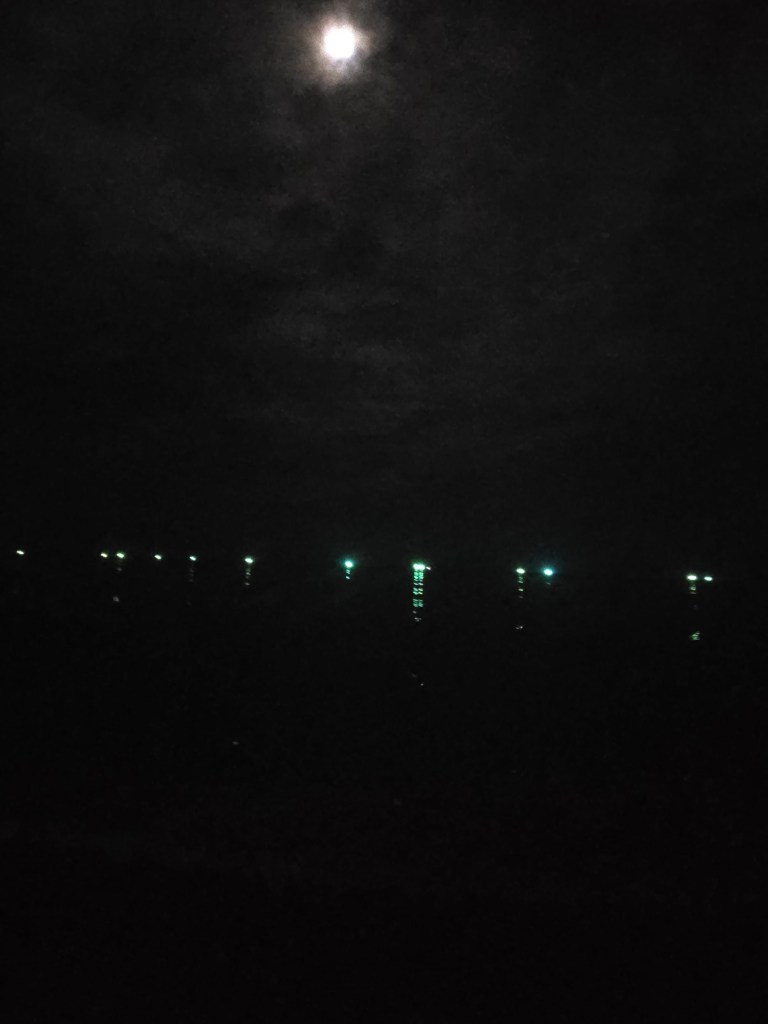
By night, this stretch of the Gulf of Thailand becomes a quiet constellation of green and blue lights. The bright beacons strung along the horizon are squid-fishing boats, their powerful lamps suspended high above the decks to draw the squid towards the surface. Each light may be visible from as far as fifteen or twenty kilometres away, their glow mirrored perfectly in the flat calm of the sea.
Yesterday evening the water was so still, it felt like gliding over glass. I had two kilometres of beach entirely to myself, the surf reduced to a faint whisper. Thung Wua Laen shelves so gently that you can wade out fifty metres before the water reaches your chest. Beyond that, the sea shimmered green and blue from the distant boats – the only movement a faint pulse of phosphorescence when my hands broke the surface.
A swim beneath those lights, with the night sky overhead and the horizon glowing like a string of emeralds and sapphires, felt like slipping briefly out of time.
The nation’s turkeys are queueing proudly for the block, feathers puffed up, convinced the farmer’s really one of them. He talks their talk, shares their outrage, even has a pint on telly – what’s not to trust? The dream, of course, is that the animals have taken back the farm – though, as Orwell warned, it’s the pigs who end up running the place.
No more Brussels on the menu, having given Farmer Fartage chronic indigestion of late, with his flagship Brexit dinner now thoroughly overcooked and getting dreadful reviews.
The new dish of the day is Dover Roast: slow-cooked fear, basted hourly by GB News, served with a side of “taking back control”. “He’s saying what we’re all thinking”, they cluck, while the carving knives are sharpened quietly out of sight.
The Seasoning never changes – nostalgia, envy, and a pinch of someone else to blame. Then comes the Stuffing: hospitals stripped to the bone, schools left to stew in neglect, and welfare quietly scraped into the bin. The flock nods approvingly. “At least he’s keeping the boats out!” they gobble, as their own livelihoods drift gently downstream – straight into the gravy boat, where Farmer Fartage and his friends are already topping up their glasses.
The Basting continues – resentment sizzling in its own fat. And now come the Turkey Trots: a nation running in circles, sick from swallowing the same reheated slogans, yet somehow proud of its patriotic diarrhoea.
When Carving Time arrives, Farmer Fartage stands beaming in his Union Jack apron, knife gleaming.
“Now that’s what I call taking back control,” he says, slicing through what’s left of the working class.
“Bootiful,” sigh the turkeys, as the plates are cleared. The pigs, naturally, will be dining at the Ritz.
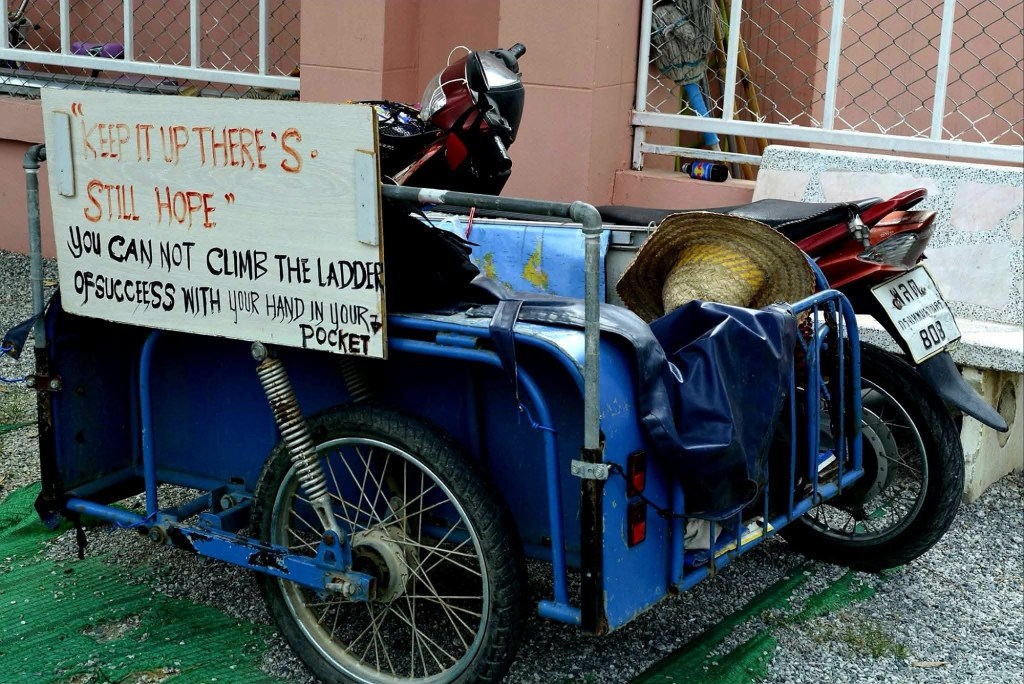
On the gardener’s sidecar at my daughter’s school in Thailand, 11 years ago.
“Keep it up there’s still hope. You cannot climb the ladder of success with your hand in your pocket”.
Whether success means career, purpose, a scrap of happiness, or simply hanging in there with sanity intact, the message still stands. You won’t get there by standing still.
In these times, when everything feels uncertain, maybe that battered sign has it right. There’s always hope – but only if we keep climbing.
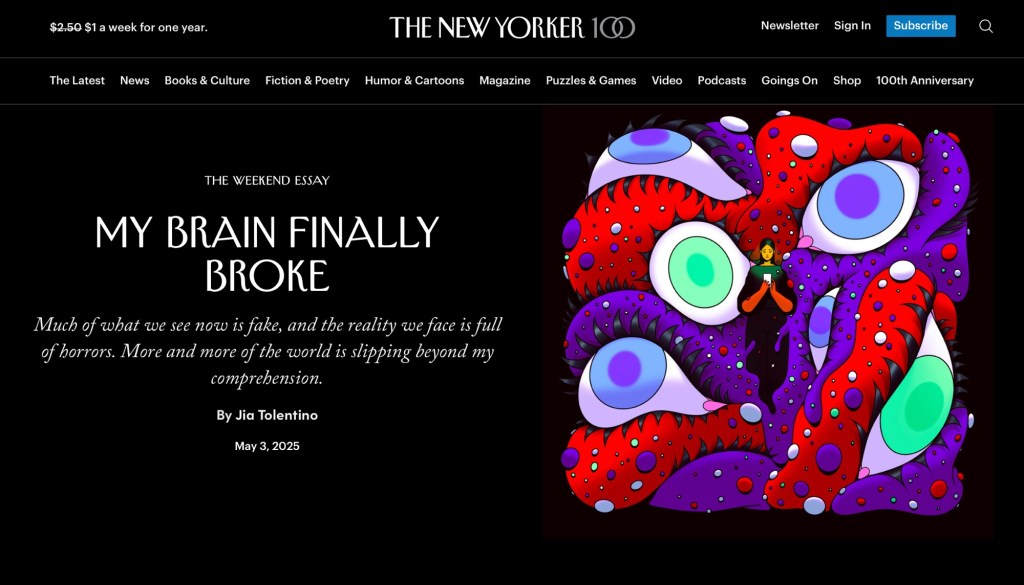
In May 2025 Jia Tolentino wrote in the New Yorker about what she calls her “broken brain”. She means the fog that settles when words slip out of focus, when news feeds pile horror upon horror, and when reality itself feels unreliable.
“I feel a troubling kind of opacity in my brain lately – as if reality were becoming illegible, as if language were a vessel with holes in the bottom and meaning was leaking all over the floor”.
She blames the speed of politics, the flood of images from Gaza, and the creeping invasion of synthetic fakery – AI faces, deepfakes, doctored clips – until the act of paying attention itself becomes exhausting.
It struck a chord with me, having been circling the same ideas for years. Newsfeed numbness – the more you see of violence, cruelty, and collapse, the less able you are to feel. The moral compass does not shatter – it just spins helplessly, like a needle over too many magnets.
Tolentino writes as an American essayist cataloguing the psychic toll of her own culture. But her “broken brain” is our common inheritance. The overload is global, the denial universal. I saw it in Thailand during the unrest of 2008, when rolling street protests became background noise; I see it in France today, where ecological breakdown and bureaucratic inertia pile on top of daily political crises. The pattern is the same: we are running systems – political, technological, ecological – at a pace no mind can process, let alone resist. Outrage itself feels redundant. And that, perhaps, is the point: flood people with so many grotesque headlines, so much noise and spectacle, that resistance fragments before it can gather force, or else curdles into manipulated anger – from America’s culture wars to Europe’s street protests and beyond. The instinctive are swept into fury; the deliberative sink into fog. Both serve the same end.
“The phone eats time; it makes us live the way people do inside a casino, dropping a blackout curtain over the windows to block out the world, except the blackout curtain is a screen, showing too much of the world, too quickly”.
This progression is brutally simple. Overload collapses empathy; numbness follows; then the very act of looking becomes unreliable. Images of suffering blur into AI hallucinations, real protest footage sits beside doctored clips, and even a child’s search results are contaminated with fakes. The result is not only fatigue, but a collapse of trust in perception itself – and numbness is not neutral. It is precisely what power structures rely on: a dazed public is easier to rule.
“Fake images of real people, real images of fake people; fake stories about real things, real stories about fake things. … The words blur and the images blur … a permission structure is erected for us to detach from reality – first for a moment, then a day, a week, an election season, maybe a lifetime”.
And detachment has a cost. It runs alongside policy changes that cut into daily life – deportations under Trump’s new orders, benefits pared back in the US, NHS waiting lists stretching beyond endurance in Britain, droughts and floods forcing migration in Asia. Authoritarian gestures are dressed up as routine governance, and by the time we notice, the damage is already done. This is not just about our minds. It is how cruelty advances while we are too dazed to resist.
I find Tolentino’s essay oddly reassuring. Not because it offers a cure, but because it confirms that even sharp observers and writers are buckling under the same weight as the rest of us. The failure is not mine alone, or yours. It is structural. Our minds were never designed for this volume of horror, this speed of contradiction, this corrosion of truth.
Perhaps the task is not to repair the mind at all, but to notice – clearly, stubbornly – that the fracture is everywhere. Naming it is resistance. What we do with that knowledge will mark the fate of our civilisation.
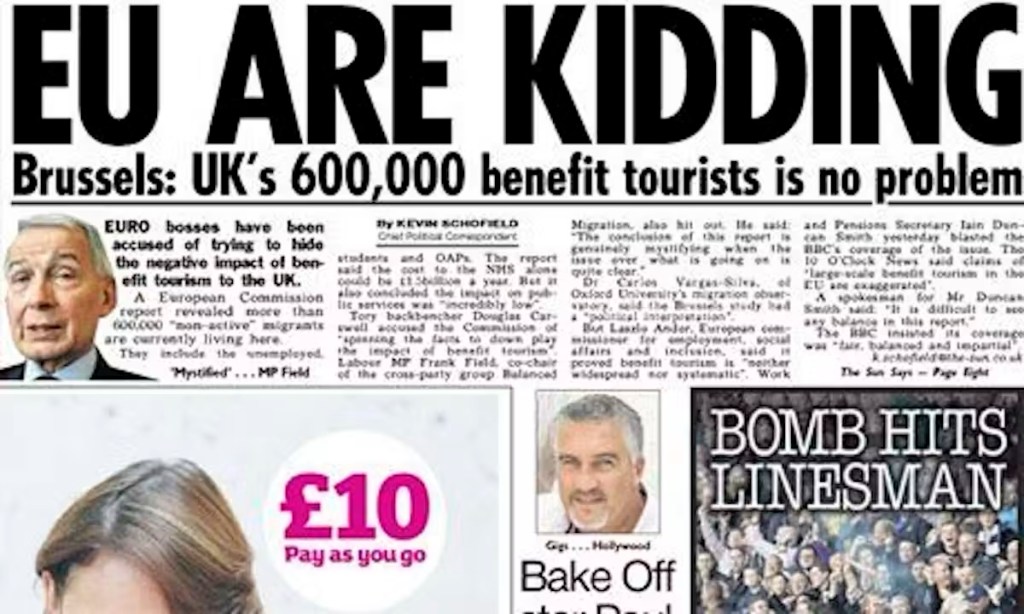
Back in 2008 – well before Brexit, Trumpism, and the subsequent parade of geopolitical absurdities – the British press was already having a mild panic about the supposed “collapse” of the expat dream. The pound had taken a tumble against the euro, the property bubble was deflating, and journalists were circling like vultures over the lavender fields of Provence and the golf courses of Andalucía.
Tabloids and broadsheets alike ran lurid stories of “broke Brits fleeing France and Spain in droves,” driven back to Blighty by collapsing exchange rates, failed gîte ventures, and sterling-linked mortgages gone sour. The underlying tone was unmistakable: serves them right for getting ideas above their station.
Nothing new under the Sun…
But was there really an exodus? Or just the usual attrition – a few dreamers heading home, chastened, while the more resilient quietly carried on?
The truth, as ever, was less dramatic. The global financial crisis had rattled everyone, and many small-scale British ventures in rural France were vulnerable. But for most long-term residents – myself included – it wasn’t the end of anything. We tightened belts, mended roofs, took on extra work, or simply adjusted our expectations. The ones who left had often come chasing a fantasy. Those who stayed had usually come looking for something more substantial: sanity.
I remember a call from Bill Coles, an Old Etonian tabloid hack writing for the Daily Express, who was doing a piece on this supposed “mass migration back to the UK”. I tried to inject a little balance: yes, some expats were struggling – but a stampede home? Hardly. Unsurprisingly, none of that nuance made it into print. The Express had already written its conclusion before the phone rang. The story needed villains and victims, not perspective.
In truth, most of us hadn’t come for the cheaper wine or larger gardens. We’d left Britain because something fundamental had begun to feel unliveable: the pace, the noise, the corrosive work culture, the unrelenting worship of growth. France, for all its bureaucracy and provincial quirks, still offered a sense that life outside work mattered. There was a slower rhythm, a stronger attachment to family and community, and an enduring respect for the art of simply being – qualities that Britain, by the early 2000s, seemed to have sold off along with its railways.
That said, even France was shifting. By 2008, the cracks were visible: rising costs, eroding public services, and rural depopulation beginning to hollow out the villages. Still, compared with the UK’s tabloid-fuelled hysteria and market-driven politics, it felt civilised – human, even.
When I later began dividing my time between France and Thailand, the contrasts sharpened further. Thailand, for all its contradictions, possessed something I’d long stopped seeing in Western societies: composure. A certain patience with life’s imperfections. A detachment from the frantic, performative misery that had infected much of the West. Thailand wasn’t paradise – far from it – but it offered perspective. It reminded me that comfort and contentment aren’t the same thing, and that dignity can exist without affluence.
So was there an exodus back around 2008? Perhaps – of those who’d come seeking an idyll, or who’d mistaken the dream for the work required to sustain it. But for many of us, the balance sheet still came out in favour of staying. The gains – time, peace, perspective – outweighed the losses.
We hadn’t emigrated for the weather, the rosé, or the romance of rural life. We’d come to breathe more slowly, to feel a little more human. And however turbulent the world became – from sub-prime crashes to Brexit psychodramas – that still seemed a bargain worth keeping.
As for returning to Britain in 2025 – where neo-fascists lead the polls and history is being rewritten in real time – you’d have to manacle me to the rear end of the Eurostar and drag me through the Channel Tunnel backwards. And even then, I’d be kicking, screaming, and plotting my escape the moment we surfaced in Kent.
Family trees are strange things. They offer the illusion of order, a tidy branchwork of names and dates. But beneath the surface, they’re tangled with myth, omission, and the mess of human behaviour. Mine is no different. It begins in Scotland, detours through Jamaica, dips its toes in the abolitionist movement, and ends up – for a moment, at least – in the House of Lords.
In 2000, curiosity got the better of me, and I began investigating my mother’s side of the family – the Wedderburns. The process started slowly, with dusty registers and hesitant searches, but eventually, a story began to emerge that was far richer – and darker – than I’d anticipated.
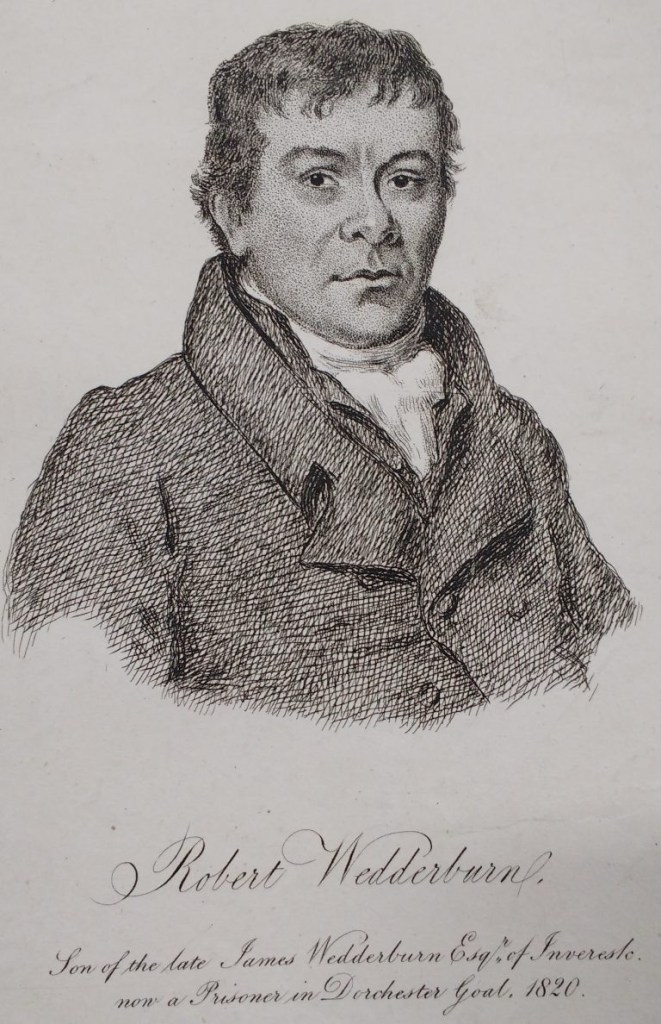
I confirmed that we were directly descended from Robert Wedderburn: a radical, a pamphleteer, an anti-slavery campaigner, a fierce critic of Empire. The illegitimate son of an enslaved woman and a Scottish plantation owner, he was born in Jamaica in the late 18th century and later became a thorn in the side of British respectability. His writings – vivid, angry, unrelenting – had been buried for years but not forgotten. And there he was, in my bloodline, my ancestral grandfather. A ghost with something to say.
I kept the discovery to myself for a while. Not because I was ashamed – quite the opposite – but because I sensed it might cause a stir. That opportunity arrived in 2001, at a centenary party for the mother of my cousin Lord Kenneth (Bill) Wedderburn, a Labour peer, legal heavyweight, and fellow descendant.
It was a polite gathering – hors d’oeuvres, linen tablecloths, clinking glasses. Various limbs of the family tree had assembled, including the more genteel of our ‘scalemaker’ line, convinced their name traced back to the aristocratic Wedderburns of Blackness in Dundee. And indeed it did – but not quite in the manner they had imagined. It was the perfect moment to drop a quiet genealogical bombshell.
I outlined, cheerfully, how our name didn’t just descend from Scottish aristocracy but also from slavery and resistance. Robert Wedderburn wasn’t some obscure offshoot. He was direct blood. Some eyebrows lifted. Some dropped. A few went missing altogether. There was a ripple of discomfort, a touch of denial. But also, to my surprise, a smattering of genuine intrigue. Bill’s daughter Professor Lucy Wedderburn, I distinctly remember, actually laughed in delight.
Bill Wedderburn wasn’t at the party – he and his mother had long since fallen out – but we met up the following day. He was sharp as ever, keen to see the evidence. I brought baptism records, slave registers, Robert’s pamphlets, even the will of Jamaican slave and plantation owner Sir John Wedderburn, who had named his mixed-race children as beneficiaries. It was all there, plain as day. And of course Robert was born ‘free’.
To Bill’s credit, he was delighted. This was no embarrassment – it was dynamite. He’d always seen the links between class struggle and racial injustice, and here they were, stitched into his own lineage. He arranged for me to visit the House of Lords – a surreal experience, not least because I was introduced as a newly discovered cousin to one Alexander Scrymgeour-Wedderburn, the 12th Earl of Dundee, hereditary peer and Royal Standard Bearer of Scotland.
The Earl was gracious, if faintly bemused. When Bill told him of our shared descent, he offered the standard reply: that the Black Wedderburns were simply former slaves who had adopted the name of their owners. Bill raised an eyebrow. I produced the documents.
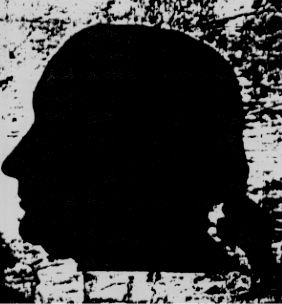
It wasn’t really a contest. The Earl, though courteous, was no match for Bill’s legal tenacity. He conceded, eventually, and even invited me to visit his estate in Scotland, where the family still kept records, letters, and a silhouette woodcut portrait of the executed Sir John Wedderburn – originally sketched by the gaoler’s daughter on the night before his hanging after Culloden.
That was the moment, I think, when history stopped being abstract. Two men, once on opposite sides of a slave-owning dynasty – one a Labour peer, the other a hereditary lord – now sat across from each other at Westminster, their bloodlines reluctantly re-entwined.
Bill and I kept in touch. We shared a quiet pleasure in the irony of it all. He once said, grinning, “Well, that puts the bloody cat among the pigeons, doesn’t it?” Indeed it did.
I wrote to the Earl later, to follow up on his invitation. He never replied.
Aquila non captat muscas, goes the old family motto – the eagle does not catch flies. Maybe not. But some of us keep flitting about, nonetheless.
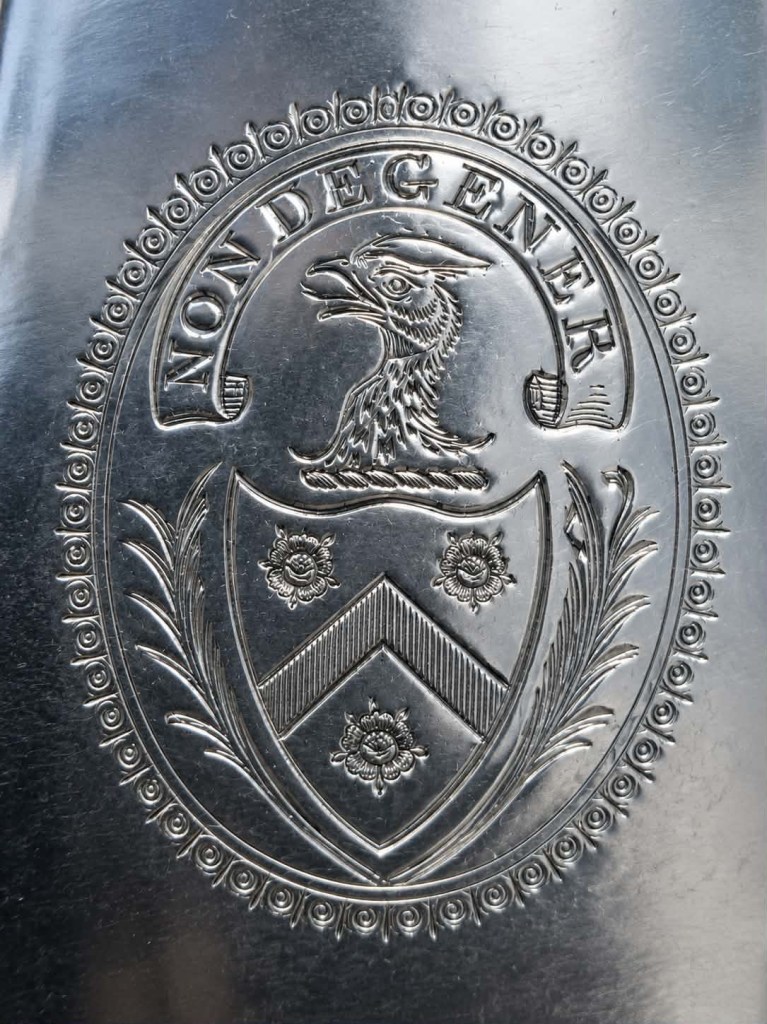
The Blackness Wedderburns – our branch of the family – have an even more interesting motto: Non Degener. Well, that didn’t quite work out for them, did it. At least, not in their intended sense.
Non Degener – “not degenerated” inscribed on the side of a Georgian sterling silver tea caddy from the late 1700s that also bears the initials of Robert Wedderburn’s father, James – now in the possession of Robert’s scalemaker descendants, Philip and Tracy Wedderburn in Australia. Robert once travelled to Inveresk to try to reconcile with his father, but James refused to see him, his footman sending him away with a cracked silver sixpence and a draft of stale ale. Robert would certainly appreciate the irony of our House of Lords meeting, more than two centuries later.
That House of Lord’s meeting was in 2001. Now in 2025, the world has changed greatly. However, the French saying “plus ça change, plus c’est la même chose” comes to mind. The more things change, the more they stay the same. And this is delightfully encapsulated in the epilogue to the detailed and meticulously researched biography of Robert Wedderburn by Ryan Hanley, published in March 2025. I’ve corresponded with Ryan several times over the past couple of years, and I’m sure he won’t mind my quoting this final passage.
“In our atomised and terminally online times, Robert’s insistence on the need for radical solidarity over liberal individualism sounds like a clarion call through the fog of an obscured past, a nearly forgotten, brief moment when another world seemed possible. It is fitting that he is more and more seen by scholars as an important figure for our understanding of the relationship between slavery and capitalism. His apparently intuitive understanding that racialised capitalism was the common denominator in the exploitation of workers around the world – from enslaved people in Jamaica to factory workers and dung-tailors in London – has inspired scholars to explore how early socialist ideas were articulated in relation to empire.
It seems difficult not to see ourselves reflected when we look at the world that made – and then so spectacularly unmade – Robert’s reputation. Within the ongoing omni-crisis of late-stage capitalism – food banks, unaffordable housing, resurgent state-condoned racism, and paid-for political gaslighting operating at an industrial scale – Robert’s outright rejection of any authority derived from the violent expropriation and hoarding of land and resources is now very much back in vogue.
The language that scholars have used when describing Robert’s radicalism – “organic,” “natural,” “earthy,” even “pungent” – speaks to an enduring sense that he embodies a pure form of radicalism: radicalism as it should be. His prophetic vision of a world without slavery or poverty was predicated on the idea that solidarity between colonised and exploited peoples was not only possible and desirable but inevitable.
While he learned, to his cost, toward the end of his life, that such solidarity could not be taken for granted, Robert remained optimistic about the capacity for poor and enslaved people to find common cause in the pursuit of freedom and equality. Until his death, he believed that they might one day even be successful. For this belief, he was once derided as naïve – even deluded. But he was more of a realist than people gave him credit for.
He understood from the example of Haiti the need to plan carefully to defend anything that might be gained from an insurrectionary movement for freedom. He learned from Barbados and Demerara, and from William Davidson and Arthur Thistlewood too, that insurrections most often ended up with bloody reprisals – with severed heads held up to the crowd or fixed on a spike over Temple Bar. He learned from his father and half-brother Andrew that the law is no guide to conscience, and that power has a habit of legitimising itself as it reproduces.
Most importantly, he learned from [his mother] Rosanna and [grandmother] Amy that sometimes it was worth the punishment to thumb one’s nose at authority – to unsettle for a moment the complacent, self-regarding assumptions about justice and honour held among a pack of slaveholders. Seemingly doomed acts of defiance in the face of overwhelming odds can yield major effects further down the line.
In Jamaica they have a saying: “If you are the big tree, then we are the small axe.” There is nothing naïve about that.”
Bill, had he still been here, would have loved this work by Dr Ryan Hanley. And I can’t help but see how our worldviews, two centuries later, uncannily mirror Robert’s, and have done so since well long before either of us even knew of his existence. A kinship in more than the genetic sense.
House of Lords revisited
If I have a regret, it’s that I only got to know Bill properly when he was nearing the end of his life. We met on several occasions afterward, usually at the House of Lords. I liked him immensely. He was direct, abrasive, unapologetic – not unlike Robert, I imagined.
We lunched together in the Peers’ Dining Room a few times – an august venue where the long table rule still holds: one sits beside whomever arrived before. One time I was sandwiched between Bill and the eccentric Lord Longford – known as “Lord Porn” for his anti-pornography crusades, and “Lord Wrongford” for his unpopular and undoubtedly misguided attempts to free Myra Hindley, one of the Moors murderers. Conversation was sporadic and punctuated by explosive sneezing, tissues tumbling from his every pocket like ticker tape.
Another visit brought minor scandal. Wandering the corridors, I found myself face-to-face with the Speaker of the House and his entourage. You’re supposed to stand aside in silence. I didn’t. Bill hissed at me like a schoolmaster catching a pupil smoking behind the bike sheds.
Later, while Bill was needed for a vote, I wandered off and slipped into what appeared to be a quiet library. Within moments, a flustered staff member appeared – but couldn’t cross the threshold from the red-carpeted corridor to the green-and-red of the room itself. “Sir! Sir!” he stage-whispered. “Only peers may enter the Library!” I apologised and stepped out, but couldn’t resist asking whether the many decrepit Lords had to do their own dusting.
For all its grandeur, its ritual and its red velvet robes, that place still can’t quite silence the ghosts.
I’ve long wondered whether human beings are anything more than elaborate, error-prone information processors – complex, yes, but not fundamentally different from other life forms. As artificial intelligence moves from science fiction to daily reality, the question seems less about our limitations than about our supposed uniqueness.
People often insist that AI will never replace humans in areas requiring subtlety or empathy – diplomacy, for instance, with its unspoken codes, glances, and emotional intelligence. But why not? With enough data and processing power, a machine could conceivably simulate those same nuances. If our instincts are simply fast-processed experience – rapid recognitions shaped by evolution – there’s no reason in principle that a machine couldn’t do the same, only faster.
Still, reading emotion, sharing it, and being moved to act on it are not the same. A system may interpret feelings flawlessly yet remain unmoved by them. Empathy involves motivation as well as perception.
Perhaps what we call “intuition” is a form of data compression: experience, pattern, reaction. We’re biological pattern-recognition systems built on feedback loops and fuzzy logic, prone to error but good at improvising coherence. Yet much of that intuition depends on embodiment – hormones, sensations, and habits grounded in a physical world. Machines might reproduce the structure of intuition, but not necessarily its texture. Even so, if intuition is mostly compression, the idea that AI could surpass us – not only in speed but in subtlety – becomes difficult to dismiss.
The deeper question is self-awareness. Can a machine ever be truly conscious? Most say no – that machines can simulate understanding but never experience it. Yet human consciousness itself evolved gradually, not as a divine spark. If certain forms of intelligence and embodiment can support self-awareness, then perhaps it isn’t beyond reach for silicon. Whether functional equivalence alone can generate experience remains unresolved, but it is at least plausible.
We like to believe we’re uniquely self-aware, but perhaps, as Stephen Hawking warned, the greatest enemy of knowledge is not ignorance but the illusion of knowledge. Nowhere is that illusion stronger than in our belief that we are the pinnacle of awareness – that our consciousness is both unique and central.
Douglas Adams captured that delusion beautifully in his tale of the sentient puddle. One morning it wakes, marvelling at how perfectly the hole fits its shape. Naturally, it concludes that the world was made just for it. But the puddle is wrong. The hole wasn’t made for it; the puddle simply conforms to its container. We are that puddle. We fit the world not because it was designed for us, but because we have adapted ourselves to it – and then mistaken that fit for specialness. The same bias colours how we build machines: we design them in our image, then take the resemblance as proof of our own centrality.
Perhaps consciousness is not a revelation but a trick – a sleight of mind that lets a limited brain cope with an overwhelming world. A coping mechanism disguised as profundity. If so, AI might one day match or exceed our self-reflection – not by copying us exactly, but by evolving something functionally equivalent, perhaps even superior. To do that, though, machines may need grounding in the real world: bodies, sensors, or other means of shared reference that give meaning to their models rather than mere simulation.
And if certain forms of intelligence can support self-awareness, the future may belong to machines – not necessarily as rivals, but as successors. Yet there is also a middle path: not successors, but partners and hybrids. The frontier may lie in shared cognition rather than replacement, in symbiotic systems that blend biological and artificial minds.
That need not be a tragedy. It could mark the next step, not of biological evolution, but of cognitive and perhaps moral evolution. Cooperation, after all, was never uniquely human; it was an evolutionary advantage. Among intelligent machines, survival might favour those who collaborate – those who find value in coexistence. But cooperation is fragile. It depends on trust, incentives, and governance. Machines, like humans, would need structures of accountability to make it endure.
If so, the rise of machine intelligence may not spell our extinction, but offer continuity – a passing of the torch, not to something that mirrors us perfectly, but to something that inherits our insights. And if such systems ever cross the threshold into true experience, we’ll face another question: what, if anything, do we owe them?
If we are wise – and that remains uncertain – we may yet learn to live alongside these new minds. The question is not whether they become like us, but whether we can accept no longer being central.
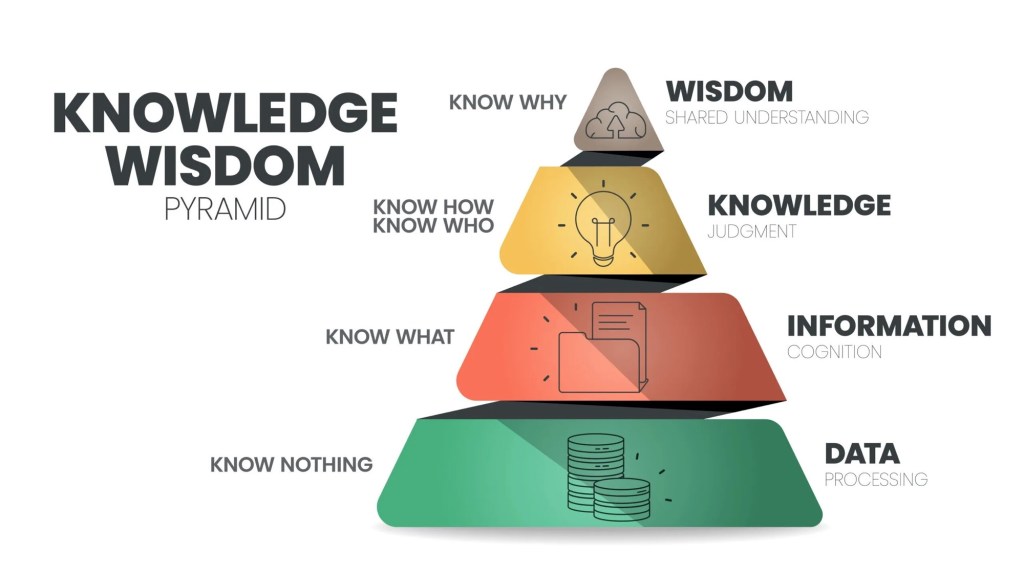
“The saddest aspect of life right now is that science gathers knowledge faster than society gathers wisdom”
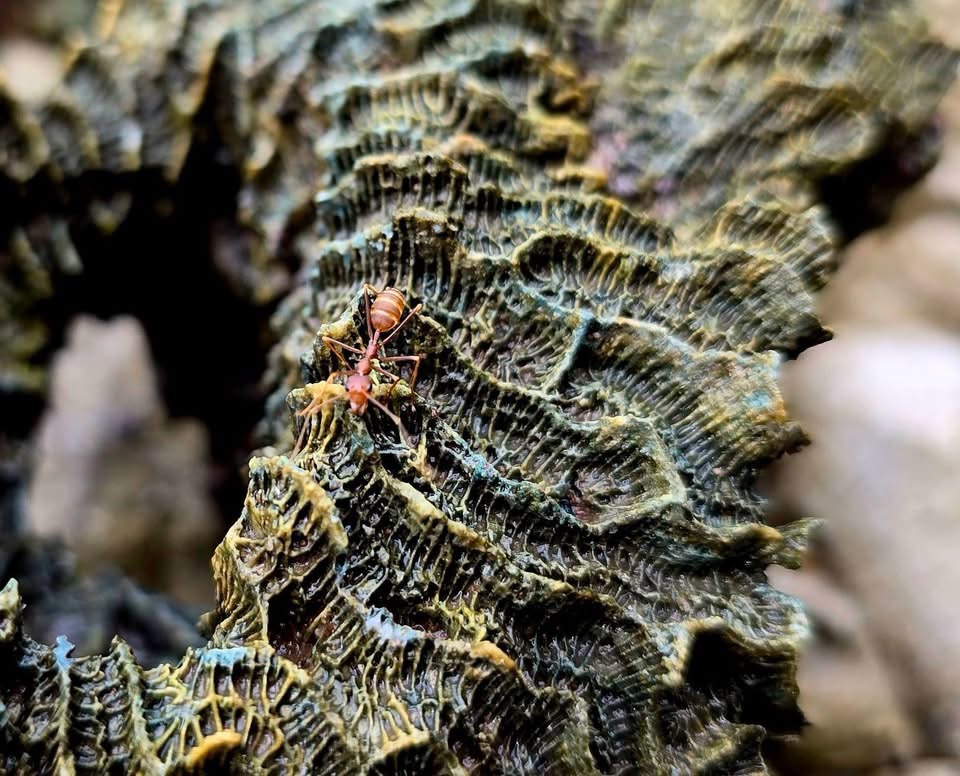
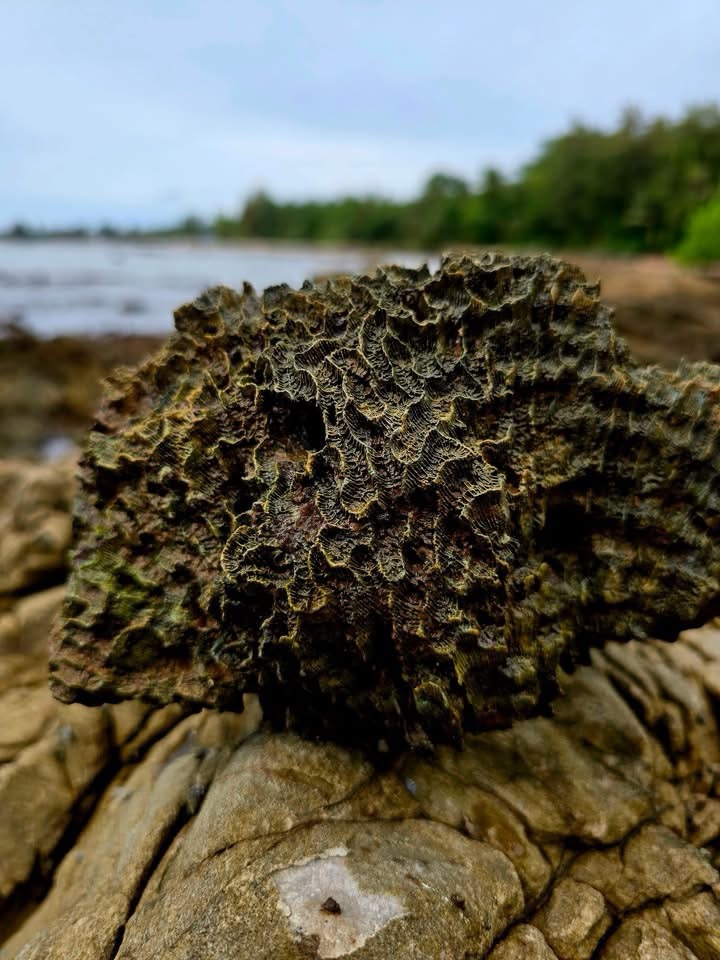
Once, this was a living coral – a complex city of polyps, feeding and breathing in warm tropical waters. Now it lies bleached and brittle on a Chumphon shoreline, carved by time and tide into a relic of itself. A single Asian weaver ant explores the labyrinth where an ocean colony once thrived.
Brain coral, long dead, now carried ashore – an ant tracing the outline of a vanished ecosystem.
Life continues, but on a smaller scale – as it always does when the great systems fail.
Along much of Thailand’s coast, pieces like this have been washing up more often. The Gulf has warmed sharply over recent years, and surveys across both the Gulf and the Andaman show widespread bleaching – in some shallow zones as high as 80–90 per cent. Even protected marine parks have reported repeated stress events, the kind reefs cannot fully recover from.
The coral in my hand is just one fragment, but it speaks to a wider pattern: systems under pressure, ecosystems thinning out, and the quiet arrival of signs most people only notice when they are already too late. Sometimes the tide brings in more than shells.
By some feat of navigational incompetence – possibly involving an upside-down online compass or Google Maps pointing every which way except the desired direction (and certainly not my own misplaced sense of direction) – I managed to take the E-line khlong boat from Thonglor Pier entirely the opposite way. Not slightly wrong, not “I’ll hop off in two stops and fix it”, but full, unwavering commitment to the error. Quite an achievement, given that the Saen Saep line offers only two options: towards the city, or towards parts unknown. Naturally, I chose the latter.
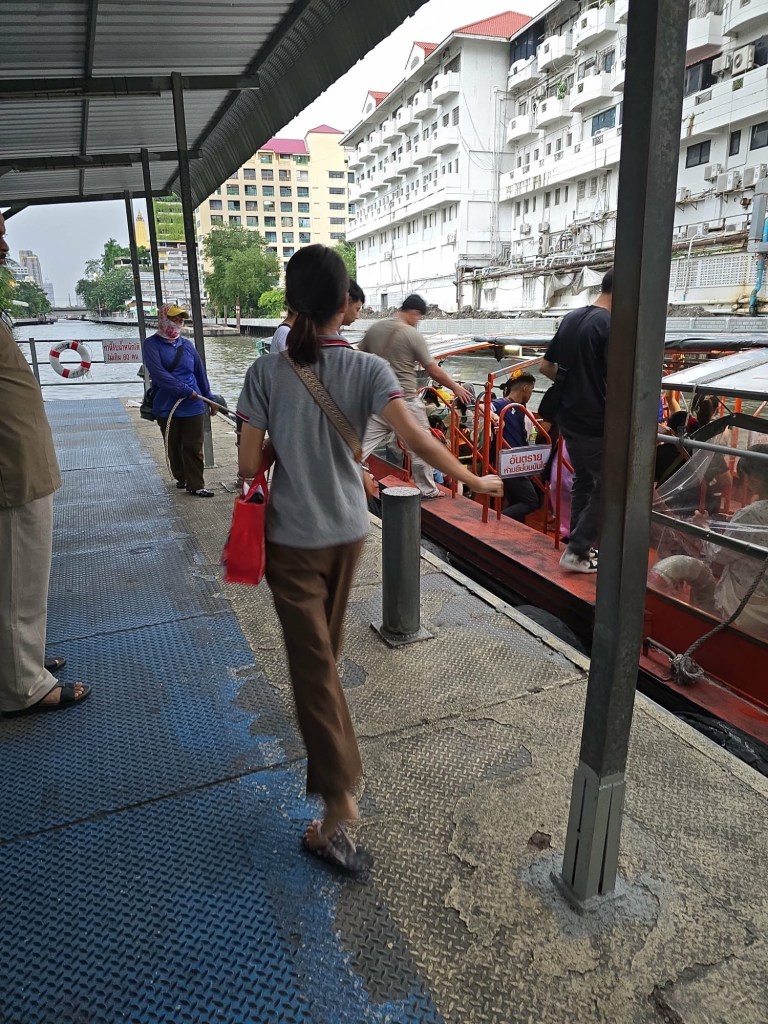
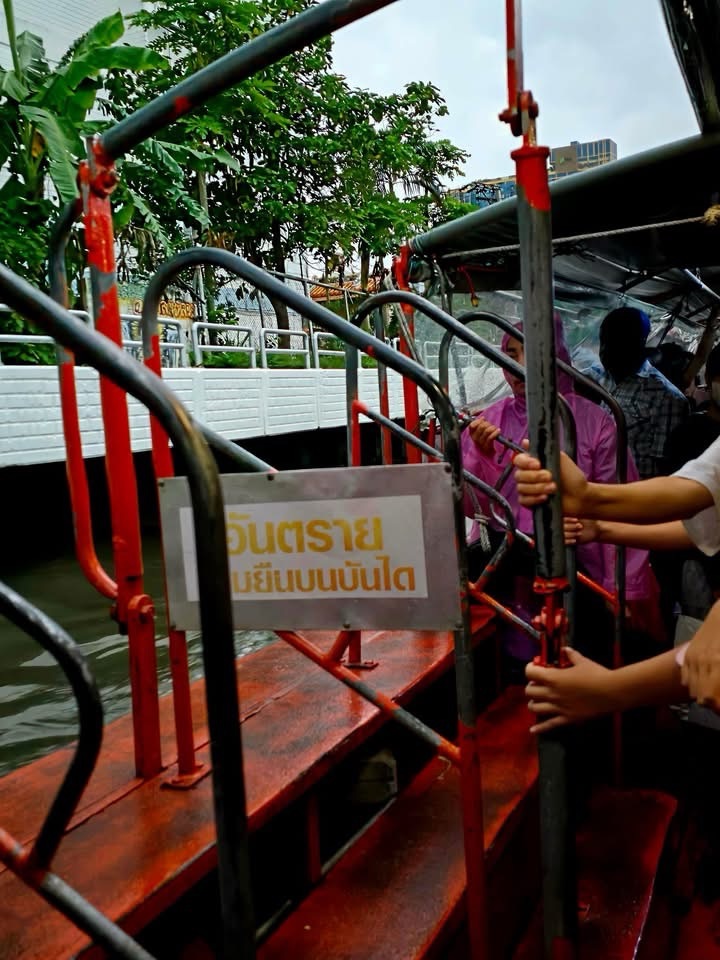
These boats have been racing up and down the canal since the 1990s, powered by ageing diesel engines that sound like a WWII submarine clearing its throat. They nominally carry around a hundred passengers, though on this particular afternoon it felt more like a hundred and fifty, plus my backpack. I doubt anyone keeps count.
Mine was packed to the gunwales. I sensibly positioned myself in a seemingly generous gap between bodies, only to discover why it had been left unclaimed. The tarpaulin roof is made of overlapping, sagging panels, each collecting its own private lake of rainwater. One enthusiastic lurch and an entire reservoir emptied itself directly onto my head, to the thinly disguised amusement of nearby seasoned commuters. I managed a resigned smile as the water trickled briskly down my spine. Bangkok canal travel initiation: complete.
Fifteen stops later – thunder cracking, lightning flashing, and the scenery becoming ever more obscure – I conceded that the surroundings were not going to become familiar. Time to get off.
Embarking and disembarking were adventures of their own. The boats do not exactly stop; they merely flirt with the idea of slowing down. In that theatrical split second, a wiry, perpetually exasperated crewman – the conductor, who hops on and off with feline agility – loops a rope around a bollard just long enough for passengers to throw themselves on or off. My own attempt was greeted with an expression combining pity, urgency, and the faintly hopeful assumption that I would not fall in.
I had arrived at a gloomy, deserted pier whose roof leaked in sympathy with the boat’s. The location could best be described as “somewhere in Bangkok, technically”. A flash of lightning illuminated corrugated shacks and shadowy warehouses, and the following crack of thunder delivered a distinctly Calvino-esque jolt — the sort of Bangkok backwater where, in Christopher G. Moore’s Vincent Calvino novels, rain hammers on corrugated roofs, shadows gather in unhelpful places, and a wrong turn tends to precede something regrettable happening to the detective.
“In the end, we are all characters in other people’s stories”
District #3 – a Vincent Calvino crime novel, 18th in the series
Mercifully, although khlong boats do not run far into the night, one appeared. Another eighteen baht bought me a place on a blissfully emptier vessel – this time heading the way I had intended all along – and I retraced my unintended odyssey, complete with the expected splashes, sharp turns, and several enthusiastic near-collisions with oncoming traffic.
True to form, I still overshot Asoke Pier by two stops, but E5 and Phetchaburi MRT were perfectly serviceable. After my brief career as a maritime liability, I decided it was far safer to continue underground.