• A Night On Borrowed Time

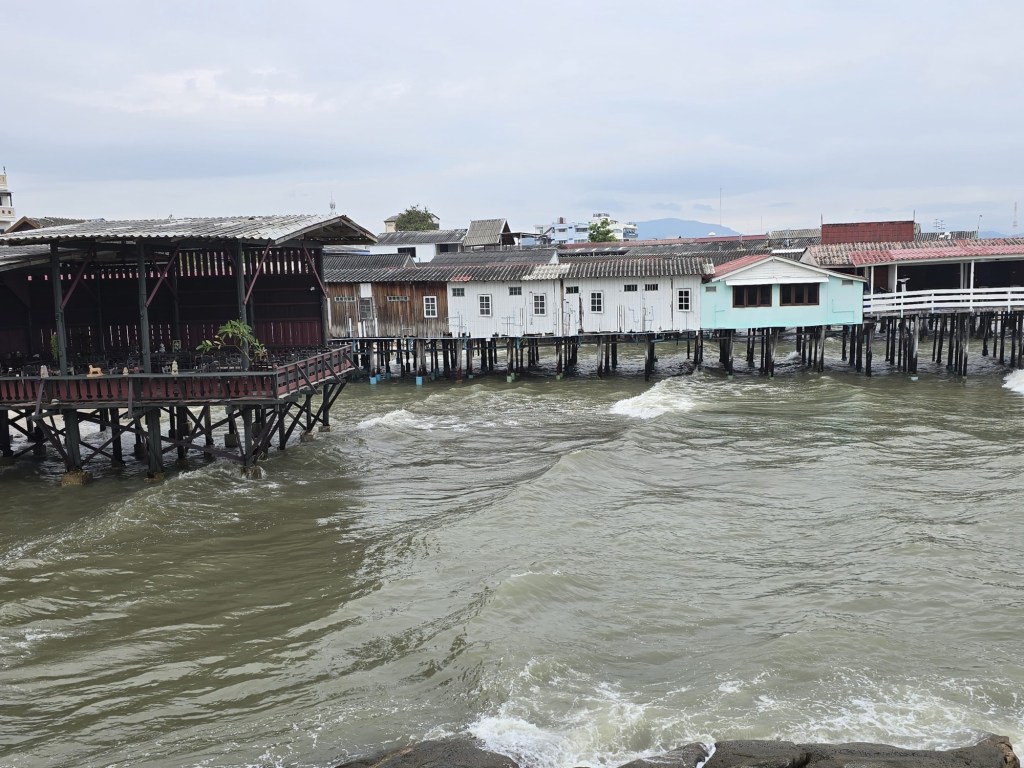
    I seem to have checked myself into what can only be described as a vintage survival capsule. One of Hua Hin’s old stilted piers, the sort the municipality has been dismantling for “encroaching on public land” since roughly the Late Bronze Age. Some have already gone. This one is still here through sheer bloody-mindedness and salt deposits.
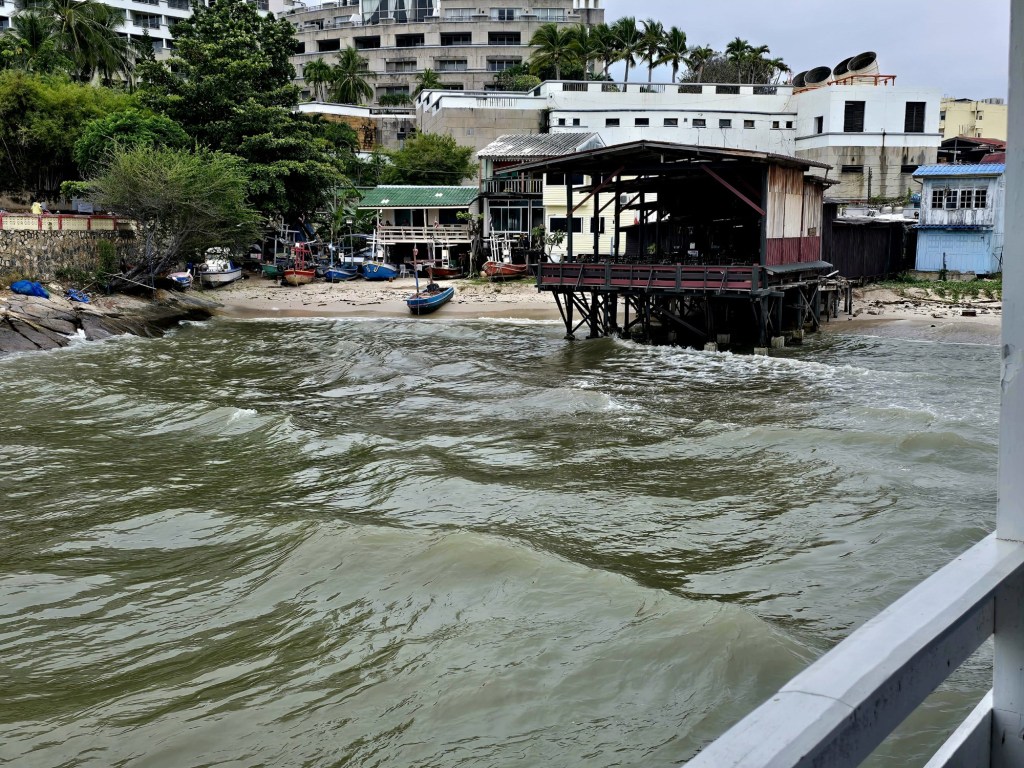
    I found it during an insomniac dawn wander, following the roar of the surf like a moth with questionable judgement. Suddenly I was in the old fishing-pier quarter, staring at a wooden structure clinging to the coastline as if no one had told it the century had changed. Naturally, I booked a room.

    The deal: 550 baht for a fan (the November sea breeze does most of the work anyway), or 850 baht for aircon if you enjoy chilling the Gulf of Thailand at your own expense.
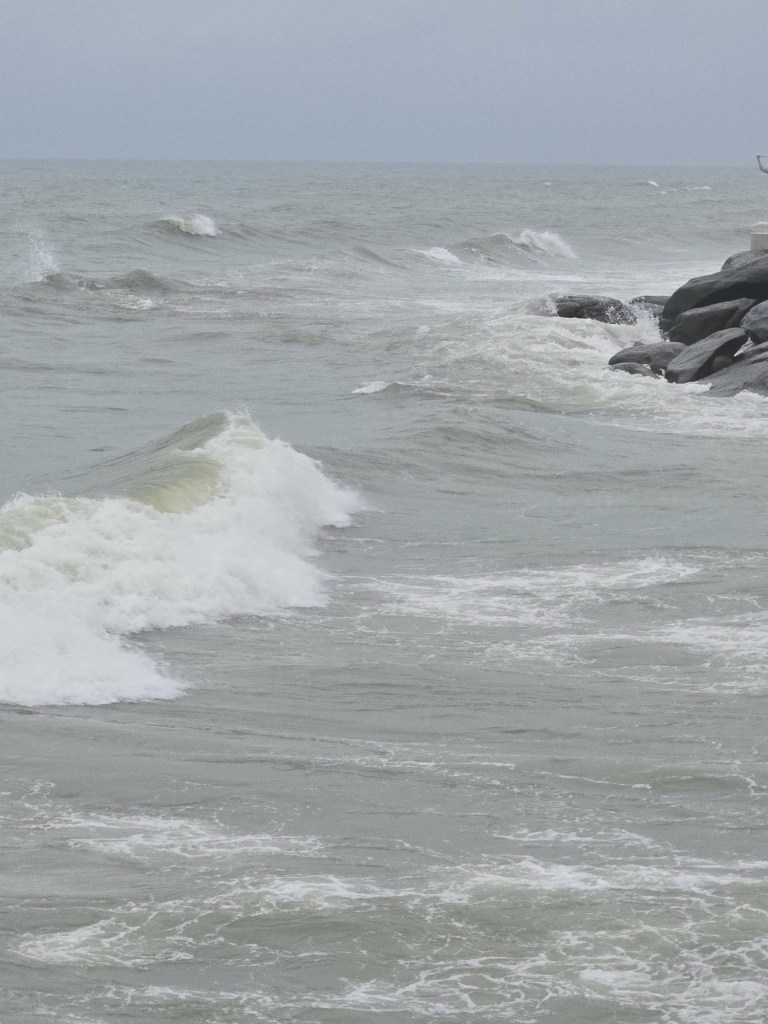
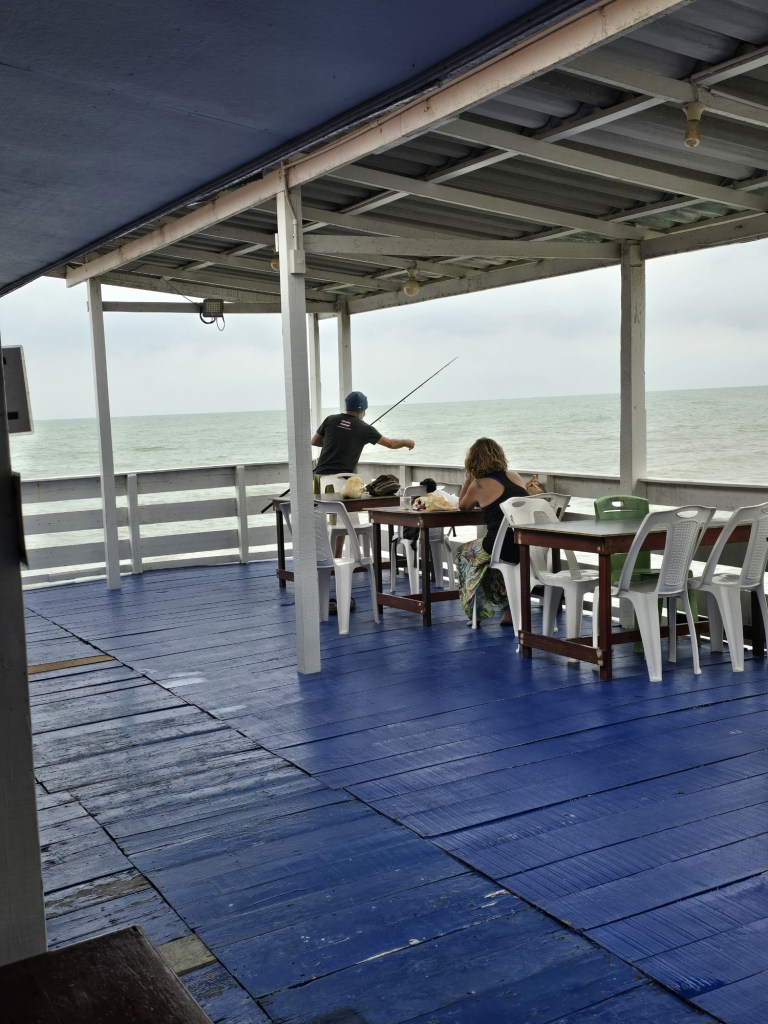
    The room itself is painted a cheery sky-blue, presumably so you do not notice when the actual sky comes in through the rattling windows. The waves thunder directly beneath the floorboards with all the subtlety of a bowling alley. But honestly, this is precisely the charm. Old Hua Hin, before glossy resorts and rooftop cocktails. Fishing boats on the sand. Salt-bleached timber. And the constant sense that the sea would quite like its living room back.

    Clip one: filmed inside the room while hoping not to be adopted by Poseidon.

    WATCH THE VIDEO ON YOUTUBE

    Still, sleeping above the water in a place that may not exist much longer feels like a novelty worth embracing. Preferably while sober.


    Postscript: the morning after.

    WATCH THE VIDEO

    The whole place sways with each crashing wave, like a Clacton beach hut in a north-easterly gale quietly questioning its life choices.

    I cannot pretend I slept. I had, with flawless timing, chosen the night Hua Hin was being slapped about by the remnants of a tropical storm.

    WATCH THE VIDEO

    In fact, while I was lying there waiting for the floorboards’ final monologue, the city raised red flags and banned swimming altogether:

    🚩 “Hua Hin bans swimming” … as the sea tries to climb onto the land
    Waves of two to three metres, a beefed-up northeast monsoon, and a wind surge marching across the South… basically everything you do not want when your bedroom is held up by wooden legs older than most democracies.
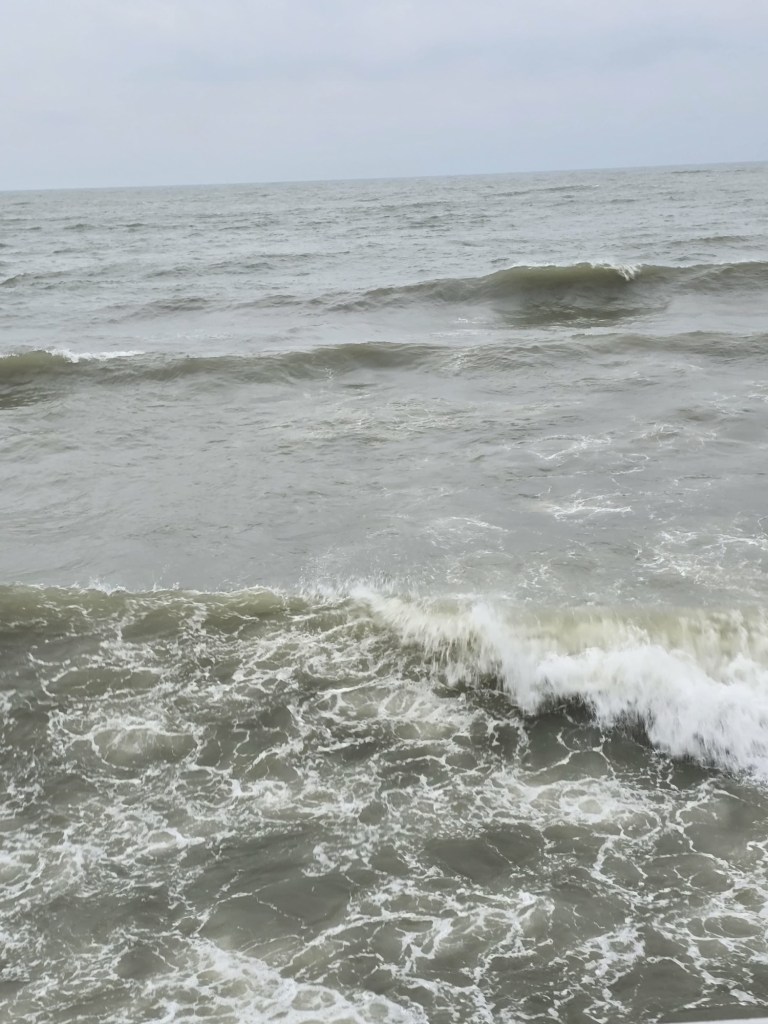
    Officials installed red flags along the main beach from the Chao Mae Tubtim shrine to Khao Takiab and told everyone to stay out of the water until further notice. Sensible, though I would have appreciated a similar notice pinned to my stilted room.
  • (and why we all are, sometimes)

    What is the Dunning-Kruger effect?

    “The trouble with the world is that the stupid are cocksure and the intelligent are full of doubt” (Bertrand Russell)

    We like to imagine stupidity as something that happens to other people – the loud ones, the red-faced pub ranters, the ones convinced that climate change is a hoax and that immigrants are personally responsible for NHS waiting times. But the uncomfortable truth is that the Dunning-Kruger effect isn’t a political problem or a class problem. It’s a human one.

    It’s what happens when confidence outpaces competence – when ignorance dresses up as certainty and decides expertise is just elitism by another name. And, inconveniently, we’re all prone to it. Every last one of us.

    Signs you might be stuck in the trap

    “Ignorance more frequently begets confidence than does knowledge” (Charles Darwin, The Descent of Man, 1871)

    The trap is simple: the less you know about a subject, the less aware you are of what you don’t know. The gaps in your understanding are invisible from the inside, so you feel informed, even expert. Meanwhile, genuine expertise often breeds caution and hesitation, because the more you learn, the more complexity you see. Knowledge expands your horizon; ignorance shrinks it until you think you’ve reached the edge of the world.

    So how do you spot when you’ve wandered into Dunning-Kruger territory yourself?

    Start with the inner monologue. When you find yourself absolutely certain about something you’ve never studied, never tested, and never risked being wrong about – pause and reflect. Because that’s the faint hum of Dunning-Kruger in the wiring.

    Then listen for reinforcement. Are you seeking information that challenges you, or just nods in your direction? Do you read people who know more than you, or only those who confirm that you’re already right? Certainty without challenge isn’t wisdom. It’s insulation.

    How to escape the trap

    “It ain’t what you don’t know that gets you into trouble. It’s what you know for sure that just ain’t so” (Mark Twain)

    There are a few ways out of the trap, though none especially comfortable:

    – Seek friction. Talk to people who disagree intelligently. It’s the intellectual equivalent of stretching.

    – Read and study. Stay curious. Because curiosity and humility share a root system. Starve one and the other dies.

    – Revisit your opinions. If something you said a year ago doesn’t embarrass you at least a little, you probably haven’t learned much since.

    Why it matters in today’s world

    “Doubt is not a pleasant condition, but certainty is absurd” (Voltaire)

    Most of us oscillate between knowing too little and thinking we know too much. It’s the human condition. But the moment we start to believe we’re immune – that the fools are always someone else – we’ve ourselves fallen into the trap.

    And of course, even humility has its own vanity. We can end up boasting about our doubt, congratulating ourselves for being sceptical while quietly admiring the reflection. Uncertainty isn’t the destination – it’s the method. The moment we worship it, we’ve stopped practising it.

    Humility isn’t weakness. It’s intellectual hygiene – the daily hand-washing of the mind.

    “Real knowledge is to know the extent of one’s ignorance” (Confucius)

    Not knowing – and being at peace with it

    Authors note:

    Originally published on NoSacredCows.blog – where certainty goes to die.

  • Influencer Interruptus

    When even solitude needs a tripod. One man’s dawn swim meets the selfie apocalypse.

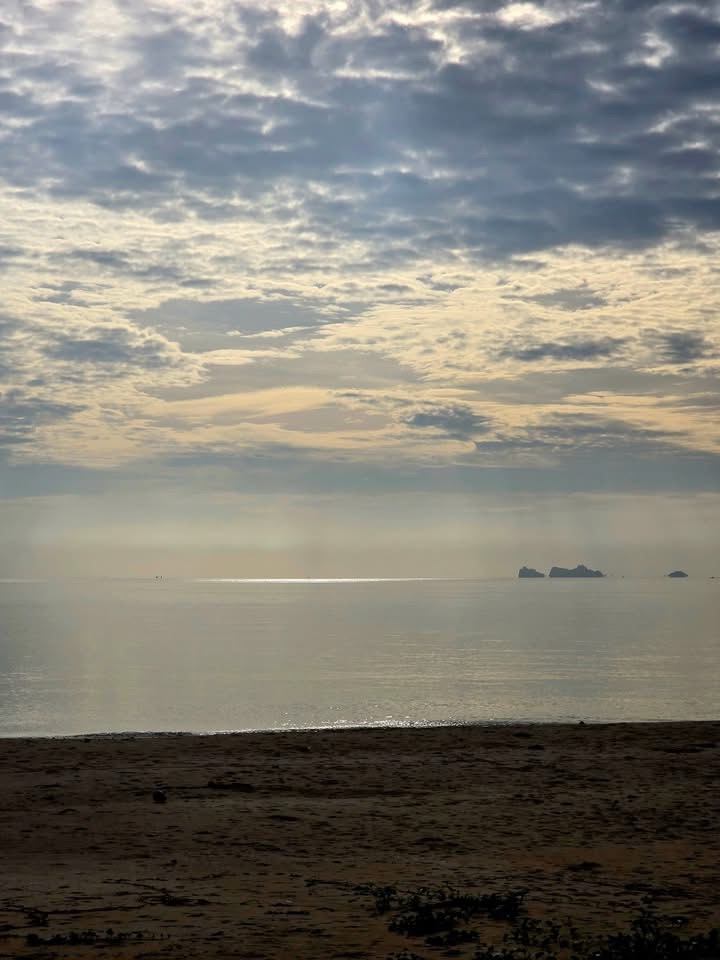
    After an hour’s swim at dawn in glorious solitude, the sea smooth as glass, the horizon glowing like molten silver – I thought I had the beach to myself: two kilometres of unspoilt quiet. Then, inevitably, modern civilisation arrived.

    A lone ‘content-creator-slash-YouTuber-slash-influencer’ appeared, tripod in hand. For forty-five relentless minutes she performed interpretive TikTok semaphore to music only she could hear – all legs, hair, and self-adoration – stopping and restarting each take with admirable determination. What was this, performance art? No, impossible. I’ve seen better choreography at a wake. So it could only be what’s now ironically called content – a word redefined to mean vacuous, pointless nonsense for fans with the attention span of a flea.

    When at last she was satisfied, she packed up and drove away without a backward glance, leaving the sea, the sand, and what remains of civilisation exactly as she found them: untagged.

    The tide, mercifully, is still analogue.

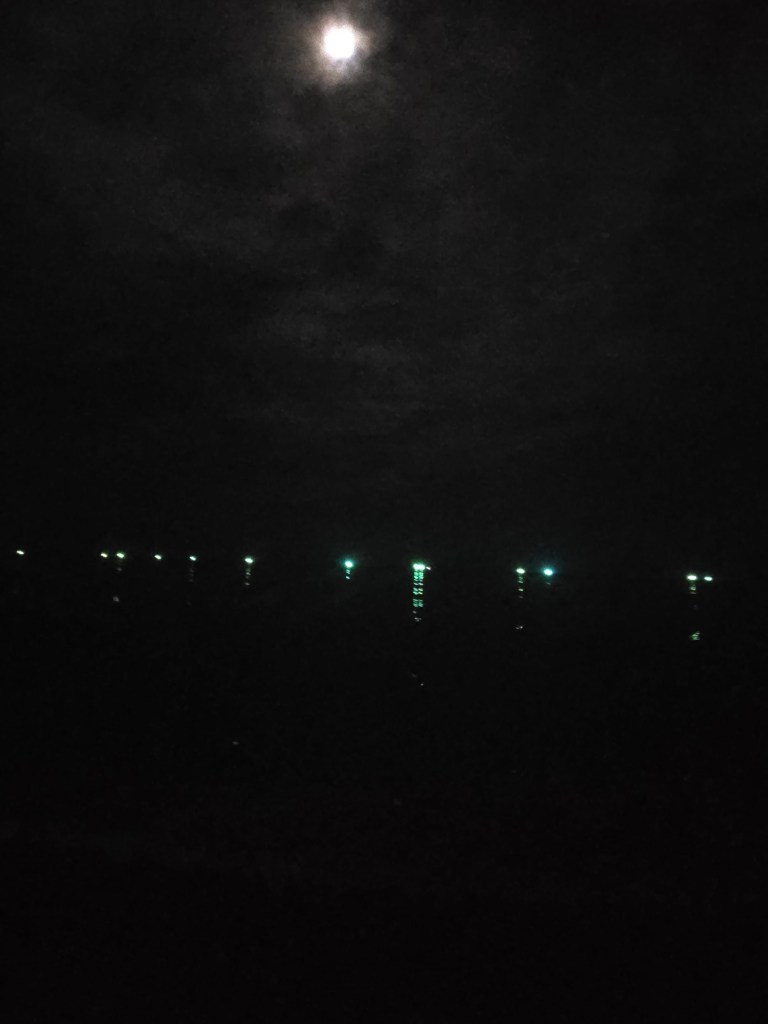
  • By night, this stretch of the Gulf of Thailand becomes a quiet constellation of green and blue lights. The bright beacons strung along the horizon are squid-fishing boats, their powerful lamps suspended high above the decks to draw the squid towards the surface. Each light may be visible from as far as fifteen or twenty kilometres away, their glow mirrored perfectly in the flat calm of the sea.

    Yesterday evening the water was so still, it felt like gliding over glass. I had two kilometres of beach entirely to myself, the surf reduced to a faint whisper. Thung Wua Laen shelves so gently that you can wade out fifty metres before the water reaches your chest. Beyond that, the sea shimmered green and blue from the distant boats – the only movement a faint pulse of phosphorescence when my hands broke the surface.

    A swim beneath those lights, with the night sky overhead and the horizon glowing like a string of emeralds and sapphires, felt like slipping briefly out of time.

  • Trussing Season (Bootiful Britain)

    It’s Trussing Season again in Bootiful Britain.

    The nation’s turkeys are queueing proudly for the block, feathers puffed up, convinced the farmer’s really one of them. He talks their talk, shares their outrage, even has a pint on telly – what’s not to trust? The dream, of course, is that the animals have taken back the farm – though, as Orwell warned, it’s the pigs who end up running the place.

    No more Brussels on the menu, having given Farmer Fartage chronic indigestion of late, with his flagship Brexit dinner now thoroughly overcooked and getting dreadful reviews.

    The new dish of the day is Dover Roast: slow-cooked fear, basted hourly by GB News, served with a side of “taking back control”. “He’s saying what we’re all thinking”, they cluck, while the carving knives are sharpened quietly out of sight.

    The Seasoning never changes – nostalgia, envy, and a pinch of someone else to blame. Then comes the Stuffing: hospitals stripped to the bone, schools left to stew in neglect, and welfare quietly scraped into the bin. The flock nods approvingly. “At least he’s keeping the boats out!” they gobble, as their own livelihoods drift gently downstream – straight into the gravy boat, where Farmer Fartage and his friends are already topping up their glasses.

    The Basting continues – resentment sizzling in its own fat. And now come the Turkey Trots: a nation running in circles, sick from swallowing the same reheated slogans, yet somehow proud of its patriotic diarrhoea.

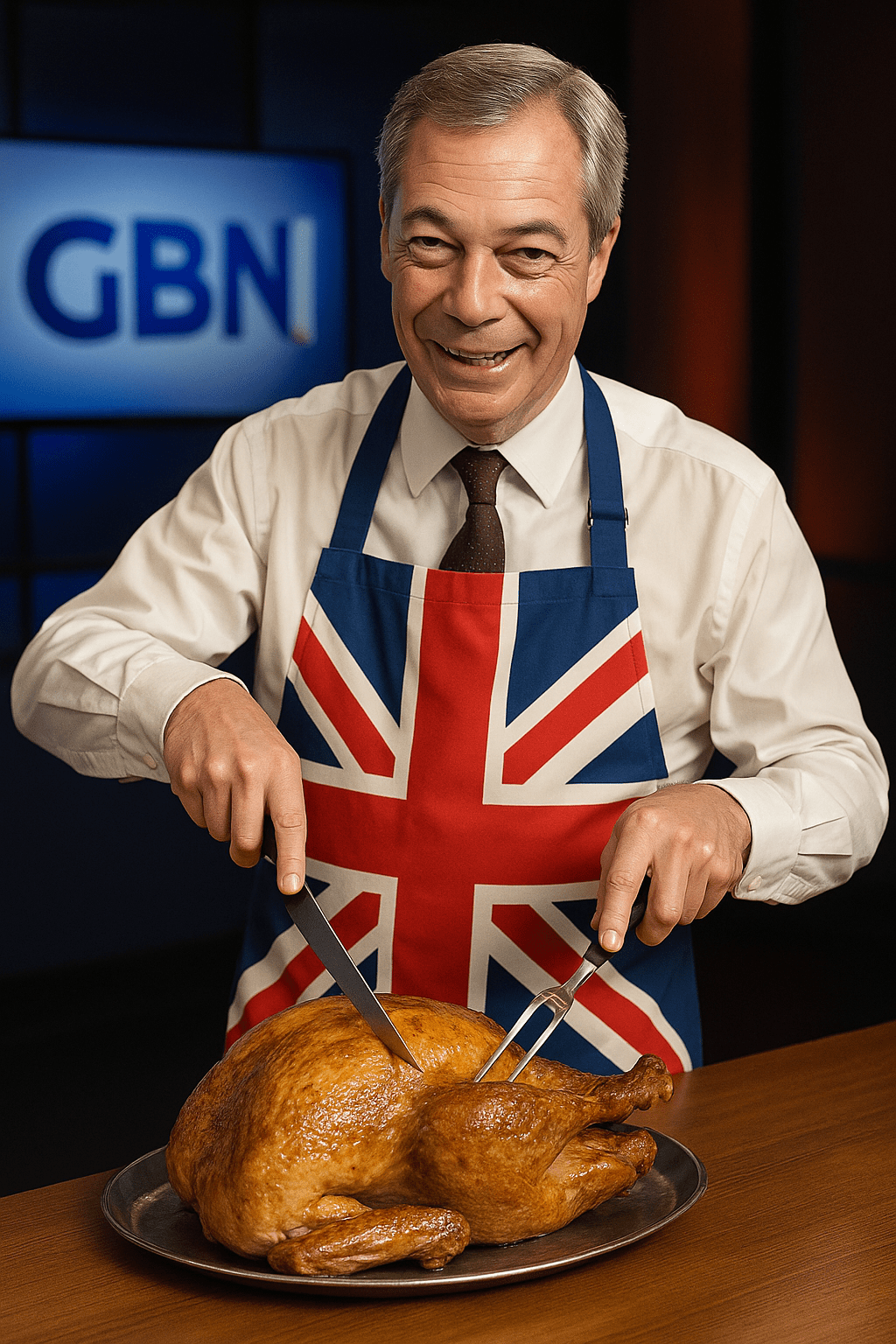
    When Carving Time arrives, Farmer Fartage stands beaming in his Union Jack apron, knife gleaming.

    “Now that’s what I call taking back control,” he says, slicing through what’s left of the working class.

    “Bootiful,” sigh the turkeys, as the plates are cleared. The pigs, naturally, will be dining at the Ritz.

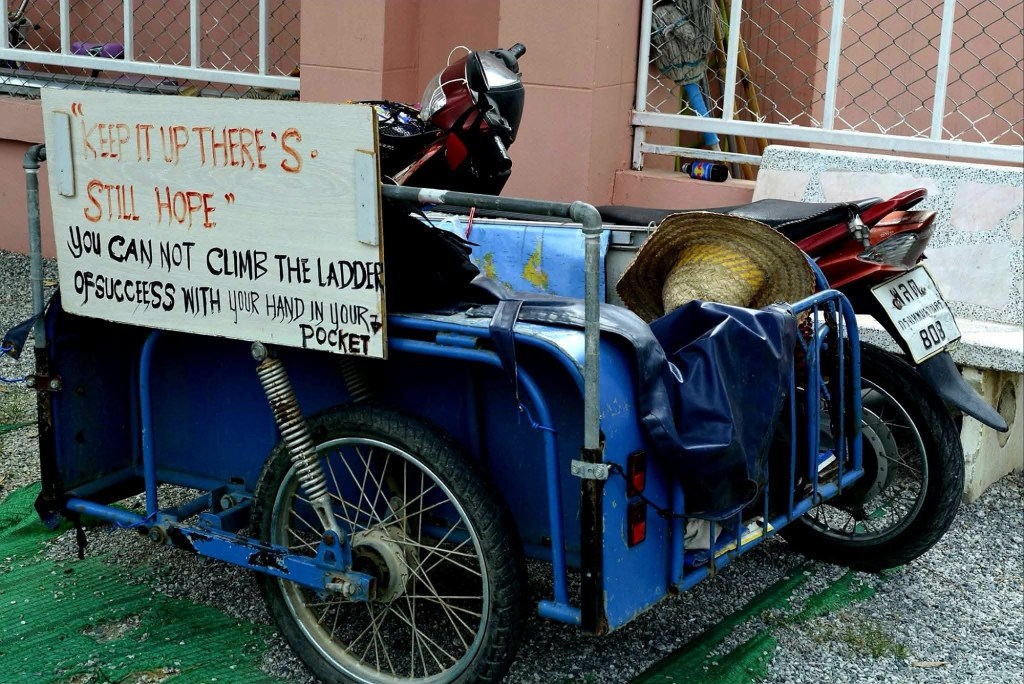
  • On the gardener’s sidecar at my daughter’s school in Thailand, 11 years ago.

    “Keep it up there’s still hope. You cannot climb the ladder of success with your hand in your pocket”.

    Whether success means career, purpose, a scrap of happiness, or simply hanging in there with sanity intact, the message still stands. You won’t get there by standing still.

    In these times, when everything feels uncertain, maybe that battered sign has it right. There’s always hope – but only if we keep climbing.

  • This content is password-protected. To view it, please enter the password below.

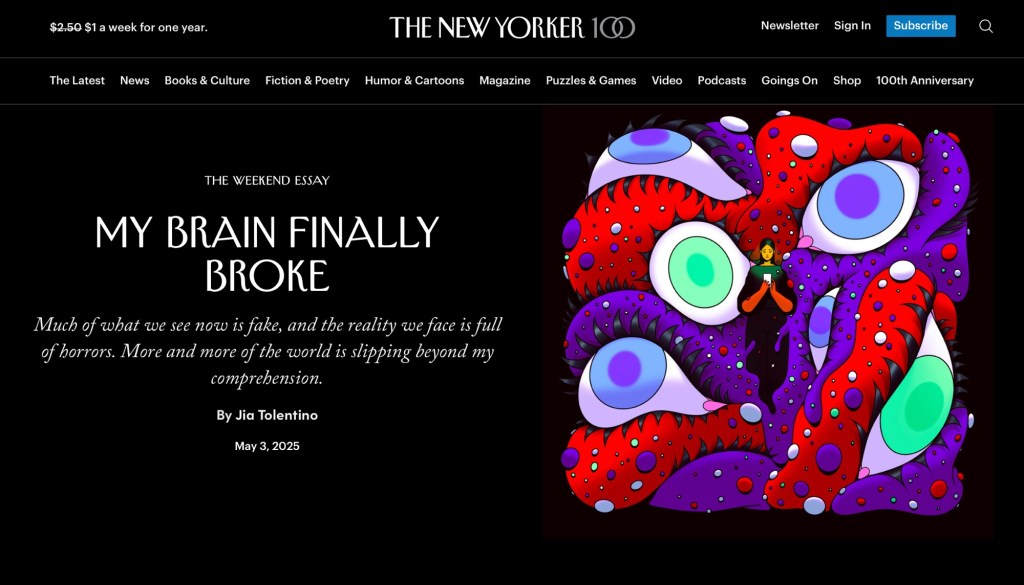
  • In May 2025 Jia Tolentino wrote in the New Yorker about what she calls her “broken brain”. She means the fog that settles when words slip out of focus, when news feeds pile horror upon horror, and when reality itself feels unreliable.

    “I feel a troubling kind of opacity in my brain lately – as if reality were becoming illegible, as if language were a vessel with holes in the bottom and meaning was leaking all over the floor”.

    She blames the speed of politics, the flood of images from Gaza, and the creeping invasion of synthetic fakery – AI faces, deepfakes, doctored clips – until the act of paying attention itself becomes exhausting.

    https://www.newyorker.com/culture/the-weekend-essay/my-brain-finally-broke

    It struck a chord with me, having been circling the same ideas for years. Newsfeed numbness – the more you see of violence, cruelty, and collapse, the less able you are to feel. The moral compass does not shatter – it just spins helplessly, like a needle over too many magnets.

    Tolentino writes as an American essayist cataloguing the psychic toll of her own culture. But her “broken brain” is our common inheritance. The overload is global, the denial universal. I saw it in Thailand during the unrest of 2008, when rolling street protests became background noise; I see it in France today, where ecological breakdown and bureaucratic inertia pile on top of daily political crises. The pattern is the same: we are running systems – political, technological, ecological – at a pace no mind can process, let alone resist. Outrage itself feels redundant. And that, perhaps, is the point: flood people with so many grotesque headlines, so much noise and spectacle, that resistance fragments before it can gather force, or else curdles into manipulated anger – from America’s culture wars to Europe’s street protests and beyond. The instinctive are swept into fury; the deliberative sink into fog. Both serve the same end.

    “The phone eats time; it makes us live the way people do inside a casino, dropping a blackout curtain over the windows to block out the world, except the blackout curtain is a screen, showing too much of the world, too quickly”.

    This progression is brutally simple. Overload collapses empathy; numbness follows; then the very act of looking becomes unreliable. Images of suffering blur into AI hallucinations, real protest footage sits beside doctored clips, and even a child’s search results are contaminated with fakes. The result is not only fatigue, but a collapse of trust in perception itself – and numbness is not neutral. It is precisely what power structures rely on: a dazed public is easier to rule.

    “Fake images of real people, real images of fake people; fake stories about real things, real stories about fake things. … The words blur and the images blur … a permission structure is erected for us to detach from reality – first for a moment, then a day, a week, an election season, maybe a lifetime”.

    And detachment has a cost. It runs alongside policy changes that cut into daily life – deportations under Trump’s new orders, benefits pared back in the US, NHS waiting lists stretching beyond endurance in Britain, droughts and floods forcing migration in Asia. Authoritarian gestures are dressed up as routine governance, and by the time we notice, the damage is already done. This is not just about our minds. It is how cruelty advances while we are too dazed to resist.

    I find Tolentino’s essay oddly reassuring. Not because it offers a cure, but because it confirms that even sharp observers and writers are buckling under the same weight as the rest of us. The failure is not mine alone, or yours. It is structural. Our minds were never designed for this volume of horror, this speed of contradiction, this corrosion of truth.

    Perhaps the task is not to repair the mind at all, but to notice – clearly, stubbornly – that the fracture is everywhere. Naming it is resistance. What we do with that knowledge will mark the fate of our civilisation.

  • Expat Exodus? Not So Fast…

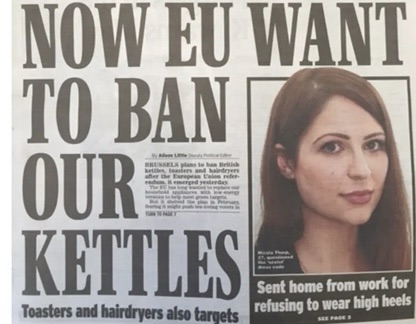
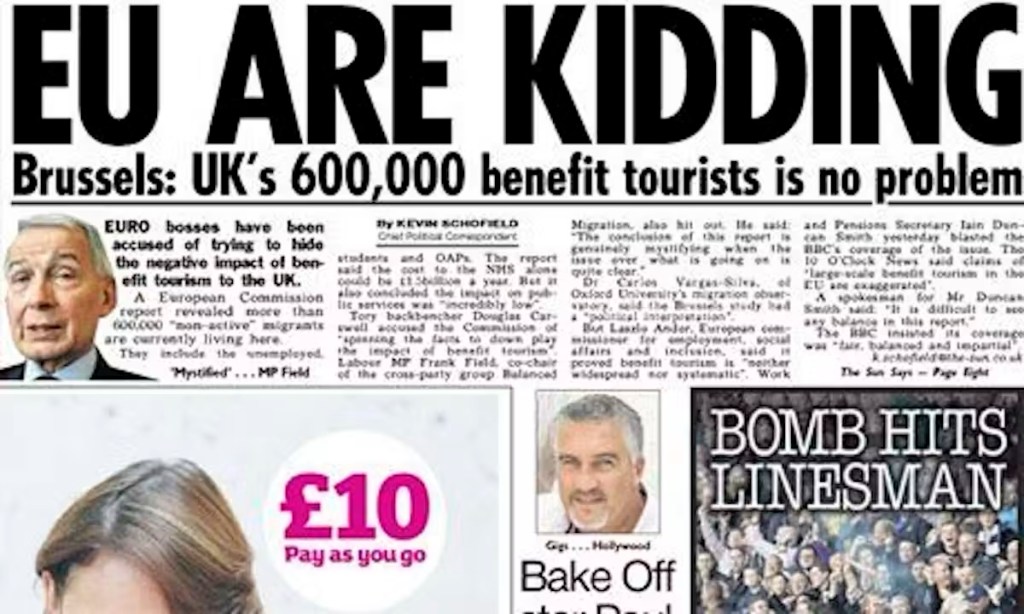
    Back in 2008 – well before Brexit, Trumpism, and the subsequent parade of geopolitical absurdities – the British press was already having a mild panic about the supposed “collapse” of the expat dream. The pound had taken a tumble against the euro, the property bubble was deflating, and journalists were circling like vultures over the lavender fields of Provence and the golf courses of Andalucía.

    Tabloids and broadsheets alike ran lurid stories of “broke Brits fleeing France and Spain in droves,” driven back to Blighty by collapsing exchange rates, failed gîte ventures, and sterling-linked mortgages gone sour. The underlying tone was unmistakable: serves them right for getting ideas above their station.

    Nothing new under the Sun…

    But was there really an exodus? Or just the usual attrition – a few dreamers heading home, chastened, while the more resilient quietly carried on?

    The truth, as ever, was less dramatic. The global financial crisis had rattled everyone, and many small-scale British ventures in rural France were vulnerable. But for most long-term residents – myself included – it wasn’t the end of anything. We tightened belts, mended roofs, took on extra work, or simply adjusted our expectations. The ones who left had often come chasing a fantasy. Those who stayed had usually come looking for something more substantial: sanity.

    I remember a call from Bill Coles, an Old Etonian tabloid hack writing for the Daily Express, who was doing a piece on this supposed “mass migration back to the UK”. I tried to inject a little balance: yes, some expats were struggling – but a stampede home? Hardly. Unsurprisingly, none of that nuance made it into print. The Express had already written its conclusion before the phone rang. The story needed villains and victims, not perspective.

    In truth, most of us hadn’t come for the cheaper wine or larger gardens. We’d left Britain because something fundamental had begun to feel unliveable: the pace, the noise, the corrosive work culture, the unrelenting worship of growth. France, for all its bureaucracy and provincial quirks, still offered a sense that life outside work mattered. There was a slower rhythm, a stronger attachment to family and community, and an enduring respect for the art of simply being – qualities that Britain, by the early 2000s, seemed to have sold off along with its railways.

    That said, even France was shifting. By 2008, the cracks were visible: rising costs, eroding public services, and rural depopulation beginning to hollow out the villages. Still, compared with the UK’s tabloid-fuelled hysteria and market-driven politics, it felt civilised – human, even.

    When I later began dividing my time between France and Thailand, the contrasts sharpened further. Thailand, for all its contradictions, possessed something I’d long stopped seeing in Western societies: composure. A certain patience with life’s imperfections. A detachment from the frantic, performative misery that had infected much of the West. Thailand wasn’t paradise – far from it – but it offered perspective. It reminded me that comfort and contentment aren’t the same thing, and that dignity can exist without affluence.

    So was there an exodus back around 2008? Perhaps – of those who’d come seeking an idyll, or who’d mistaken the dream for the work required to sustain it. But for many of us, the balance sheet still came out in favour of staying. The gains – time, peace, perspective – outweighed the losses.

    We hadn’t emigrated for the weather, the rosé, or the romance of rural life. We’d come to breathe more slowly, to feel a little more human. And however turbulent the world became – from sub-prime crashes to Brexit psychodramas – that still seemed a bargain worth keeping. 

    As for returning to Britain in 2025 – where neo-fascists lead the polls and history is being rewritten in real time – you’d have to manacle me to the rear end of the Eurostar and drag me through the Channel Tunnel backwards. And even then, I’d be kicking, screaming, and plotting my escape the moment we surfaced in Kent.